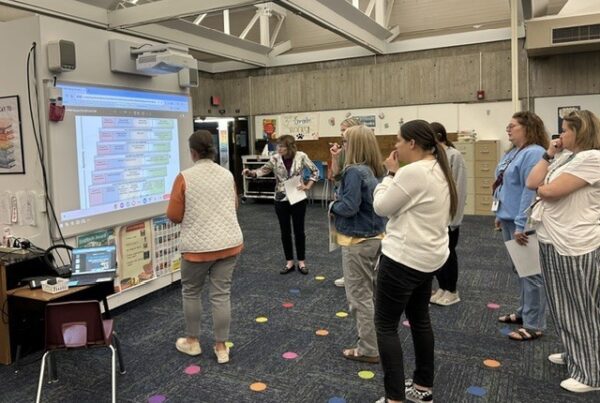

Students using HQIM in Colorado Springs School District 11. The district partnered with Instructional Empowerment to implement an instructional system designed to get more achievement gains out of the district’s existing curriculum. Photo: Colorado Springs School District 11 Facebook page.
September 2026
By: Michael D. Toth and Merewyn Lyons, Ed.D.
The Disconnect Between HQIM Adoption and Achievement
Curriculum leaders across the country have done the demanding work of vetting, selecting, and adopting high-quality instructional materials. They have succeeded in getting a rigorous curriculum into every teacher’s hands, yet the payoff has largely not shown up in the research. One study of 6,255 elementary schools across six states found little evidence of differences in average gains among schools using different mathematics textbooks in the three years following adoption (Blazar et al., 2020).
Research and field experience tell us that HQIM selection is rarely the main problem—and neither is teacher compliance, nor students’ capacity for rigorous learning. HQIM often fail to raise achievement when they are placed inside instructional models that were not designed for student-led rigorous learning.
Districts choose curriculum deliberately, with thoughtful rubrics, committees, and pilots. But the instructional system that delivers it is rarely presented as a choice at all. It is most often inherited and invisible. The result is a curriculum implementation gap: the distance between the rigor a curriculum was designed to deliver and the rigor students experience.
That leaves curriculum leaders with a decision. Adopting a new curriculum would consume budget, leadership attention, and teacher capacity. If achievement is still below expectations and the district has already invested in materials and support, it is worth examining whether strengthening the instructional system around the current curriculum could improve results instead.
In this article, we’ll explore the research on why HQIM are so often watered down or abandoned by teachers, plus three gaps that surface when rigorous materials are dropped into a traditional, teacher-centered model.
We will focus on one important and often underexamined missing piece: pairing HQIM with an instructional system built for today’s curricula and today’s students—one where students engage in academic discourse, think critically, and solve problems together, and every student can reach the rigor the materials were meant to deliver.
Key Takeaways
- HQIM adoption alone does not guarantee achievement gains; implementation depends on how teachers and students use the materials every day.
- Three recurring gaps can limit HQIM impact: teacher capacity, classroom enactment, and district systems.
- These gaps often appear when rigorous materials are implemented inside a traditional, teacher-centered instructional model.
- Districts can strengthen HQIM implementation by pairing rigorous curriculum with an instructional system that supports student discourse, collaboration, teacher coaching, and evidence of enactment.
- A new curriculum may not be the next step. Districts should also examine how their current materials are enacted and can often get more achievement out of the HQIM they already own.
What Are HQIM? A Research-Based Definition
High-Quality Instructional Materials (HQIM) are curriculum resources that align to rigorous state standards, present content in a coherent sequence, and have been validated through independent review. When used well, they are associated with higher student achievement (NIET, 2020). How those materials are enacted—the instructional approach that surrounds them—is a separate question, and the focus of this article.
HQIM are also called high-quality curriculum or high-quality curriculum resources (NIET, 2020). For the sake of clarity and brevity in this article, we refer to both curriculum and resources as HQIM.
According to the research (NIET, 2020; Short & Hirsh, 2020), HQIM share four defining features:
- Align to rigorous state standards that prepare students for postsecondary education and careers
- Articulate high expectations for achievement
- Incorporate learning opportunities that meet the diverse needs of learners
- Support student-centered learning through a coherent sequence of research-based instruction and embedded formative assessments
This definition of HQIM clarifies that it is not just the quality of the materials themselves, but also how the HQIM are used in classrooms that determines their success. It explains why the same materials can produce rigorous, student-led learning in one classroom and lower-rigor, surface-level work in another.

How HQIM Are Used
“It’s more than just making sure everyone is using the same resource—it’s also ensuring that resource is getting used in a high-quality, rigorous way with all students and all populations.”
– Dr. Krystal Rasmussen
Chief of Curriculum, Colorado Springs School District 11, CO
Does HQIM Adoption Alone Raise Student Achievement?
Research supports that HQIM adoption alone may not raise achievement. For example, one researcher noted that focusing solely on the curriculum to improve student learning is a fallacy (Graves, 2023).
The empirical case comes from the study cited earlier: 6,255 elementary schools in six states using mathematics textbooks aligned to the Common Core State Standards (CCSS). Teachers received an average of 1.8 days of professional development for the new curriculum. Based on three years of student assessment data, it found little evidence of differences in average achievement gains among schools using the adopted textbooks (Blazar et al., 2020). That supports caution about curriculum replacement alone rather than a conclusion about HQIM in every subject.
“We conclude that the adoption of a new textbook or set of curricula materials, on its own, is unlikely to improve student outcomes at scale and in the way that some policy makers, practitioners, and researchers have suggested and hoped.”
– Blazar et al., 2020, p. 969
Bringing the Rigor of HQIM to All Students
Rigorous materials only translate to rigorous learning when the classroom has structures that make them accessible for every student. One of the predominant reasons teachers say they supplement or substitute materials in place of the HQIM is the perceived rigor of the HQIM and their students’ ability to manage it (Blazar et al., 2020; Steiner, 2024).
These are legitimate concerns, and not the fault of teachers who are often working hard to bring rigor into their lessons. Most HQIM lay out what students need to learn in terms of scope and sequence. But making rigorous learning accessible to all students isn’t spelled out, nor is it intuitive. Most classrooms still operate within a legacy teacher-centered model that was never built with the structures, procedures, routines, and protocols for all students to access academic rigor.
We have visited many classrooms that have shifted from a teacher-led to a student-led model of instruction and witnessed all students, including English learners and students with disabilities, flourish as they wrestle with high academic rigor in their teams. They confidently engage in discussions, use academic vocabulary fluently, and support one another using specific learning roles and protocols.
Teachers learn to build that level of student ownership intentionally through a lesson cycle that still includes explicit instruction but introduces more time spent on student team tasks aligned to the rigor of the curriculum. Teachers receive coaching as they learn the structures, which is consistent with NIET’s (2020) point that curriculum support works best when it is integrated with instructional skill development and ongoing professional learning.
Real Classroom Example: “A Totally Different Level”
Dr. Krystal Rasmussen is the Chief of Curriculum at Colorado Springs School District 11, Colorado. The district partnered with Instructional Empowerment to implement the Model of Instruction for Deeper Learning®. Dr. Rasmussen described the difference she observed between classrooms in the same school, with the same HQIM—the difference was in the delivery of the HQIM in a deeper learning instructional model:
Kindergarteners Discuss Aerodynamics
“There was one class we went into where they were talking about gravity and aerodynamics, and these were kindergartners who could explain, ‘well, this car didn’t go as fast because it wasn’t aerodynamic, I’d have to change this so the air can flow this way’— those were the words they were using. They were able to have really in-depth conversations. Where in some of the other classes we popped into, it was more like, ‘I think it’s going to go fast because I have a lot of stickers on it.’ It was the intentionality of the vocabulary, the language, the understanding, which just wasn’t there in the other class. It was just at a totally different level.”
– Dr. Krystal Rasmussen
Chief of Curriculum, Colorado Springs School District 11, CO
Which HQIM Implementation Barriers Can an Instructional System Help Address?
An instructional system can address barriers inside the classroom: teacher capacity to enact rigor, how students interact with the materials, and the district structures that support both. But it cannot resolve every HQIM implementation barrier.
This article focuses on what changes when teachers and students experience the curriculum differently every day. It does not address obstacles outside daily instruction, including:
- Misalignment of assessments to standards addressed in HQIM (Goldman & Pellegrino, 2015; Kaufman et al., 2016; National Academy of Education, 2024)
- Gaps in the materials themselves, including a shortage of culturally and linguistically appropriate resources for multilingual learners (Zahner et al., 2024)
- Funding constraints, master scheduling, and the amount of instructional time available
- Teacher shortages, vacancies, and turnover
These are real constraints to HQIM implementation, but they cannot be the only focus. An important and often underexamined lever is the instructional system used to deliver the HQIM. The following section shares the gaps that are within your control when you focus on your instructional system.
Three HQIM Implementation Gaps in a Teacher-Centered Model
The teacher-centered model most classrooms still run on was built for an era when the teacher was the primary source of content—decades before rigorous, standards-aligned curricula existed. Nobody chose it; it was inherited. Drawing on implementation research, we see three gaps that surface when rigorous HQIM are dropped into the legacy model: a capacity gap in how teachers are prepared to use HQIM in planning instruction, an enactment gap in what happens during lessons, and a systems gap in how districts support the work.
Consider these three gaps, our synthesis of the implementation research—if you recognize them in your own district and achievement is not where you want it to be yet, adopting an intentional instructional system can help you get more lift out of your existing curriculum.
1: The Capacity Gap—Professional Learning Teaches the “What,” Not the “How”
The lack of effective professional development for teachers is an often-cited barrier to HQIM implementation (NIET, 2020; Steiner, 2024; EdReports, 2022). Teachers report that the professional development provided by publishers is shallow and insufficient to help them understand how best to teach the curriculum (Polikoff, 2018).
This is because without a well-defined, intentional instructional model, professional learning focuses on the “what” without the “how,” leaving teachers unprepared to enact the full rigor of the HQIM.
As a result, most teachers build the “how” themselves, filling the gap with supplemental materials that never went through the district’s vetting process. Survey data show that 80 percent of teachers report using instructional materials they created themselves, 90 percent search for materials on Google, and 70 percent draw on sources such as Teachers Pay Teachers and Pinterest (Polikoff, 2018).
New and alternatively certified teachers can be especially vulnerable to capacity gaps, as it takes time to develop curriculum literacy (Marek et al., 2025). Without an instructional model that explains the “how” and includes structures to make rigor accessible to all students, teachers will often struggle with HQIM implementation.
2: The Enactment Gap—Adopting Materials Doesn’t Always Change What Happens in Classrooms
The issue is not with the content of the curriculum itself; HQIM provide rigorous content meant to facilitate student collaboration, critical thinking, and robust debates. The issue is that the HQIM must be enacted using instructional practices that make the curriculum accessible to every student (Pak et al., 2020), and the traditional teacher-centered model is not built for rigorous student-led discourse.
Without an intentional model of instruction, teachers fit new HQIM into the practices they already have (Pak et al., 2020). When students get lost during a rigorous task, the teacher-centered model offers no structure for closing gaps, so teachers may respond by reducing task demands when they lack effective structures and support.
Recognizing the enactment gap and frustrated with the results, districts often turn to scripted curricula to create consistency. Although well-intended, scripted curricula can strip away teacher judgment and leave them without the expertise and creativity to adapt HQIM to the unique situation of each classroom (Muskin, 2015). Scripted curricula don’t change the underlying instructional model that teachers operate within.
3: The Systems Gap—Legacy Systems Are Built to Track Adoption, Not Enactment
When student outcomes do not improve after adopting HQIM, the typical response is to provide additional support and monitoring of the technical details of the materials, such as scope and sequence, suggested activities and applications (Pak et al., 2020). This is an understandable reaction to the problem, but it overlooks the instructional system within which the HQIM is used.
Research supports that improving student learning through HQIM requires ongoing professional learning at all levels of the district, a commitment to continuous improvement, a consistent districtwide vision for instruction, and strong pedagogical practices built into system structures and routines (Chu et al., 2026).
And yet, HQIM implementation often focuses more narrowly on technical professional development and compliance-oriented management (Pak et al., 2020). Moving from a rigid compliance view to a rigorous outcomes view means focusing on districtwide systems that build teachers’ capacity and develop classroom conditions for successful enactment (Muskin, 2015).
Three Questions to Discuss with Your Curriculum Team
- Capacity: Can teachers explain and demonstrate how they preserve a task’s rigor when students struggle?
- Enactment: What evidence shows that students are reasoning with the curriculum, rather than mainly receiving explanations?
- Systems: Do coaching and leadership routines examine student thinking and task quality alongside pacing and materials use?
The Missing Piece: Pairing HQIM With an Instructional System for Deeper Learning
Getting the most lift out of your HQIM requires closing the gaps in capacity, enactment, and systems. The legacy model of teacher-centered instruction has proven insufficient in doing so. Instead, effective HQIM implementation requires an instructional system for deeper learning.
We define deeper learning as a classroom learning environment where all students develop into leaders of their own learning. They collaborate in teams, engage in rich discourse, and tackle rigorous tasks that prepare them for both academic and real-world success.
Whatever system a district chooses for HQIM implementation, it has to do three things the curriculum cannot do on its own: build teacher capacity to enact rigor, give students the structures to access that rigor, and give leaders actionable evidence of what is happening in classrooms.
The Model of Instruction for Deeper Learning® was designed as a research-based instructional system for delivering HQIM, helping teachers shift their classrooms from traditional teacher-centered methods to student-led teams. It puts rigorous curricular content into a structure that allows all students to access it. As a complete system, it gives leaders the metrics and processes to support and monitor HQIM implementation throughout the district.

A System of Support
“It really is more than just what’s happening in the classroom. It is the system that has to be in place to provide coaching and feedback, and to provide the professional learning, follow-up, and continued support.”
– Dr. Karen Barber
Superintendent, Santa Rosa County School District, FL
A Curriculum Implementation Framework for Rigorous Team Learning
A curriculum implementation framework defines how teachers and students work with the curriculum day to day, including classroom protocols, learning structures, lesson-cycle planning, coaching, and evidence of enactment. In the Model of Instruction for Deeper Learning, that framework starts at the student team level.
The model equips each student team with a defined set of structures: assigned team roles, norms and protocols for academic discourse, and critical thinking guides. Teachers use a full lesson cycle format with support for planning rigorous tasks using the district’s HQIM, delivering explicit instruction, monitoring student team tasks, and reflecting for continuous improvement.
Students gradually take on more academic responsibilities as they learn to lead, collaborate, and think critically in their teams. Unlike typical group work, specific protocols ensure equal participation, accountability, and deeper learning, with less reliance on the teacher for constant support.
A partner classroom using the district’s existing HQIM within student-led team structures. Source: LLT Academy via Facebook.
Closing the Capacity Gap: Verifying Teacher Competencies Rather Than Compliance
Closing the capacity gap means verifying that teachers demonstrate the competencies to enact the curriculum effectively. To implement the Model of Instruction for Deeper Learning, teachers complete professional development in deeper learning pedagogy, receive kits of classroom resources, and engage in coaching support. This aligns with the research that asserts teachers must develop into skilled enactors of the curriculum through professional learning and coaching to master principled adaptation of the HQIM to meet the needs of all students while maintaining high levels of rigor (Marek et al., 2025).
Teachers who demonstrate the evidence-based competencies in practice can be verified in the model through Instructional Empowerment’s certified verification process. Verification examines both teacher and student evidence of implementation. Verifiers look not only at what the teacher does but also whether students demonstrate the target skills, which is critical because teacher actions alone don’t confirm that students reached the rigor the curriculum intended.
The model is designed to support all teachers, from every grade level and subject area. For a closer look at your own subject or student population, the Activating the Rigor in Your Curriculum series shows the model in action with the HQIM in these areas:
The model is also especially helpful for new and alternatively certified teachers. School and district leaders report that their least experienced teachers use the model’s team structures to turn the district’s HQIM into high-quality instruction. The model’s professional development and tools can quickly accelerate pedagogical skill development and build confidence as teachers develop their expertise with the HQIM.

Leveling the Playing Field for Alternatively Certified Teachers
“I think it gives alternatively certified teachers the tools to level the playing field, along with strategies for helping with student behaviors. They see their students talking and thinking at a deeper level. They may not have the background in teaching and pedagogy, but they do have the tools that are very simple and effective.”
– Christina Andrus
Coordinator of Professional Learning, Santa Rosa County School District, FL
Closing the Enactment Gap: Deeper Implementation of the HQIM Instead of Surface Learning
The difference between the enactment of HQIM in a deeper learning model versus traditional instruction is not the materials—it is what students are required to do with them. That difference is visible in how students interact with one another and the academic content.
For example, in a typical turn-and-talk, students often exchange answers briefly and return to a worksheet, stopping at surface-level learning. They are talking and participating, but nothing about the task or the structure requires them to fully engage with the HQIM.
Within the deeper learning model, the same students use team structures that require them to share evidence, reasoning, and disciplinary language as they challenge and refine each other’s thinking. The same students with the same HQIM are fully capable of analyzing, debating, and defending ideas when the task and the team structures are designed for it.

Deeper Learning, Better Student Results
“I think the biggest difference I see is we’re not stopping at an answer and moving on—we’re asking why. My eight- and nine-year-olds are using verbiage like, ‘Can you please explain the evidence behind your thinking?’—my students are having higher-level conversations. The autonomy my students have is also far superior using the Model of Instruction for Deeper Learning. They have become much more independent, better critical thinkers, and it correlates perfectly to their test scores. I had a child in the tenth percentile who was a level 1 become a level 5 and exit Tier 3 reading.”
– Emily McCallum
Third-grade teacher, Oriole Beach Elementary School, FL
Closing the Systems Gap: Building the Instructional Systems, Coaching, and Planning
According to the research, successful HQIM implementation requires adopting districtwide systems to support it, including a shared vision for instruction, professional learning at all levels, teacher collaboration and planning, and peer observation (Chu et al., 2026; Pak et al., 2020).
The Model of Instruction for Deeper Learning is a research-validated system that aligns coaching with teacher competencies, provides a verification process to ensure those competencies achieve the intended student outcomes, and facilitates continuous improvement through a Professional Learning Community (PLC) process for rigorous lesson planning and data-focused adjustments. The system also involves support to help school and district leaders more effectively coach their teachers.

Coaching with a Lens for Rigor
“Our leaders have developed a more critical lens around what instruction is supposed to look like, and we’ve also strengthened our ability to coach to that level of expected performance.”
– BJ Price
Director of Human Resources, Santa Rosa County School District, FL
Research Supporting the Model: Higher ELA and Math STAR Scores With the Same Curriculum
Instructional Empowerment’s Applied Research Center has studied the Model of Instruction for Deeper Learning across varied district contexts, with positive achievement results replicated in Title I schools, and in rural, urban, and suburban communities.
A recent study in Colorado Springs School District 11 found that students taught by teachers verified in the model scored an adjusted 22.44 STAR scale-score points higher in ELA and 18.24 points higher in mathematics than matched comparison students in the same grade levels, using the same curriculum, in the same district.
Student performance was measured using fall and spring scale scores from school year 2025-2026 on the STAR assessment, a nationally normed interim assessment used by the district to monitor student growth. The students included are those of teachers who completed verification in the model, which is a subset of all the teachers, including some who may have participated in related professional development.
Conducted by Instructional Empowerment’s Applied Research Center in partnership with District 11 using 2025–26 assessment data, the study covered grades 2–11, including 357 students across 18 ELA teacher-grade clusters and 449 students across 20 math teacher-grade clusters. Both differences were statistically significant (ELA p = .045; mathematics p = .011). The analysis accounted for students’ prior achievement, demographic characteristics, and the clustering of students within classrooms.
A nationally certified What Works Clearinghouse reviewer conducted the analysis; the What Works Clearinghouse itself did not review or endorse the study. As with any single-district study, the findings describe one context and cannot establish that the same results would follow elsewhere. The full study is available here: https://instructionalempowerment.com/library/instructional-model-curriculum-ela-math-achievement-gains/.

Figure 1. Students of teachers verified in the Model of Instruction for Deeper Learning® scored significantly higher than matched comparison students on spring STAR assessments in both ELA (+22 points, p = .045) and mathematics (+18 points, p = .011). Colorado Springs School District 11, 2025–26.
Additional studies and district case studies examine the model’s association with:
- Increased student achievement
- Better student attendance
- Lower teacher burnout
- Improved student behavior
- Higher student engagement
- Closed achievement gaps
- Districtwide results within one year
If you would like to examine these instructional shifts and the research behind them with your own curriculum team, learn more about our complimentary workshops for curriculum teams.
Rapidly Developing Students’ Academic Skills
“I had a student last year who only said a couple of words for the first few weeks of school. He was very shy and didn’t want to interact. By the end of the year, he was having full academic conversations, using his resources, and leading his team as a facilitator. Watching my students build these skills, I just think to myself, ‘This was worth the short time it took to introduce it.’ You teach them how to use the structures, and it happens so quickly—much quicker than I anticipated.”
– Emily McCallum
Third-grade teacher, Oriole Beach Elementary School, FL
Next Steps
For district leaders, the next step is not replacing your curriculum but determining whether the instructional system around it is strong enough to help teachers and students use it well. The Model of Instruction for Deeper Learning was designed to put the HQIM into a structure every student can access.
If you want to strengthen HQIM implementation in your own schools, there are two places to start: view our webinar that walks through the instructional shifts and the research behind them, or use the form below to talk with us about a workshop for you and your curriculum team.
Talk With Us About a Workshop for Your Curriculum Team
Prefer to learn more and view our webinar first? Register here: https://instructionalempowerment.com/hqim-implementation-for-caos/
About the Authors
Michael D. Toth

Michael D. Toth is founder and CEO of Instructional Empowerment (IE) and leads IE’s Applied Research Center. He is also the author of the multi-award-winning book The Power of Student Teams with David Sousa; author of Who Moved My Standards; and co-author with Robert Marzano of multiple books. He co-authored peer-reviewed research articles published in academic journals in collaboration with researchers Lindsey Devers Basileo, Merewyn Lyons, Franz Hofmann, Barbara Otto, and Natalie Vannini. Most recently, he authored multiple articles published in the American School Board Journal by the National School Board Association (NSBA), including “Deeper Learning and Educational Screen Time.” Michael is a keynote speaker at conferences and coaches superintendents on creating a bold instructional vision, designing and launching a high-functioning cabinet team, transforming Tier 1 core instruction, and leading systems-based school advancement.
Learn more about Michael: https://instructionalempowerment.com/ie-founder-michael-d-toth/
Merewyn Lyons, Ed.D.

Merewyn Lyons, Ed.D. is a Senior Research Analyst with Instructional Empowerment’s Applied Research Center. Her primary research interest is educational psychology, with a focus on understanding the effect of motivation on teaching, learning, and educational leadership. She is co-author of peer-reviewed articles in Sage Open, Frontiers in Education, Quality Education for All, and Discover Education. Dr. Lyons is a member of the Center for Self-Determination Theory. She is also a retired officer of the United States Navy and a retired K-12 educator.
Learn more about Merewyn: https://instructionalempowerment.com/applied-research-center/#libba
Merewyn’s ORCID: https://orcid.org/0009-0004-1240-4421
Glossary
Key terms and frameworks referenced throughout this article:
Capacity gap: The first of three implementation gaps. Professional learning on new HQIM covers what the materials contain but not how to enact them, leaving teachers to build the instructional “how” themselves.
Curriculum implementation framework: A definition of how teachers and students work with the curriculum day to day, including student and teacher roles, protocols for academic discourse, lesson-cycle planning, coaching, and evidence of enactment.
Curriculum implementation gap: The distance between the rigor a curriculum was designed to deliver and the rigor students experience.
Enactment gap: The second of three implementation gaps. Adopting rigorous materials does not by itself change what happens during a lesson. Without structures that make rigor accessible to every student, teachers fit new materials into the practices they already have, which often results in lower rigor than the HQIM demand.
High-quality instructional materials (HQIM): Curriculum resources that are standards-aligned, coherently sequenced, and independently reviewed for rigor and quality.
Model of Instruction for Deeper Learning®: Instructional Empowerment’s research-validated instructional system for delivering HQIM through student-led team structures, verified teacher competencies, and district-level instructional systems.
Systems gap: The third of three implementation gaps. The standard HQIM implementation approach—adopt, train, monitor—gives leaders visibility into whether materials were adopted and training was attended, but not into whether the curriculum is being enacted in classrooms.
References
Blazar, D., Heller, B., Kane, T. J., Polikoff, M., Staiger, D. O., Carrell, S., Goldhaber, D., Harris, D. N., Hitch, R., Holden, K. L., & Kurlaender, M. (2020). Curriculum reform in the Common Core era: Evaluating elementary math textbooks across six U. S. states. Journal of Policy Analysis and Management, 39(4), 966-1019. https://doi.org/10.1002/pam.22257
Chu, E., Corwin, E., Gumy, M., Kurzweil, M., Ramos, J., & Thomas, C. (2026). Reach higher, together. How trajectory changing school districts used curriculum as a launchpad to improve outcomes. Columbia University Center for Public Research and Leadership. https://static1.squarespace.com/static/69779d393f31e715299b0694/t/6a0b7d246222f5605a2ee037/1779137828537/**CPRL-All-Systems-Go-Case-Study-FINAL_REPORT_v7.pdf
EdReports. (2022, September 12). High quality materials are available – So why aren’t they being used? https://edreports.org/resources/article/high-quality-materials-are-available-so-why-arent-they-being-used
Goldman, S. R., & Pellegrino, J. W. (2015). Research on learning and instruction. Policy Insights from the Behavioral and Brain Sciences, 2(1), 33–41. https://doi.org/10.1177/2372732215601866
Graves, K. (2023). Mind the gap: A tale of two curriculum fallacies. Language Teaching, 56, 197-209. https://doi.org/10.1017/S0261444821000148
Kaufman, J. H., Thompson, L. E., & Opfer, V. D. (2016). Creating a coherent system to support instruction aligned with state standards. https://www.rand.org/pubs/research_reports/RR1613.html
Marek, M., Lizárraga-Dueñas, L., Woulfin, S., Wetzel, M. M., & Muñoz, E. (2025). A framework for curriculum literacy in initial teacher preparation: Policy, practices, and possibilities. Journal of Teacher Education, 76(4), 337-350. https://doi.org/10.1177/00224871241263803
Muskin, J. (2015). From good ideas to good practice: Putting teachers at the center of education improvement, where they belong. Educational Assessment, Evaluation and Accountability, 27, 93-102. https://doi.org/10.1007/s11092-015-9216-7
National Academy of Education. (2024). Reimagining Balanced Assessment Systems (S. Marion, J. Pellegrino, & A. Berman, Eds.). National Academy of Education. https://doi.org/10.31094/2024/1
NIET. (2020). High-quality curriculum implementation. Connecting what to teach with how to teach it. National Institute for Excellence in Teaching. https://www.niet.org/assets/1da4c1fbd6/high-quality-curriculum-implementation.pdf
Pak, K., Polikoff, M. S., Desimone, L. M., & García, E. S. (2020). The adaptive challenges of curriculum implementation: Insights for educational leaders driving standards-based reform. AERA Open, 6(2), 1-15. https://doi.org/10.1177/2332858420932828
Polikoff, M. (2018). The challenges of curriculum materials as a reform lever. Evidence Speaks Reports, 2(58). https://www.brookings.edu/articles/the-challenges-of-curriculum-materials-as-a-reform-lever/
Short, J., & Hirsh, S. (2020). The elements: Transforming teaching through curriculum-based professional learning. The Carnegie Corporation of New York. https://www.carnegie.org/publications/elements-transforming-teaching-through-curriculumbased-professional-learning/
Steiner, D. (2024). The unrealized promise of high-quality instructional materials. State Education Standard, 24(1). https://www.nasbe.org/the-unrealized-promise-of-high-quality-instructional-materials/
Zahner, W., Skarin, R., & Pelaez, K. (2024, April). Mathematics teachers’ perceptions of their instructional materials for English Learners: Results from a national survey. Paper presented at the Annual Meeting of the American Educational Research Association, Philadelphia, PA.
Model of Instruction for Deeper Learning® is a registered trademark of Instructional Empowerment and is research-validated.