
Last Updated: September 2026
Topics Covered
- Executive Summary
- A Cycle That Keeps Failing Our Schools
- How Many Schools Are in the Turnaround Trap?
- The Familiar “Quick Fixes”—and Why They Fall Short
- The Hidden Costs of Quick Fixes
- Three Root Causes Behind the Turnaround Trap
- Case Study: A District That Overcame the Turnaround Trap
- The Path Out: A Model for Sustainable School Turnaround
- Conclusion: Out of the Turnaround Trap—and Beyond
- About the Authors
- About Instructional Empowerment
- References
Executive Summary
Millions of students attend schools caught in the Turnaround Trap, a repeating cycle of low performance. Under pressure, these schools often rely on quick fixes, which may yield enough short-term growth to exit state accountability. But academic proficiency often remains unchanged, and schools soon fall back into turnaround status.
Students are paying the price with an education that leaves them without the skills they need to thrive beyond school. And it’s not just students who pay the price. Teachers become frustrated by systems that don’t support professional growth and autonomy. Administrators face constant pressure without the tools to create lasting change. Parents and communities lose trust as schools promise improvement but can’t sustain it.
There is a path out of the Turnaround Trap, but it doesn’t come from adding another program. It comes from transforming the classroom learning environment. This report identifies the three areas that matter most for leaders doing the tough work of school turnaround:
- Increase the rigor of Tier 1 instruction
- Build systems and develop people for long-term success
- Use leading data for short cycles of instructional improvement
This report also includes a case study that shows lasting school improvement is possible: starting with a school once ranked among the lowest-performing in the entire state, Putnam County Schools transformed Tier 1 instruction across their district until there wasn’t a single school left in turnaround status.
Backed by over a decade of research findings, including original research from Instructional Empowerment’s Applied Research Center, this report offers a new way forward for districts ready to break free from the Turnaround Trap—for good.
A Cycle That Keeps Failing Our Schools

“For all its benefits, acting with an infinite, long-term view is not easy. It takes real effort.”
— Simon Sinek, The Infinite Game (2019, p. xii)
For schools under pressure to improve fast, it is especially hard to play what Simon Sinek (2019) calls “The Infinite Game”—building systems that last beyond a leader’s time at the school.
The daily challenges of student behavior, chronic absenteeism, and high teacher turnover leave school leaders fatigued and triaging symptoms with quick fixes, leaving the root causes unaddressed.
As a result, school turnaround efforts leave schools to “yo-yo” in and out of state accountability systems. Programs yield short-term gains—bumping up student achievement just enough to exit turnaround status—only for schools to see their scores fall again as the quick fixes fade.
This is the Turnaround Trap: a cycle of short-term school turnaround solutions that never reach the heart of the problem—weak Tier 1 instruction.
And it’s costing students, teachers, leaders, and communities more than we realize.

How Many Schools Are in the Turnaround Trap?
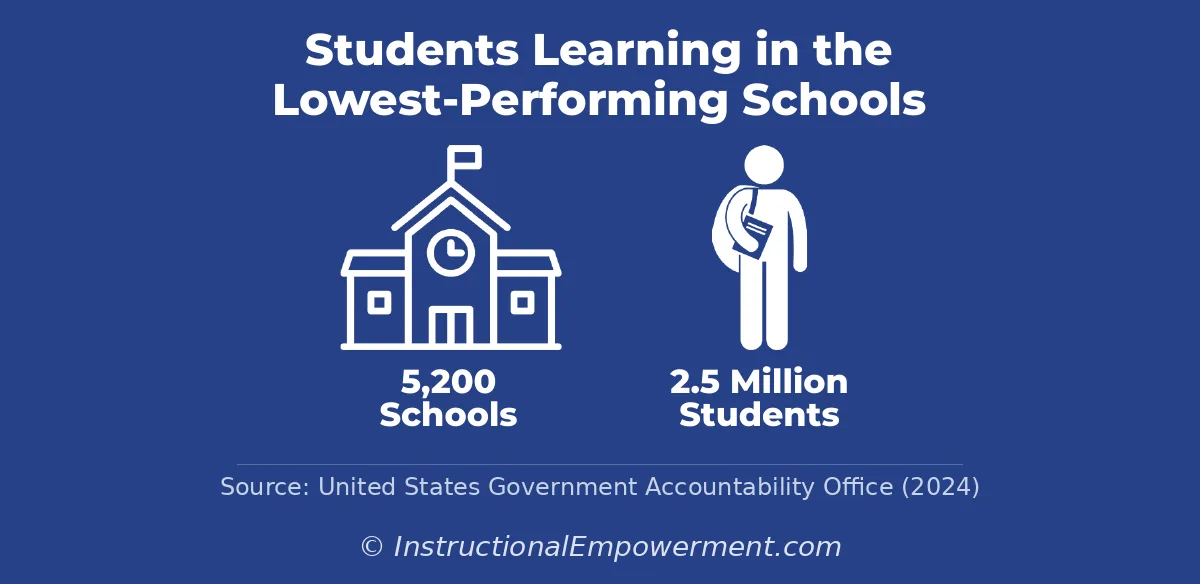
Students Learning in the Lowest-Performing Schools: 5,200 Schools | 2.5 Million Students
While not every school receiving support is undergoing formal “turnaround,” we can get a clear picture of the scale from federal and state accountability statistics.
Under the Every Student Succeeds Act (ESSA), schools are identified for improvement based on overall performance and the performance of different categories of students. One such designation—Comprehensive Support and Improvement (CSI)—applies to the lowest-performing 5% of Title I schools in each state.
Approximately 5,200 U.S. schools are currently classified as CSI, serving more than 2.5 million students (United States Government Accountability Office, 2024).
By law, all CSI schools are required to implement evidence-based interventions approved by their state education agencies. Many of these interventions were derived from school turnaround strategies established under Race to the Top and focused primarily on replacing leaders and teachers and on recruiting and retaining more effective educators. Essentially, these strategies were based on the assumption that the root cause of poor performance was ineffective leaders and teachers, and that the only way to correct the issue was to replace them.
Many states continued pursuing these aggressive turnaround strategies after Race to the Top was over—but the outcomes have been limited.
For example, in Tennessee, the Achievement School District (ASD) and iZone programs ran for over a decade. Yet, neither produced sustained improvements in test scores, attendance, or graduation rates (Pham et al., 2025).
In Florida, recent school accountability grade data shows considerable instability (Florida School Grades Archives, 2015-2024). Among schools on the improvement list in 2023–24, 32% earned a C or better one year, only to fall to a D or F the next.
These yo-yo patterns—moving in and out of turnaround status—are a hallmark of the Turnaround Trap: schools cycling through short-term gains that are not sustainable.
The Familiar “Quick Fixes”—and Why They Fall Short
School turnaround is some of the most demanding work in education. The pressure to show fast gains—often within a single school year—leads to urgent decisions and constrained timelines to establish goals, create a turnaround plan, and implement strategies.
This urgency has often induced districts to select a turnaround model that appeared easiest to implement rather than one that was best suited to the schools’ needs.
Research shows that time-limited implementation windows frequently produce shallow or fragile improvements (Meyers, 2024; Murphy & Bleiberg, 2019).
Many leaders have implemented school turnaround strategies like tutoring, computer-based programs, and extended learning time because they can deliver visible gains under tight accountability timelines. When implemented well, these approaches provide meaningful support for students.
The challenge comes when these strategies are expected to carry the full weight of school improvement. Without a strong foundation of rigorous Tier 1 instruction, even the best supplemental strategies will have limited results. Sustainable school turnaround means moving beyond quick fixes and pairing supports with the deeper systems work of redesigning Tier 1 instruction so that every student benefits every day.
“Without a strong foundation of rigorous Tier 1 instruction, even the best supplemental strategies will have limited results.”
Common Quick Fixes in School Turnaround
| Common Quick Fixes in School Turnaround | |
|---|---|
| Quick Fix | Why It Falls Short |
| Targeting students just below proficiency | This strategy overlooks the students furthest behind and ignores the real issue: Tier 1 instruction isn't lifting all students up. |
| Test prep | Drills and rote practice may boost test-taking skills, but they don't build deep understanding—and often disengage students in the process. |
| Computer-based programs | Often low-rigor and isolating, these programs can't substitute for rich, collaborative classroom learning. |
| Tutoring programs | Tutoring is often not consistent or scalable—and it can't make up for weak Tier 1 instruction. |
| Behavior programs | Students disengage further when control and extrinsic rewards become the focus, and they don't have a real role in their learning. |
| Extended day programs (after-school, Saturday, summer) | More time doesn't help if students are getting the same low-rigor instruction that didn't work for them during the normal school day. |
| RTI (Response to Intervention) and MTSS (Multi-Tiered Systems of Support) | Instead of strengthening Tier 1 instruction, schools may unintentionally build an "upside-down pyramid," with growing numbers of students placed in interventions. The core remains weak, and the system becomes overloaded. |
| Leadership or staffing changes (the "revolving principal") | Without systems that support strong instruction, even the best leaders and teachers struggle to succeed—and the turnover cycle continues. |
The Hidden Costs of Quick Fixes
Poor Student Outcomes
Quick gains in test scores often fade and leave students behind in the long run.
Some turnaround programs may show modest gains in test scores, but research finds these improvements are often short-lived and don’t translate to long-term outcomes in academics, behavior, or graduation (Pham et al., 2020; 2025).
For example, in one state’s transformation network school improvement efforts were in place for 10 years with no long-term positive effects.
Middle school students who attended these turnaround schools experienced some short-term academic gains, but by high school, those positive effects faded.
In fact, students who attended these turnaround schools later experienced lower ACT scores, higher chronic absenteeism, and lower graduation rates, compared to their peers (Pham et al., 2025).
- After the intervention, students in turnaround schools had lower ACT scores than students in comparison schools (14.51 in turnaround schools, 14.98 in comparison schools). Students in turnaround schools started with higher ACT scores before the intervention (15.55 in turnaround schools, 15.28 in comparison schools).
- Rates of chronic absenteeism for students in turnaround schools increased from 29% to 36%, while these rates in comparison schools remained stable at 32%.
- Graduation rates in turnaround schools dropped from 87% to 71%, while the rate in comparison schools also dropped, but by much less (from 85% to 79%).
Quick fixes may help schools exit accountability status, but they often only treat the problem superficially and leave students without the long-term skills they need to thrive.
Educator Turnover
Poorly executed reforms lead to teacher and principal burnout and loss of motivation.
Turnaround efforts often demand long hours and add pressure—especially when layered on top of other initiatives such as curricular changes. This overload contributes to educator demoralization and attrition (Harbatkin et al., 2024).
In some cases, teachers are placed in turnaround schools without preparation or choice—making it harder to build a committed, capable team (Murphy & Bleiberg, 2019).
The results, according to a systematic review of research literature about school turnaround (Harbatkin et al., 2024), are:
- Program fatigue and burnout
- Increased principal and teacher turnover
- Difficulty recruiting and retaining qualified staff
- Low teacher engagement in improvement efforts
When teachers’ needs for autonomy, connection, and competence are unmet, they experience burnout and disengagement (Collie, 2021; Eyal & Roth, 2011)—making it harder to support student learning and motivation.
Research shows that when teachers’ needs are fulfilled, they are more likely to support students’ needs as well (Ahn et al., 2021; Soenens et al., 2012; Basileo & Lyons, 2024).
“Research shows that when teachers' needs are fulfilled, they are more likely to support students' needs as well.”
Ahn et al., 2021; Soenens et al., 2012; Basileo & Lyons, 2024
Community Distrust
Reforms without a clear vision and thoughtful communication often meet resistance from the community.
School turnaround efforts are often experienced by communities as externally imposed—with little consideration to the concerns of families and local leaders and little to no time spent sharing the vision of the reform. This can erode trust and lead to resistance (Harbatkin et al., 2024).
Some approaches to school turnaround fail to also consider the importance of local context and circumstance and that differences may call for different mechanisms, not solely drastic personnel changes (Meyers & Smylie, 2017).
Common sources of tension from the community include:
- Perceived loss of local control
- Lack of community voice in planning and implementation
- Reforms that ignore local context or frame failure as community-based
Families of students in turnaround schools want to be involved with the improvement process but are often left out, since educators are too consumed by the intensity and time pressures of the work to include them.
Yet research shows that authentic family and community engagement increases the likelihood of lasting improvement (McAlister, 2013).

"When we talk about turnaround schools, it is critical that the school community is initially involved in the development of the plans for improvement. Too often, districts will quickly react to fix the problems but forget the community the school resides in. Community trust is a hard thing to quantify, but you know when you have it and when it is missing."
— Michael Grego, Ed.D., former Pinellas County Schools Superintendent
Weakened Professional Capacity
Scripted programs erode teachers’ confidence and fail to develop their skills for strengthening Tier 1 instruction.
Rather than investing in teacher professional development, turnaround often relies on external programs and interventions.
These programs and interventions are often scripted, and teachers do not always internalize the lessons or receive guidance on how to adapt them for the particular needs of their students. This approach fails to strengthen the school’s overall instructional capacity, at no fault of teachers.
Few curriculum resources give teachers the structures and tools needed to make academic rigor truly attainable for all students. As a result, many educators feel their students cannot handle the rigor of high-quality instructional materials and turn elsewhere for lesson material (Steiner, 2024). Too often, that means relying on unvetted sources. Without professional development that equips teachers to design standards-based, engaging tasks within an effective model of instruction, teachers lack the support to ensure every student can successfully grapple with rigor.
When teachers feel limited in their professional autonomy with rigid implementation plans, don’t receive professional development in rigorous lesson planning, and are asked to teach scripted lessons that they don’t believe can help their students, it leads to:
- Erosion of teachers’ self-efficacy
- Low professional self-worth
- Overdependence on outside programs
- A classroom learning experience that isn’t tailored to students’ needs or the community’s context
- Tier 1 instruction that remains weak and inconsistent
Even well-intentioned support systems like RTI and MTSS can create unintended consequences—schools experience the “upside-down pyramid” where more and more students are funneled into interventions, while the foundation of Tier 1 instruction and professional capacity remains unaddressed. According to anecdotal data, 50% or more of students in some districts are in Tier 3 interventions (Spruell, 2024).

"Turnaround happens when teachers and instructional leaders work side by side, anchored by high-quality instructional materials. Strong Tier I instruction requires both the right resources and a shared commitment to use them with integrity, collaboration, and purpose. When we build those types of partnerships within strong systems and continuous improvement, every student gains consistent access to rigorous, grade-level learning, and that's how we change outcomes."
— Brandon C. White, Ph.D., Harvard Community Unit School District 50 Superintendent
When the Costs Outweigh the Gains
Schools that focus on short-term school turnaround strategies may briefly “climb out” of accountability status—but the gains fade, and the deeper work of instructional improvement never gets done. That’s the real cost of the Turnaround Trap.
Without transforming Tier 1 instruction, schools hit a ceiling: they can no longer rely on growth to keep climbing and are unable to move students to true proficiency. And proficiency—not temporary growth—is where real, sustainable school turnaround lives.
The solution is not new programs or compliance checklists, it’s changing the actual classroom environment to one that gets better outcomes for all students, improves educator morale, wins the trust of the community, and strengthens the instructional capacity of the entire school. To get there, schools need coherent systems designed to create high-rigor, high-agency classrooms.
“Schools that focus on short-term turnaround strategies may briefly ‘climb out’ of accountability status—but the gains fade, and the deeper work of instructional improvement never gets done. That's the real cost of the Turnaround Trap.”
Subscribe for curated education insights delivered every two weeks.
Three Root Causes Behind the Turnaround Trap
Decades of research—and the lived experiences of educators—reveal a set of persistent conditions that prevent schools from sustaining improvement. These three root causes are among the most common reasons schools remain trapped in cycles of underperformance.

1. Low Rigor Tier 1 Instruction
School turnaround efforts often focus narrowly on remediation without ever shifting to rigorous, grade-level instruction. Many students start the school year below proficiency—the National Center for Education Statistics (2025) reports that 40% of students were learning below grade level in at least one academic subject at the beginning of the 2024-2025 school year—and low expectations keep them there.
- Widespread low rigor is a systemic issue. Across 383 classrooms in 39 turnaround schools in Florida, Texas, Arizona, Indiana, and Iowa, data shows that 85% of observed classrooms either had no evidence of student work or were at the lowest level of rigor. Only 1% showed evidence of analysis, and not a single classroom reached the highest level of rigor, knowledge utilization (Instructional Empowerment Applied Research Center, 2025). See Figure 1.
- Many schools settle for minor improvements. Research supports the idea that teachers and leaders in turnaround schools may accept early improvements in behavior and classroom climate as success, without pushing further toward rigorous instruction (Meyers, 2024).

Figure 1. Data from 39 turnaround schools shows that only 1% of classrooms showed evidence of the higher levels of academic rigor (analysis and knowledge utilization), while half were at the lowest level of rigor (retrieval) and a third included no evidence of student work at all. (Instructional Empowerment Applied Research Center, 2025)
“School turnaround efforts often focus narrowly on remediation without ever shifting to rigorous grade-level instruction.”
2. Failure to Invest in Systems and People
School improvement is too often treated as a “one and done” compliance exercise. But to sustain improvement over time, schools need strong systems and skilled educators.
- Surface-level reforms mask systems issues.
- Districts may overlook the systemic nature of organizational decline, failure, and improvement, believing that turnaround work can be limited to the school and leaving the broader system untouched (Meyers & Smylie, 2017).
- Some districts adopt the language of turnaround while preserving the same structures, avoiding the disruption real change requires (Torres et al., 2024).
- Lack of support from the district level can hinder schools’ progress. When a district doesn’t consistently and intentionally support school turnaround efforts, it can lead to barriers and slowed progress.
- Without strategic infrastructure, educational reforms effort collapse. Many efforts fail due to not having a clear instructional vision and plan for how to make this vision a reality through changing systems and developing human capacity. According to school turnaround research (Meyers, 2024; Harbatkin et al., 2024), many efforts fall apart due to:
- Mid-course changes in leadership vision
- Failure to adapt strategies and structures to the local context
- Inattention to developing the capacity of leaders and teachers
- Poor planning for personnel turnover
- Schools entering reform initiatives without preparation
- Shifting priorities that lead to reduced support or redirected funding
“To sustain improvement over time, schools need strong systems and skilled educators.”
3. Reliance on Lagging Student Data
Most turnaround models rely on lagging data—such as state test scores and interim benchmarks—which surface problems only after they’ve grown large and are much harder to reverse.
- Real-time, data-based decisions are rare. Although leaders recognize the need for timely, multiple metrics (Torres, 2024), most schools lack tools that provide actionable, leading data.
- By the time gaps appear, it’s too late. Without daily insight into how students are learning, instruction can’t be adapted in time. Students fall behind and get routed into interventions that could have been avoided with stronger Tier 1 instruction and the tools to identify and close gaps quickly.
- Typical school improvement models lack leading indicators. The Instructional Empowerment Applied Research Center found no existing studies of districts using leading indicators to guide school improvement efforts. The Center published a research brief and a full peer-reviewed study examining Rigor Appraisal as an instrument that provides real-time insight into instructional quality (Basileo et al., 2024). The main findings were that higher Rigor Appraisal scores were correlated to higher student achievement and attendance, fewer suspensions and referrals, and higher 5Essentials climate scores. See Figures 2 and 3 for more detail on how the tool accurately predicts student outcomes and allows for timely adjustments to instruction. Related studies are synthesized on our school turnaround research evidence page.
When leaders use real-time data in short improvement cycles, they can proactively target support, monitor progress, and ensure rigorous Tier 1 instruction across all classrooms—before small learning gaps become long-term achievement gaps.

Figure 2. As Rigor Appraisal scores increased, so did ELA and math learning rates. The evidence had very strong statistical significance for ELA and was approaching statistical significance for math. This correlation means that districts can use Rigor Appraisal scores to reliably predict student achievement before the state assessment and make adjustments as needed.


Figure 3. As schools increased their scores on the Rigor Appraisal, they saw decreased rates of student behavior referrals and suspensions and the findings were statistically significant. These measures were significant at one of the highest levels possible for social science (-.730 and -.636). A negative number in this context indicates an inverse relationship: as Rigor Appraisal scores increase, student behavior referrals and suspensions decrease. The results mean that when schools focus on raising their Rigor Appraisal score, improvement in student behavior should follow.
Together, the three barriers—low rigor Tier 1 instruction, failure to invest in systems and people, and reliance on lagging student data—create a pattern of short-term gains followed by regression. Schools are left stuck in the Turnaround Trap despite the best intentions of their leaders and teachers.
But it doesn’t have to be this way.

Case Study: A District That Overcame the Turnaround Trap
Putnam County School District’s story shows that real, lasting school improvement is possible—even in the face of significant challenges. Located in Palatka, a rural area in North Florida, this fully Title 1 district serves about 10,000 students across 12 traditional public schools.
From 2015 to 2018, a quarter or more of Putnam schools consistently received D or F state accountability grades (Florida School Grades Archives, 2015-2024). District leaders knew their schools had potential—but the schools also faced considerable difficulty.
At William D. Moseley Elementary School, for example:
- 100% of students come from low socioeconomic backgrounds
- 14% are homeless or in foster care
- 25% receive special education services
After fluctuating between a “D” and “F” state accountability grade for nine years, in 2017, Moseley was ranked by the state as the fifth lowest performing traditional public school in Florida (Becoming a School Where All Students Thrive, 2019).
A Strategic Partnership to Build Sustainable Practices
Putnam County School District partnered with our team because they believed investing in long-term systems and capacity-building would help Moseley break free from the Turnaround Trap once and for all. They wanted their students to experience redesigned, rigorous instruction and believed student-led team learning would completely transform the classroom environment.

"For a long time, our district had been focused on programs, but we wanted to partner with an outside expert to build sustainable practices that were not reliant on a specific program. One of the things that drew us to this partnership was that it was not program-based. Over time, we could substitute or replace curriculum materials or different programs but the practices would remain because the partnership helps to change educators' way of work, their classroom practices, and their expectations for students."
— Jonathan Hinke, Executive Director of Strategic Initiatives, Putnam County School District
Rapid Results at Moseley Elementary—and a Transformed Learning Culture
Classrooms at Moseley began to move from traditional teacher-centered instruction to a model our team introduced, now known as the Model of Instruction for Deeper Learning®. Moseley’s students collaborated in teams, guided by clear roles and responsibilities. Unlike traditional grouping, they had the structures and student resources to participate equally and take accountability for their own learning. Soon, teachers saw their students who once struggled with academics and behavior begin to thrive and become independent, critical thinkers.
Moseley successfully exited school turnaround status after two years of support. The school raised ELA proficiency by 20 points and mathematics by 13 points, increased teacher retention from 44% to 83%, and reduced behavior referrals by more than half (Becoming a School Where All Students Thrive, 2019).
Leaders, teachers, students, and the community recognized that the entire culture of the school was transformed. The changes were so impactful that Moseley became a demonstration site, helping other schools across the district learn and grow from its example.

"When I was told I had to give ownership to the students, I was very hesitant because I'm used to being in control. I feel like if I'm not doing the talking, then my students aren't getting what they need. But I stuck with the process, and I can see change. I can see how my kids are blossoming, how they're learning, how they're eager, they're more motivated, they're engaged. It has really helped my students be more successful."
— Tonya Miles, 5th Grade Teacher, Moseley Elementary

"Back in third grade, I was one of the more troubled students. I understood everything, but behavior problems started to kick in because I was not very socially active. I didn't like people, so that was a problem. But now that I'm with grouping, I have to deal with people and their emotions, so now I understand them better."
— 5th Grade Student, Moseley Elementary

Students at Moseley Elementary School in Putnam County School District work in teams to tackle rigorous academic tasks.
“I think Moseley is the best school we have in Putnam County—the staff supports every student to excel. We knew it would take more than a year. In the second year we started blooming. Parents were on Facebook bragging about Moseley. People are trying to get their kids into Moseley now. They have to drive—sometimes far out of their way—to get their kids here. Even upscale people who can be picky want their kids here. It wasn't like that at first, but they see the change in Moseley. My son has learned so much from being here. I hate that he has to move on, now that he's graduating to middle school. All my grandkids will go to Moseley. I'm definitely proud to be a Moseley parent.”
— Cornethia Foreman, Parent of a fifth grader, Moseley Elementary
Sustained Improvement, Even Through a Pandemic
After years with a quarter or more of its schools in turnaround status, by 2019 not a single school in Putnam County School District was rated “D” or “F.” Improvement held steady even during the COVID-19 pandemic: only one school received a “D” or “F” in both 2022 and 2023. By 2024, all schools were rated C or higher (Florida School Grades Archives, 2015-2025). The district continued this success in 2025, with all schools receiving a “C” or higher for the second year in a row.

Figure 4. This analysis of Putnam County School District includes 12 traditional public schools (excludes charter and virtual schools). (Florida School Grades Archives, 2015-2025)
Another major indicator of long-term success: the district’s graduation rates climbed from 54.9% in 2015 to 96.6% in 2026 (Putnam County School District, 2026; Putnam County School District, n.d).
Putnam County’s trajectory represents a powerful example of a school district that not only escaped the Turnaround Trap—but stayed out for good.

District superintendent celebrating Moseley’s achievement with the school team.

"Collaborating with Instructional Empowerment's team members as an outside partner helped shape our district's vision for teaching and learning. Their intensive partnerships at two schools provided our district team an opportunity to learn effective instructional practices that we then leveraged at other schools in the district."
— Dr. Rick Surrency, Superintendent, Putnam County School District, 2023 Florida Superintendent of the Year

"So much of the work that has come out of our partnership with the team at Instructional Empowerment has empowered teachers and leaders who have gone on to influence so many levels and areas in our district. Not only did the work empower the teachers, but also the students, parents, and the community. It gave everyone confidence, love, and a will to learn."
— Sarajean McDaniel, Executive Director of Leadership Development and former Principal of Moseley Elementary
The Path Out: A Model for Sustainable School Turnaround

How can districts support their schools in escaping the Turnaround Trap?
Based on more than a decade of work in turnaround schools, we have identified three high-leverage focus areas that consistently drive and sustain success: rigorous Tier 1 instruction, strong systems and skilled people, and leading data for short cycles of improvement. Each one is designed to reverse the common barriers outlined earlier in this article.
1. Increase the Rigor of Tier 1 Instruction
Barrier Reversed: Low rigor Tier 1 instruction
Most schools are still operating in a legacy instructional model, where learning is teacher-directed and students are passive recipients (Darling-Hammond, 2024). To truly change outcomes, schools must adopt a research-based, student-centered model of instruction—one that centers on deeper learning and student agency.
In turnaround schools, this shift requires explicit support for both teachers and students:
- Teachers need coaching and professional learning to shift instruction and create rigorous student tasks.
- Students need structures and resources that build the self-regulation, collaboration, and critical thinking skills to thrive in student-led learning.
2. Build Systems and Develop People for Long-Term Success
Barrier Reversed: Failure to invest in systems and people
The sustainable results that schools strive for won’t happen without strong systems and skilled people. Turnaround leaders need support to lead school transformation:
- Clear vision for rigorous student learning: While instructional leadership—including conducting observations and giving feedback on teaching and learning—has been increasingly emphasized in principals’ roles, there has been little guidance on how leaders can recognize rigorous student learning. Research shows that informal classroom observations or walkthroughs have a negative or no effect on improving instruction when principals do not use them to support teacher practice (Grissom, 2013). It is critical that school leaders learn to identify gaps in academic rigor and student agency and lead the way to optimal learning environments in all classrooms.
- Leadership coaching: School leaders need support in navigating the complexity of turnaround leadership, troubleshooting challenges, and leading rapid cycles of school improvement.
- Scalable structures: A systems-based approach enables leaders to shift the entire school—not just individual classrooms—and sustain progress through staff turnover or shifting priorities.
- Expert guidance on change management and implementation planning: System-level change requires developing principals’ capacity for strategic decisions, alignment to school context, and thoughtful processes to ensure strong implementation and buy-in from teachers, students, and the community. Leaders must define clear, specific expectations for effective instruction and build the systems that enable educators to achieve those expectations.
- Professional collaboration: Leaders must establish guidelines for Professional Learning Communities (PLCs) and teacher teams, while also providing the time, resources, and support they need to grow more effective over time. This enables teachers to continually strengthen their professional knowledge and skills and design rigorous, deeper learning experiences for all students.
3. Use Leading Data for Short Cycles of Instructional Improvement
Barrier Reversed: Reliance on lagging student data
Without timely feedback, it’s nearly impossible to support teachers and adjust instruction in time to change outcomes. Turnaround schools need leading indicators—metrics that show what is happening in classrooms in real time, not what happened last year.
Ensure classroom walkthrough tools are:
- Research-validated and predictive of student outcomes
- Rooted in national best practices for instruction and student engagement
- Focused on student evidence, not just teacher actions
When leaders use real-time data in short improvement cycles, they can proactively target support, monitor progress, and ensure rigorous Tier 1 instruction across all classrooms—before small learning gaps become long-term achievement gaps.
How Systemic Change Lifts the Whole School
When implemented well, a school turnaround model should transform the school experience for students and teachers.
| Student Achievement & Gaps Eliminating the daily learning gap can mitigate the effects of opportunity gaps over time and keep achievement gaps from ever forming. |
Student Behavior When students learn to work in teams, those who once felt isolated take ownership of their behavior and contribute to a positive learning environment. |
| Student Engagement Authentic collaboration on rigorous tasks helps students take an active role in learning and rediscover the joy of school. |
Chronic Absenteeism Transforming Tier 1 instruction to build agency addresses one of the pervasive root causes of chronic absenteeism: student disengagement from learning. |
| Teacher Retention Teacher retention rises when leaders build schoolwide systems that promote professionalism, autonomy, and purposeful support for the practices that help students succeed. |
Deeper Learning in Title 1 Schools Deeper learning empowers students in Title 1 schools with the skills, confidence, and critical thinking needed to disrupt cycles of poverty and thrive. |
| Immersing English Learners Student team structures accelerate both language and academic growth by immersing English learners in collaborative learning experiences with peers. |
Integrating Students with Disabilities Mixed-ability teams with clear structures and rich academic dialogue support the full participation of students with disabilities—fostering real inclusion and stronger outcomes. |
Conclusion: Out of the Turnaround Trap—and Beyond
Permanent escape from state accountability status is possible. But it doesn’t happen by chance—and it won’t last without a systems-level shift.
The most successful districts invest in a long-term approach to school turnaround grounded in rigorous instruction, strong systems, and real-time data. As the case study in this report shows, when those competencies are developed, even the most challenged schools can become high-performing, student-centered learning environments.

At Moseley Elementary, students who once struggled are now engaged and motivated through the Model of Instruction for Deeper Learning.
“It takes an outside set of eyes—which is what Instructional Empowerment provided for us—to come in and really look at our practices objectively and say, ‘you're not at the level of rigor you need to be at.”
— Dr. Rick Surrency, Superintendent, Putnam County School District, 2023 Florida Superintendent of the Year
Our team of educators is here to share what works. Learn more: https://instructionalempowerment.com/school-turnaround/
See more results from districts that made the shift: https://instructionalempowerment.com/library/school-turnaround-results-case-studies/
About the Authors
Michael D. Toth

Michael D. Toth is founder and CEO of Instructional Empowerment (IE) and leads IE’s Applied Research Center. He is also the author of the multi-award-winning book The Power of Student Teams with David Sousa; author of Who Moved My Standards; and co-author with Robert Marzano of multiple books. He co-authored peer-reviewed research articles published in academic journals in collaboration with researchers Lindsey Devers Basileo, Merewyn Lyons, Franz Hofmann, Barbara Otto, and Natalie Vannini. Most recently, he authored multiple articles published in the American School Board Journal by the National School Board Association (NSBA), including “Deeper Learning and Educational Screen Time.” Michael is a keynote speaker at conferences and coaches superintendents on creating a bold instructional vision, designing and launching a high-functioning cabinet team, transforming Tier 1 core instruction, and leading systems-based school advancement.
Learn more about Michael: https://instructionalempowerment.com/ie-founder-michael-d-toth/
Michael on LinkedIn: https://www.linkedin.com/in/michael-d-toth-author/
Michelle Fitzgerald, Ed.D.

Michelle Fitzgerald, Ed.D., serves as the Executive Director of Advocacy and Networking for Instructional Empowerment. She has been an educator for more than 30 years and has served as an area superintendent – principal supervisor, assistant superintendent for teaching and learning, director of curriculum, building administrator, and middle school teacher. Michelle has built instructional leadership in district leaders, principals, and assistant principals capitalizing on her extensive experience in curriculum, instruction, and assessment.
Learn more about Michelle: https://instructionalempowerment.com/michelle-fitzgerald/
Michelle on LinkedIn: https://www.linkedin.com/in/mfitzgerald44/
Merewyn E. Lyons, Ed.D.

Merewyn Lyons, Ed.D. is a Senior Research Analyst with Instructional Empowerment’s Applied Research Center. Her primary research interest is educational psychology, with a focus on understanding the effect of motivation on teaching, learning, and educational leadership. She is co-author of peer reviewed articles in Sage Open, Frontiers in Education, Quality Education for All, and Discover Education. Dr. Lyons is a member of the Center for Self-Determination Theory. She is also a retired officer of the United States Navy and a retired K-12 educator.
Learn more about Merewyn: https://instructionalempowerment.com/applied-research-center/#libba
Merewyn’s ORCID: https://orcid.org/0009-0004-1240-4421
About Instructional Empowerment
Instructional Empowerment’s mission is to end generational poverty and eliminate achievement gaps through redesigned rigorous Tier 1 instruction that ensures deeper learning for ALL students.
We partner with school and district leaders to build schools’ capacity and instructional systems. Our goal is for schools to achieve rapid, measurable outcomes for their students by focusing on rigorous classroom instruction and deeper learning for lasting school improvement.
References
Ahn, I., Chiu, M. M., & Patrick, H. (2021). Connecting teacher and student motivation: Student-perceived teacher need-supportive practices and student need satisfaction. Contemporary Educational Psychology, 64(101950). https://doi.org/10.1016/j.cedpsych.2021.101950
Basileo, L. & Lyons, M.E. (2024). An exploratory analysis of Early Adopters in education innovations. Quality Education for All, 1(1), 158-179. https://doi.org/10.1108/QEA-10-2023-0009
Basileo, L. D., Lyons, M. E., & Toth, M. D. (2024). Leading indicators of academic achievement: Investigating the predictive validity of an observation instrument in a large district. SAGE Open, 14(2). https://doi.org/10.1177/21582440241261119
Becoming a School Where All Students Thrive (2019). https://instructionalempowerment.com/library/moseley-elementary-leverages-student-led-team-learning-to-success/
Collie, R. J. (2021). COVID-19 and teachers’ somatic burden, stress, and emotional exhaustion: Examining the role of principal leadership and workplace buoyancy. AERA Open, 7, 23328584209896187. https://doi.org/10.1177/2332858420986187
Darling-Hammond, L. (2024). Reinventing systems for equity. ECNU Review of Education, 7(2), 214-229. https://doi.org/10.1177/20965311241237238
Eyal, O., & Roth, G. (2011). Principals’ leadership and teachers’ motivation. Journal of Educational Administration, 49(3), 256-275. https://doi.org/10.1108/09578231111129055
Florida School Grades Archives (2015-2024). https://www.fldoe.org/accountability/accountability-reporting/school-grades/archives.stml
Grissom, J. A., Loeb, S., & Master, B. (2013). Effective instructional time use for school leaders: Longitudinal evidence from observations of principals. Educational Researcher, 42(8), 433- 444. https://doi.org/10.3102/0013189X13510020
Harbatkin, E., Pham, L. D., Redding, C., & Moran, A. J. (2024). What are the side effects of school turnaround? A systematic review. Review of Research in Education, 48(1), 58-88. https://doi.org/10.3102/0091732X241248151
Instructional Empowerment Applied Research Center. (2025). Analysis of rigor in 39 schools, 2022-2024 (Unpublished).
McAlister, S. (2013). Why community engagement matters in school turnaround. Voices in Urban Education, 36, 35-42. http://files.eric.ed.gov/fulltext/EJ1046328.pdf
Meyers, C. V. (2024). An urban district’s struggle to preserve school turnaround change. Urban Education, 59(1), 300-329. https://doi.org/10.1177/0042085920966031
Meyers, C.V., & Smylie, M.A. (2017). Five myths of school turnaround policy and practice. Leadership and Policy in Schools, 16(3), 502-523. https://doi.org/10.1080/15700763.2016.1270333
Murphy, J. F., & Bleiberg, J. F. (2019). School Turnaround Policies and Practices in the US (Vol. 6). Springer International Publishing. https://doi.org/10.1007/978-3-030-01434-6
National Center for Education Statistics. (2025). School Pulse Panel: Surveying high-priority, education-related topics. https://nces.ed.gov/surveys/spp/results.asp#learning-strategies-oct24-chart-1
Pham, L. D., Corcoran, S. P., Henry, G. T., & Zimmer, R. (2025). Do the effects persist? An examination of long-term effects after students leave turnaround schools. American Educational Research Journal, 62(1), 180-213. https://doi.org/10.3102/00028312241284026
Pham, L. D., Henry, G. T., Kho, A., & Zimmer, R. (2020). Sustainability and maturation of school turnaround: A multiyear evaluation of Tennessee’s Achievement School District and local Innovation Zones. AERA Open, 6(2). https://doi.org/10.1177/2332858420922841
Putnam County School District (2026). PCSD reaches 5th in the state with a 96.6% graduation rate! https://www.putnamschools.org/o/jal/article/2647696
Putnam County School District (n.d.). Welcome to the superintendent’s office. https://www.putnamschools.org/page/superintendents-office
Sinek, S. (2019). The infinite game. Penguin Business.
Soenens, B., Sierens, E., Vansteenkiste, M., Dochy, F., & Goossens, L. (2012). Psychologically controlling teaching: Examining outcomes, antecedents, and mediators. Journal of Educational Psychology, 104(1), 108-120. https://doi.org/10.1037/a0025742
Spruell, S. (2024). Flipped MTSS triangle? Effective strategies for school administrators. https://www.branchingminds.com/blog/how-to-respond-to-an-upside-down-mtss-tiered-triangle
Steiner, D. (2024). Why teachers don’t use the high-quality instructional materials they’re given. The 74. https://www.the74million.org/article/why-teachers-dont-use-the-high-quality-instructional-materials-theyre-given/
Torres, A. C., Frost Waldron, S., & Burns, J. (2024). Compliance, chaos, or coherence? How superintendents, districts, and schools draft coherence from school turnaround policy. Educational Evaluation and Policy Analysis, 46(1), 133-159. https://doi.org/10.3102/01623737231161363
United States Government Accountability Office. (2024). Education could enhance oversight of school improvement activities. https://www.gao.gov/assets/gao-24-105648.pdf
Subscribe for curated education insights delivered every two weeks.
Model of Instruction for Deeper Learning ® is a registered trademark of Instructional Empowerment and is research-validated.