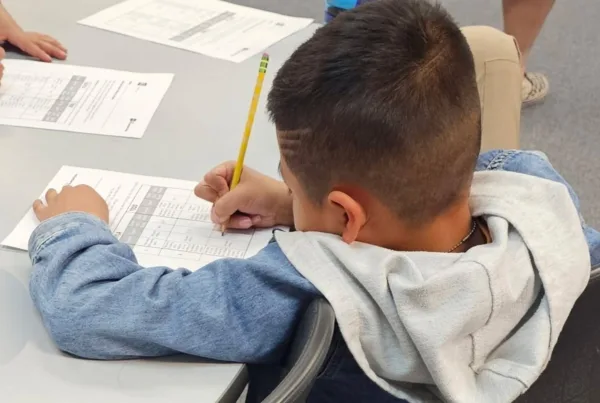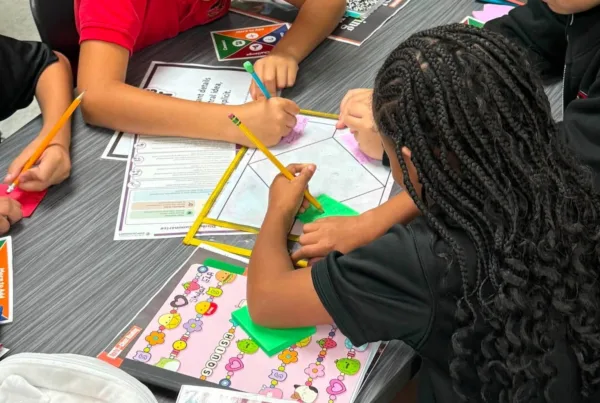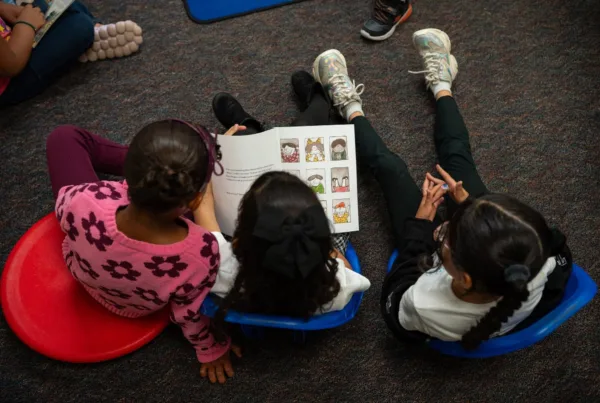
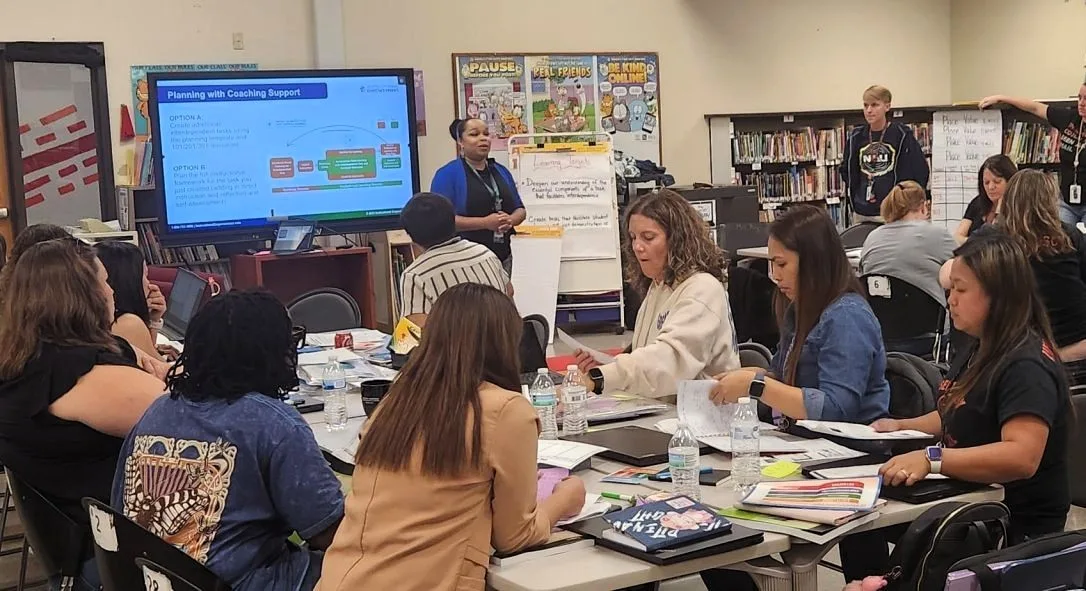
Teachers and leaders in Bullhead City School District #15, Arizona—one of the districts included in this research study—engage in professional learning on the Model of Instruction for Deeper Learning, which has been shown to mitigate teacher burnout.
By: Lindsey Devers Basileo, Ph.D.
Study Participants
Teachers: 570
Schools: 76
Districts: 10
States: 7 (Colorado, Arizona, Iowa, Illinois, Indiana, West Virginia, and North Carolina)

The Instructional Empowerment Applied Research Center conducted a study in 76 elementary, middle, and high schools (across 10 districts, in 7 states) to determine if there is a relationship between teacher burnout, school culture, and implementing the Model of Instruction for Deeper Learning®.
The study analyzed surveys from 570 teachers, administered during the 2024-25 school year.
Findings on Teacher Burnout and the Model of Instruction for Deeper Learning
Teacher burnout is associated with turnover, absenteeism, low morale, and deterioration in the quality of care provided to students (Maslach, et al., 1996).
Our Applied Research Center used a scientifically-validated burnout scale designed for the education field (Maslach, et al., 1996) with survey questions focusing on teachers’ experiences of:
- Emotional exhaustion—Depleted emotional resources to the point educators can no longer give their best.
- Depersonalization—Negative, cynical attitudes and feelings about students.
- Reduced personal accomplishment—Negative self-evaluation and dissatisfaction with their work with students.
The study investigated burnout in teachers implementing the Model of Instruction for Deeper Learning.
What Is the Model of Instruction for Deeper Learning?
- The Model of Instruction for Deeper Learning is a research-based approach to classroom instruction that puts students at the center of their learning by shifting from teacher-directed methods to student-led teams.
- Students work together with clear roles and rigorous tasks, gradually taking on more responsibilities as they learn to lead, collaborate, and think critically.
- Unlike typical group work, specific protocols ensure equal participation, accountability, and deeper learning, with less reliance on the teacher for constant support.
- To implement the model, schools equip their teachers with professional learning, coaching, classroom resources, and certifications.
Clear Link Between Lower Burnout and Implementation of the Model
The study found a moderate correlation between implementing the Model of Instruction for Deeper Learning and reduced teacher burnout (r = –0.38, where r indicates the strength and the direction of the relationship).
The correlation was statistically significant (p < 0.001), meaning the results are very unlikely to be due to chance (less than a 1 in 1,000 probability).
This suggests that implementing the model can mitigate teacher burnout.

Figure 1. Higher implementation of the Model of Instruction for Deeper Learning is associated with significantly lower teacher burnout.
How Much Was the Reduction in Teacher Burnout?
To test the magnitude of the effect the Model of Instruction for Deeper Learning has on teacher burnout, the Applied Research Center used a more advanced statistical approach called a structural equation model, which goes beyond correlation and examines how multiple factors interact.
This more robust analysis found that teachers who reported higher implementation of the Model of Instruction for Deeper Learning had significantly lower levels of burnout compared to their peers—even after accounting for individual differences (gender, race, ethnicity, years of experience) and similarities among teachers in the same schools.
The study found that a one standard deviation increase in implementation of the Model of Instruction for Deeper Learning corresponded to about a 0.40 standard deviation decrease in overall teacher burnout.
A reduction in burnout of this magnitude suggests that teachers with higher implementation of the Model of Instruction for Deeper Learning experienced noticeably lower burnout than peers.
See Figure 2 for the equivalent difference in burnout percentile between higher and lower implementing teachers. These findings suggest a considerable difference in burnout with higher levels of implementation of the model.

Figure 2. Teachers with higher implementation of the Model of Instruction for Deeper Learning tended to report lower burnout. A 0.40 standard deviation reduction in burnout corresponds to roughly 50→35, 75→61, and 90→81 in percentile points.
Subscribe for curated education insights delivered every two weeks.
Findings on School Culture and Burnout
The study further analyzed positive school culture, where teachers have a sense of professional agency and the support necessary to provide the best possible education for their students.
The study’s measure of school culture aligned with five areas Instructional Empowerment emphasizes in our teacher professional development and leadership coaching.
-
- Teachers’ autonomy satisfaction—Whether teachers felt they were empowered in their professional practice.
- Autonomy-supportive leadership—Whether teachers perceived their principals as supporting them to exercise their professional skills and judgment.
- Innovativeness—Whether teachers were willing to try new instructional methods.
- Effective Professional Learning Communities (PLCs)—Whether PLC time was used to examine student work and develop standards-based learning targets and tasks.
- Implementation of the Model of Instruction for Deeper Learning—Whether teachers were using the model with their students.
Clear Link Between Lower Burnout and Improved School Culture
This study found that Instructional Empowerment’s definition of school culture had the strongest mitigating impact on teacher burnout (r = –0.53). The correlation was statistically significant (p < 0.001). See Figure 3.
This means that higher levels of school culture, as we define it, are associated with significantly lower levels of teacher burnout.
The strength of this relationship suggests a substantial impact between the areas that Instructional Empowerment focuses on in our partnership models and teacher burnout.

Figure 3. Higher levels of school culture, as defined by Instructional Empowerment, are associated with significantly lower levels of teacher burnout.
How Much School Culture Affected Teacher Burnout
In testing the strength of the relationship between school culture and teacher burnout, the Applied Research Center used the same advanced statistical approach noted above.
The study found that a one standard deviation increase in the school culture score corresponded to about a 0.61 standard deviation decrease in overall teacher burnout.
A reduction in burnout of this magnitude suggests that an improved school culture is associated with noticeably lower burnout. See Figure 4. This suggests a considerable difference in burnout by focusing on the five areas that Instructional Empowerment uses to define school culture.

Figure 4. The equivalent difference in burnout percentiles with an improved school culture, which we defined as teachers’ autonomy satisfaction, autonomy-supportive leadership, innovativeness, effective PLCs, and implementation of the Model of Instruction for Deeper Learning.
Takeaways for Educators
- Implementation matters: Teachers who engaged more deeply with the Model of Instruction for Deeper Learning experienced significantly lower burnout.
- School culture is critical: Instructional Empowerment’s definition of school culture—which included the Model of Instruction for Deeper Learning, along with leadership and PLC support—also had a strong relationship with reduced teacher burnout.
- Consistent results: The positive effects remained strong even after controlling for factors like years of experience, gender, race, and school context.
- Meaningful impact:
- A one standard deviation increase in implementation led to about a 0.40 standard deviation reduction in burnout.
- A one standard deviation increase in school culture led to about a 0.61 standard deviation reduction in burnout.
- Big picture: These results suggest that the Model of Instruction for Deeper Learning not only improves student outcomes, as evidenced in our previous analysis of students’ chronic absenteeism, but the model also reduces teacher burnout.
About the Author
Dr. Lindsey Devers Basileo
Dr. Lindsey Devers Basileo is the Director of Research at Instructional Empowerment’s Applied Research Center. She earned her doctorate from Florida State University in 2010 and is a nationally certified reviewer for the What Works Clearinghouse, specializing in Group Design Standards (Version 4.0 and 4.1). Her research interests include school improvement, educational innovations, self-determination theory, Diffusion of Innovation theory, Group Design standards, survey design and collection, and both quantitative and qualitative methods.
Dr. Basileo’s dedication to conducting thorough and impartial research in the field of education has not only tremendously helped our organization, but the many students and educators that we collaborate with through our efforts to improve educational outcomes in schools.
References
Maslach, C., Jackson, S. E., & Leiter, M. P. (1996). Maslach Burnout Inventory – Educators Survey (MBI-ES). In Maslach Burnout Inventory Manual (3rd ed.). Consulting Psychologists Press.
Subscribe for curated education insights delivered every two weeks.
About Instructional Empowerment
Our mission is to end generational poverty and eliminate achievement gaps through redesigned rigorous Tier 1 Instruction that ensures deeper learning for ALL students.