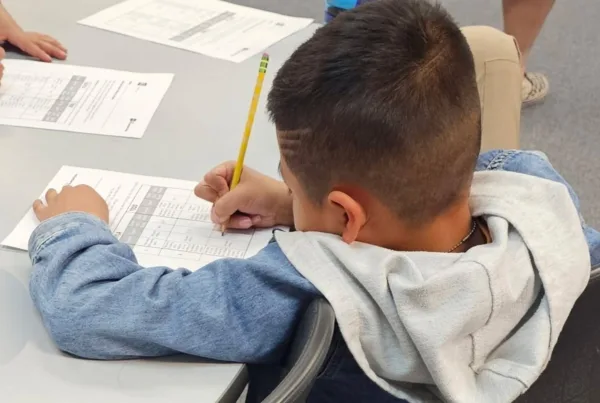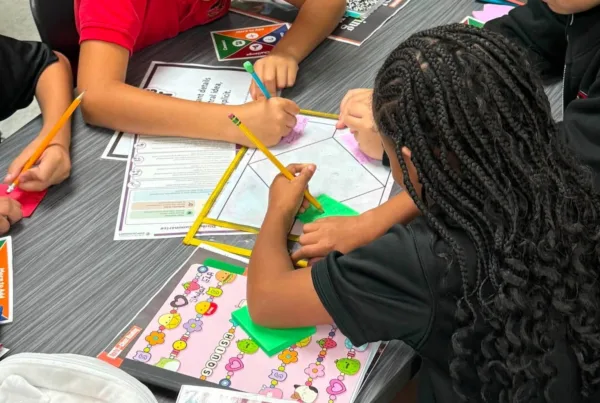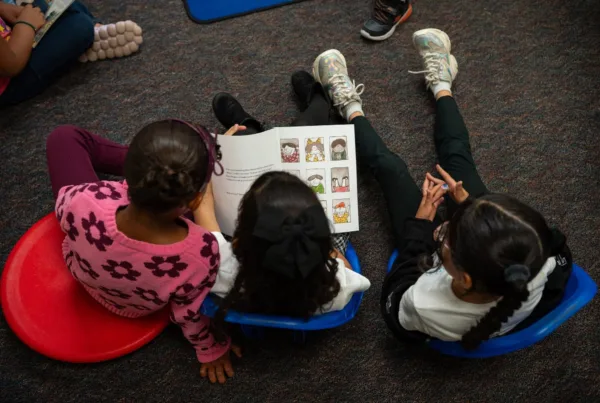
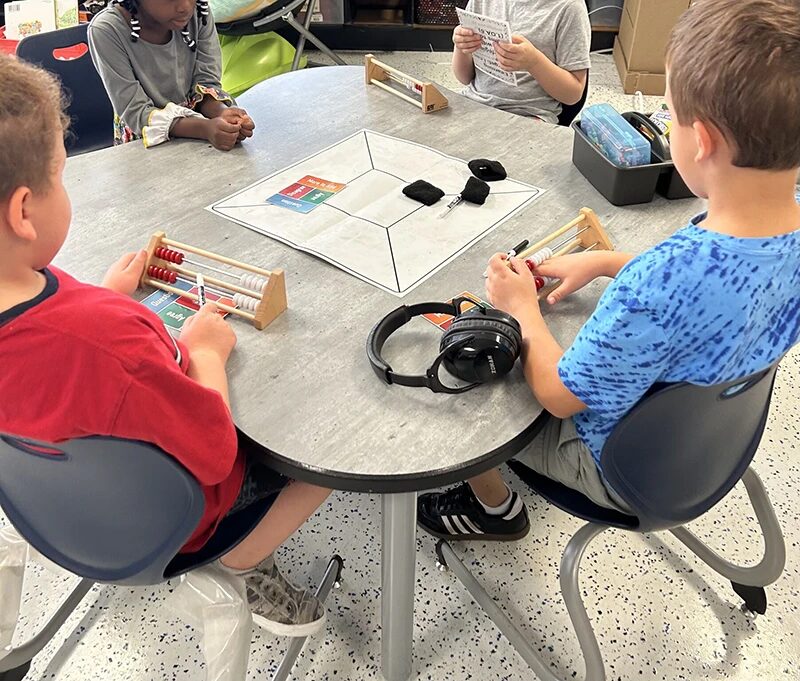
First grade students use their Summarizing Thinking Guide and Mat to collaborate at Cleveland Elementary School in Cedar Rapids Community School District.
Topics Covered
- Executive Summary
- Cedar Rapids Community School District Demographics
- The Challenge: A District Ready for More
- What Drew CRCSD to Instructional Empowerment
- Implementation
- Early Wins: Visible Change from Week Four
- Positive Shifts That Changed Student Outcomes
- Shift 1: Students Find Their Voice
- Shift 2: Skills Transfer Beyond the Classroom
- Shift 3: Breaking Down Social Barriers
- Shift 4: Behavior Improves with Engagement
- The Leadership System: How Leaders Drove Continuous Improvement
- Districtwide Results: One Year of Impact
- Students Show Up: Chronic Absenteeism Drops
- Fewer Students Receive Referrals
- Exceptional Mathematics Performance and Meaningful ELA Progress
- Closing Achievement Gaps: Results for All Students
- Looking Ahead
Executive Summary
In the 2024-2025 school year, Cedar Rapids Community School District (CRCSD) launched a districtwide implementation of Instructional Empowerment’s Model of Instruction for Deeper Learning across all 31 schools, serving more than 14,500 students. CRCSD is the second-largest public school district in Iowa.
This case study tells the story of how CRCSD transformed instruction, re-engaged students, and accelerated learning for all student groups in one year—and what other districts can learn from their approach.
| 2024-2025 Cedar Rapids Community School District Demographics | |
|---|---|
|
Grades: K-12 Number of students: 14,729 Percent Students with Disabilities: 15.8% Percent Low Socioeconomic Status: 56.88% Percent English Learners: 9.9% |
Percent White: 55.3% Percent Hispanic: 9.4% Percent Black of African American: 21.6% Percent Multi-Racial: 10.8% Percent Asian: 1.8% Percent American Indian: 0.2% Percent Hawaiian or Pacific Islander: 0.9% (Iowa Department of Education, 2024) |
Within the district are:
|
|
The Challenge
- After conducting a School Comprehensive Needs Assessment (SCNA), the Instructional Empowerment team found that many schools throughout the district struggled with inconsistent instruction. Instruction in several schools was not aligned to the Iowa Academic Standards.
- During classroom walkthroughs, the Instructional Empowerment team found students primarily learned online or with individual worksheets, resulting in low academic rigor and a lack of connection to their peers, which contributed to high levels of chronic absenteeism and behavior referrals.
Vision, Mission, & Goals
For the 2024-2025 school year, the main focus for all schools in the district included:
- Learning targets aligned to Iowa Academic Standards: Ensuring students know exactly what they’re learning and why.
- Tasks that are aligned to the target and academic standard: Creating opportunities for critical thinking, problem-solving, and deeper learning.
- Teaming structures: Empowering students to collaborate, hold each other accountable, contribute equally, and lead their own learning.
- Ongoing professional development: Providing continuous learning for teachers and cohort coaching where principals and instructional coaches across schools learned together.
The Partnership
- All 31 schools in CRCSD received varying levels of support from Instructional Empowerment based on their needs, identified collaboratively with the district.
- Principals received coaching, measurement tools, and opportunities to come together in small groups to discuss data trends and share best leadership practices.
- Teachers received professional learning, physical resource kits, and tools designed for deeper learning, with systems for tracking student evidence and recognizing teachers’ progress with badges.
The Results:
- A 9.2 percentage point reduction in chronic absenteeism
- A 5.3 percentage point increase in math proficiency districtwide
- A 2.5 percentage point increase in ELA proficiency districtwide
- Significant growth for Black students in math (+5.9 points) and ELA (+2.5 points)
- i-Ready outcomes surpassing national norms in Grades K-8, with significant gains in math
- Subgroup gap closures across Black, Hispanic, low socioeconomic backgrounds, English Learners, and students with disabilities
The Challenge: A District Ready for More
Before partnering with Instructional Empowerment, district leadership at Cedar Rapids Community School District saw a familiar pattern. Despite having dedicated educators and a clear strategic priority around student achievement, something fundamental was missing.
“Prior to [Instructional Empowerment], we didn’t have a systematic way to incorporate student-led learning in our building,” explained Principal Jessica Westercamp of Kenwood Leadership Academy, capturing what many of her colleagues were experiencing across the district.
CRCSD began exploring Instructional Empowerment during Superintendent Dr. Tawana Lannin’s early tenure, starting with a Why Workshop and a School Comprehensive Needs Assessment (SCNA) to determine the scope of the challenge.
“I can remember telling [Dr. Lannin], your teachers are teaching like it’s still COVID,” recalled Dr. Michelle Fitzgerald, Executive Director of Advocacy and Networking at Instructional Empowerment.
Dr. Lannin reflected on the insights gained from the SCNA: “This data provides clear direction. In a post-COVID educational landscape, intentional instructional support and student engagement are foundational. When engagement is prioritized, we see growth in achievement, development, and student voice.”
The district had embraced digital tools during the pandemic but, like many schools, never fully returned to interactive instruction. Technology had inadvertently created barriers to authentic learning.
SCNA walkthroughs revealed that in classrooms across the district, students would enter, log onto their computers, and complete activities independently. In some classrooms, students sat with their backs to the teacher, working on worksheets in isolation. When asked why they were positioned that way, students simply replied, “This is where we were told to sit.”
District and school leaders developed a clear vision for reversing these trends by shifting classrooms to high rigor and high agency, with students actively involved in their own learning. However, what they needed was a way to translate that commitment into consistent classroom practice across the 31 schools.
What Drew CRCSD to Instructional Empowerment
CRCSD was compelled by Instructional Empowerment’s comprehensive approach, which aligns to their vision of what they want for their students:
- Clear learning targets aligned to standards: Every student would know exactly what they’re learning and why, with targets aligned to Iowa Academic Standards.
- Rigorous and interdependent tasks: Creating opportunities for critical thinking, problem-solving, and deeper learning where students work together to succeed.
- Structured teaming that put students in charge of their learning: Not just group work, but true collaboration with defined roles, equal participation, and shared accountability.
- Leadership systems for continuous improvement: Including classroom walkthroughs and daily stand-ups that would drive accountability and keep educators focused on measurable progress.
“Our goal was not to make it feel like one more thing. It’s the thing—it’s just how we do business,” explained the former Chief of Schools & Curriculum, Dr. Maura Hobson, in a meeting with the CRCSD Board of Education.
District leaders were particularly drawn to the fact that the model wasn’t prescriptive about curriculum. Instead, it focused on how to deliver any curriculum with intentionality and high expectations. It was a system for instruction, not a replacement for what teachers were already teaching.
Principals See the Vision
For Jennykaye Hampton, Principal at Johnson STEAM Academy, the decision came quickly. When she learned her building might be a candidate for partnership, she read The Power of Student Teams over the weekend. “I immediately said, our school is going to do this, because I wanted to be able to say, ‘this is how we do business.’”
What resonated wasn’t just the model—it was her teaching memories. “I think back to when I was in the classroom. I just remember those moments when the kids were doing the talking, the kids were doing the learning, the kids had agency, and I was just a facilitator. I just remember the engagement I witnessed and what the kids took away from that.”
After researching student teaming, Hampton knew this was what Johnson STEAM Academy needed. “Based on the Iowa Performance Profile, we are a comprehensive school. So, we have a lot of room for growth. I do feel like this is the thing that can bring us there. And so I just said, ‘this has to be our thing. This has to be our vessel. We can do great things, we can do hard things at Johnson STEAM Academy.”
Implementation
In September 2024, Cedar Rapids Community School District launched districtwide, providing differentiated support based on each school’s needs.
Launch: September 2024
All 31 schools began the year with Model of Instruction 101 training. Teachers learned the foundational structures of student-led learning: how to set up teams, introduce roles, facilitate academic discourse, and design tasks that require collaboration.
What is the Model of Instruction for Deeper Learning?
Instructional Empowerment’s Model of Instruction for Deeper Learning places students at the center of their learning, shifting from traditional teacher-directed methods to student-led team learning. In this approach, students collaborate in structured, interdependent teams, guided by clear roles and responsibilities.
Unlike traditional grouping, the Model of Instruction for Deeper Learning ensures equal participation and accountability and shifts classrooms away from dependent, compliant learning and toward independent, critical thinking.
Grounded in research from The Power of Student Teams: Achieving Social, Emotional, and Cognitive Learning in Every Classroom Through Academic Teaming (Toth & Sousa, 2019), the model is adaptable across all subjects and grade levels K–12—making deeper learning possible for ALL students, in every classroom.
Early Wins: Visible Change from Week Four
Within the first month of school, the change was visible—and measurable.
District leaders conducted 410 classroom visits by just the fourth week of school—a remarkable pace that demonstrated leaders’ commitment to being instructional leaders first. That momentum continued throughout the year, ultimately reaching 4,962 RigorWalks and 2,397 Look and Learn coaching sessions.
What Is RigorWalk?
RigorWalk® is a research-validated walkthrough tool designed to measure the quality and effectiveness of Tier 1 instruction in real-time—without adding tests or evaluating teachers.
How RigorWalk delivers results:
- Measures instructional rigor, alignment to standards, and student engagement
- Conducted in 7-10 minutes per classroom by school leaders
- Generates trend data and pinpoints areas to strengthen Tier 1 instruction schoolwide
“Leaders are getting into classrooms, really seeing the instruction happening, and that’s important so we know what’s happening and how we can continue to move forward in the district,” Dr. Hobson explained to the Board on June 9, 2025.
With the RigorWalks conducted in classrooms by the end of the year, district data showed:
- 40% growth average for learning targets aligned to standards, with over half of the schools having 60% or higher growth.
- 50% growth average for student learning aligned to the learning target, with over half of the schools having 50% or higher growth.
- 33% growth average for student teaming in classrooms, with a third of the schools having 60% growth average.
The First Semester at Kenwood Leadership Academy
Principal Jessica Westercamp and her team owned their implementation: “We dug in and committed to learning and implementation. Our Instructional Coach and Magnet Coordinator were key to success.”
The leadership team set clear 45-day goals, maintained daily stand-ups focused on their Action Boards, tracked implementation data, and built a “Coalition of the Willing” which is a dedicated team of teachers committed to the work.
By the first semester:
- 100% of the teachers were using Instructional Empowerment tools and structures for partner and team interactions
- 88% were implementing student roles
- The foundation was set for deeper work in the second semester
Second semester brought deeper focus:
- 80% implementation of clear learning targets
- 100% implementation of aligned tasks
Positive Shifts That Changed Student Outcomes
Shift 1: Students Find Their Voice
In classrooms across the district, students who spent the previous year working silently on computers were now talking to each other—about academics. They were arranged in teams, using role cards, sharing their thoughts, and holding each other accountable.
The transformation was particularly meaningful for students who had previously struggled to engage.
In a third-grade classroom at Johnson STEAM Academy, Principal Hampton walked in and couldn’t immediately locate the teacher.
The students were engaged in discussions, using their role cards and summary mats, while the teacher observed from the side. “Like a fly on the wall,” Hampton recalled. Students were prompting each other: “Hey, you didn’t share yet.”
“I was talking to the teacher afterwards and said, ‘I heard so-and-so leading this discussion,’” Hampton shared. “And she said, ‘You know, he’s actually low in reading.’ And I was like, ‘You couldn’t tell—the vocabulary that he was using and bringing it back to the content.’ But she had set the classroom up, and those students were helping one another.”
“Johnson STEAM Academy has experienced leadership transitions in the past, and we are now seeing the impact of a shared commitment to this work. The team has rallied around learning, growth, and student success—demonstrating what is possible when engagement is prioritized and students own their learning!”
– Dr. Tawana Lannin, Superintendent, Cedar Rapids Community School District, Iowa
At Cedar River Academy, first-grade teacher Diane Montes saw similar patterns emerge even with her youngest students. “My class—the biggest struggle is really pausing and actually listening to each other, not just focusing on my thinking. I think this structure has helped them in really pausing, thinking about what their peer is sharing, and then adding on to it or helping a peer in another way.”
Her colleague, fourth-grade teacher Joli Schroeder, described one student “who would kind of sit back and didn’t want to engage. Somehow, seeing everyone else talk in a controlled, polite manner, I think he felt more comfortable to speak out and share. You would see him start to sign, and then he would start adding, ‘Well, yeah, I do have more to add.’ It was his way of showing ‘I can speak in a safe environment.’ When we moved to actual conversations in their groups and not just whole group, he would start chiming in a lot more.”
Montes described two boys “who have trouble communicating with others when it comes to just verbal conversations, but with the structure of the agree/disagree cards and IE, they were able to communicate with others appropriately, and they were excited to do so too, because they do have great ideas to share, and they like sharing their knowledge with their peers.”
Shift 2: Skills Transfer Beyond the Classroom
The impact transcended classroom walls. Teachers reported seeing students use their collaboration skills in music class, art class, and even when guest speakers visited.
Schroeder had the experience of teaching the same group of students in second grade, watching them struggle to get along and cooperate, then teaching them again in fourth grade after a year of implementation.
“This was a class that socially and emotionally struggled to get along, struggled to cooperate,” Schroeder explained. “Giving them this structure, I could completely see how they handled situations and conflict. Even at recess, they were able to actually look each other in the eyes, have an actual conversation and explain what they were thinking and feeling. It was from them being comfortable in the classroom and articulating their thoughts with one another that they then felt safe to do that when they were in unstructured environments.”
The transformation was visible in unexpected moments. “When we did our magnet day where they got to have community members come in and they got to share their projects and writings, watching them and how comfortable they were with making eye contact and explaining to other students or peers and adults that would come in—they weren’t scared to speak up and they were articulating what they understood,” Schroeder noted. “It was beautiful to watch.”
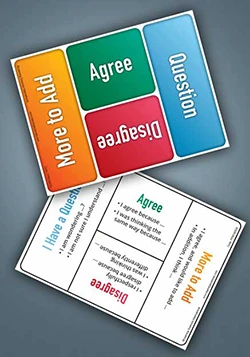 At Johnson STEAM Academy, Principal Jennykaye Hampton witnessed the shift during an informal moment on the playground. Second graders who typically might have resorted to name-calling or physical responses instead held up their agree/disagree cards during an argument.
“They held up the card and said, ‘We disagree with you,’” Principal Hampton recalled. “They didn’t say the name that they typically would. They didn’t do some of the physical things that they could have. That’s growth.”
“To see the kids say ‘I respectfully disagree’ on the playground without teachers around makes me feel good about making that decision that this is our vessel and this is the thing we’re going to do.”
– Jennykaye Hampton, Principal, Johnson STEAM Academy, Iowa
Shift 3: Breaking Down Social Barriers
Schroeder observed her fourth graders branching out to team up with new classmates.
“I no longer had to pull sticks to pull names. I could say, ‘I need you to be with a partner you haven’t been with in a few days,’ and they would gravitate naturally to anybody in the classroom. That was heartwarming to see—that truly they were building more friendships and they were welcoming one another, and everybody could have a conversation with whoever they were paired with.”
“There never was a time where they put down each other’s thinking,” Montes observed. “Knowing that they can share their thinking safely, I think, really allowed those students to just try things that they know they can struggle with.”
Shift 4: Behavior Improves with Engagement
At Cleveland Elementary, Principal Condra Allred articulated a philosophy that resonated throughout the schools implementing The Model of Instruction for Deeper Learning: “At Cleveland, we restore behavior first, punish second. If suspension is what you want, you’re probably not going to get it here. We’re in the business of teaching. When a kid has a reading disability, we teach. When a kid has a math disability, we teach. Why can’t we say that so quickly with behavior?”
The approach worked. When students are engaged in rigorous, collaborative learning where their voices matter, behavior problems diminish.
“We know when students are engaged, their brains are firing, and when their brains are firing, they’re learning,” explained Dr. Hobson. “Students are holding themselves and their peers accountable. They’re regulating their behavior between each other. They’re cheerleaders for each other. A lot of that social emotional learning and connectedness is happening, and we’re seeing better attendance.”
A third-grade teacher at Kenwood Leadership Academy, Lindsey Cliburn, noted: “The Model of Instruction has improved student behavior in my classroom by boosting engagement and increasing student participation. I have noticed students hold each other accountable by asking questions, encouraging each other to contribute equally, and supporting peers to stay on task. They don’t want to let each other down.”
“During a recent parent meeting, a family shared how noticeably more verbal and confident their student has become—an outcome they connected to an instructional environment that is inclusive and where student voice is elevated.”
– Dr. Tawana Lannin, Superintendent, Cedar Rapids Community School District, Iowa
The Leadership System: How Leaders Drove Continuous Improvement
Behind the classroom transformation was a carefully constructed system of support and accountability. District and building leaders implemented research-based structures to drive continuous improvement.
This wasn’t about adding more initiatives—it was about creating systems that kept everyone focused on the same goal: student-led learning and academic discourse so deeper learning can occur in every classroom.
Action Boards: 45-Day Goals and Concrete Action Steps
Action Boards kept leadership teams focused on measurable progress. Each building created a visual board with:
- Current instructional goals (typically 45-day cycles)
- Specific action steps to reach those goals
- Data tracking progress
- Celebration of wins
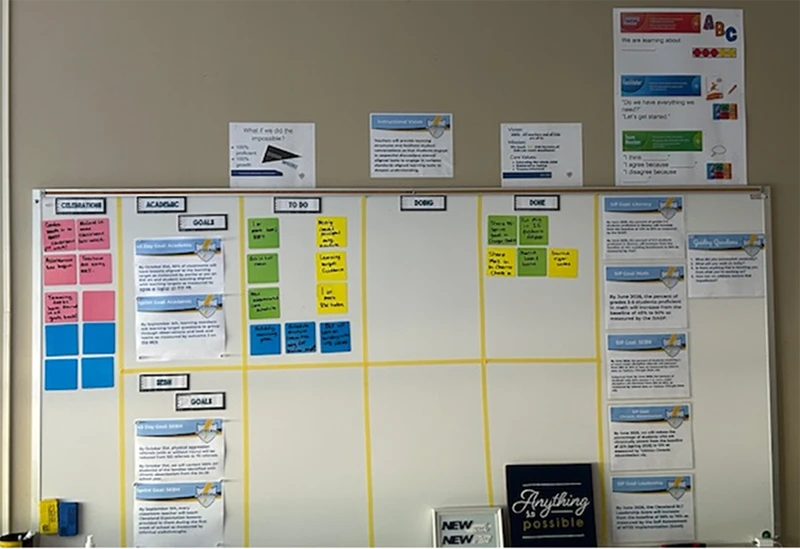
Action Board, Cleveland Elementary School (2025-2026 SY)
RigorWalks: Administrators as Instructional Leaders
Each administrator completed at least 10 classroom visits every two weeks, examining:
- Learning targets: Are they visible? Aligned to Iowa Academic Standards?
- Task alignment: Does the task match the target?
- Teaming structures: Are students working collaboratively?
- Formative assessment: How are teachers and students checking for understanding?
This wasn’t about evaluation—it was about understanding implementation and identifying where support was needed. The data from these walks informed professional development, coaching priorities, and Action Board goals.
Look & Learns: Non-Evaluative Feedback
Look & Learns provided teachers with actionable, non-evaluative feedback on implementation of the model, creating a culture of continuous improvement rather than judgement.
Instructional coaches used these observations for coaching cycles, giving teachers very targeted and specific feedback on what levers they were hitting and touch points to work on improving their implementation.
What Are Look & Learns?
Look & Learns transform classrooms into spaces for collaborative professional growth through low-stakes feedback.
How Look & Learns deliver results:
- Led by coaches, fellow teachers, or school leaders in a supportive, non-evaluative way
- Helps educators see student skill development come to life
- Enables on-the-spot professional learning and adjustments for a greater impact on student learning
- Teachers can earn Implementation Badges that recognize their classroom’s transformation, confirmed by evidence of student growth
Cohort Coaching: Leaders Learning Together
Cohort coaching for building leaders and instructional coaches ensured that the adults leading the work had their own support system and professional learning community.
Every month at principal meetings, time was built in for professional learning so all principals could network and learn from each other. District leaders looked at trends across the district and identified areas needing additional professional learning or growth, ensuring those points were touched every month.
“Instructional Empowerment has transformed our classrooms by guiding teachers to engage students in rigorous, meaningful tasks that promote rich discourse. Students are now more connected to learning than ever before. They are engaging in higher-level thinking, holding one another accountable, and building trust and a sense of safety within their learning teams.”
– Kamber Boeckmann, School Improvement Coach, Cedar Rapids Community School District, Iowa
Subscribe for curated education insights delivered every two weeks.
Districtwide Results: One Year of Impact
After one year of implementation, the data told a clear story: students showed up, stayed engaged, and learned at accelerated rates.
“I have seen more students take on leadership within their teams. I have also noticed that students will hold others in their group accountable. They are more apt to solve their own problems using norms, and are beginning to embrace ideas that come from other team members, which makes them feel part of something.”
– Holland Eggert, 5th Grade Teacher, Kenwood Leadership Academy, Iowa
Students Show Up: Chronic Absenteeism Drops
The first indicator of success wasn’t a test score—it was attendance. When students are genuinely engaged and feel they are part of a team that needs them, they want to be in school.
The Applied Research Center used publicly available data for the following analysis of chronic absenteeism rates to determine whether schools implementing the Model of Instruction for Deeper Learning saw a reduction in chronic absenteeism.
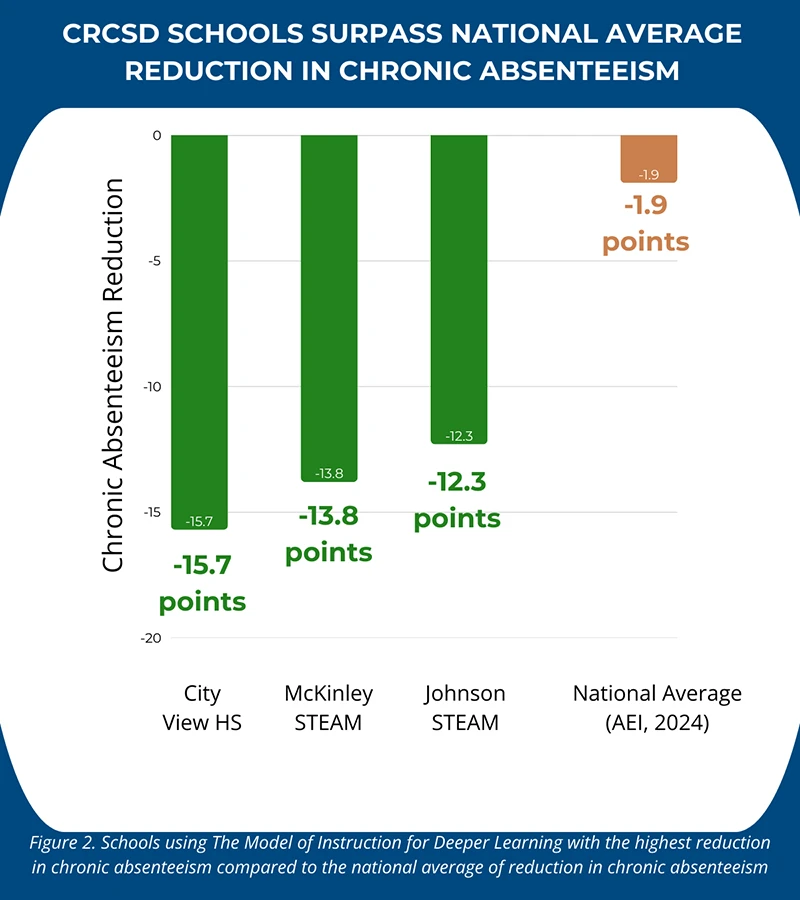
After a year of using the Model of Instruction for Deeper Learning, the schools receiving intensive support (listed in Figure 1) saw a reduction of at least 5 percentage points in chronic absenteeism, with an overall 9.2 average percentage point reduction across the schools. For comparison, the national average reduction in chronic absenteeism in 2023-2024 was 1.9 percentage points (Malkus, 2024).
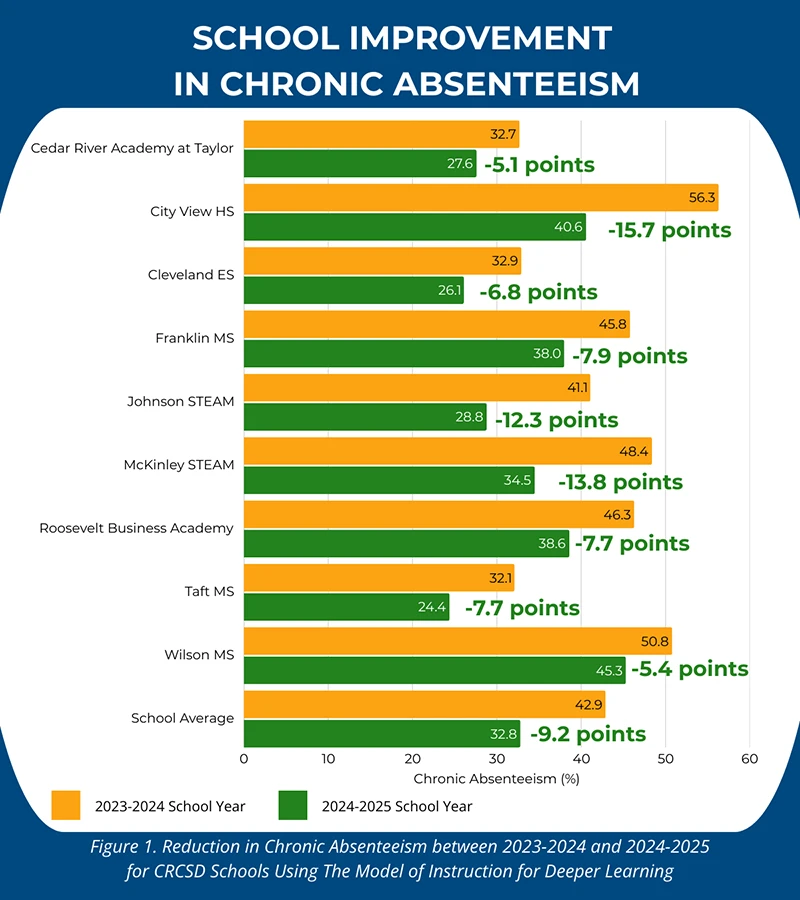
The schools with the highest reduction in chronic absenteeism (Figure 2) included:
- City View High School: -15.7 percentage points
- McKinley STEAM Academy: -13.8 percentage points
- Johnson STEAM Academy: -12.3 percentage points
“When students are engaged in their learning, they want to come to school and they want to be part of the team,” explained Dr. Hobson. “I have heard in classrooms where students are saying, ‘we missed you yesterday, you missed a great activity we did as a team.’ So, students don’t want to miss out.”
Fewer Students Receive Referrals
Shared with the CRCSD Board of Education on September 22, 2025, district data showed several schools had at least one grade level decrease their major referrals by 10% or larger for the 2024-2025 school year. This decrease was compared to the 2023-2024 school year numbers, prior to the partnership with Instructional Empowerment.
Schools with significant referral reductions:
- Cleveland Elementary School
-
-
- Decreased overall by 27%
- 3rd grade decreased by 50%
-
- Franklin Middle School
-
-
- Decreased overall by 24%
- 6th grade decreased by 38%
-
- Van Buren Elementary School
-
-
- Decreased overall by 29%
- 2nd grade decreased by 72%
-
- McKinley STEAM Academy
-
- Decreased overall by 6%
- 6th grade decreased by 29%
Cleveland Elementary Principal Condra Allred shared, “Our third grade going into fourth grade have decreased [in behavior referrals] so much because we had two teachers in third grade that were heavily invested in getting a lot of coaching and so I believe that their commitment has only made going into fourth grade better. You can see the difference between third and fourth.”
Dr. Hobson also credits these referral decreases to schools and teachers implementing the model and student teaming. “We’re seeing when students are engaged in their learning, we’re seeing their behaviors are changing in the classroom because they want to participate and don’t want to let anybody down.”
“The Model of Instruction has improved student behavior in my classroom by boosting engagement and increasing student participation. I have noticed students hold each other accountable by asking questions, encouraging each other to contribute equally, and supporting peers to stay on task. They don’t want to let each other down.”
– Lindsey Cliburn, Third-Grade Teacher, Cedar Rapids Community School District, Iowa
Exceptional Math Performance and Meaningful ELA Progress
CRCSD schools demonstrated exceptionally strong math performance across all levels. Math continues to be a strong and consistent area of growth for schools implementing the model.
i-Ready end-of-year data showed:
- Grades K-5: Students performed 25% above national norms
- Grades 6-8: Students exceeded national norms by an astounding 83%
State assessment results showed:
- Districtwide math proficiency increased 5.3 percentage points
- Students in classrooms implementing the model performed 18% above the district average and exceeded national norms
The two schools that showed the highest gains on the state assessment, according to Instructional Empowerment’s analysis, were:
- City View High School
-
-
- Math: +19.5 percentage points
- ELA: +17.3 percentage points
-
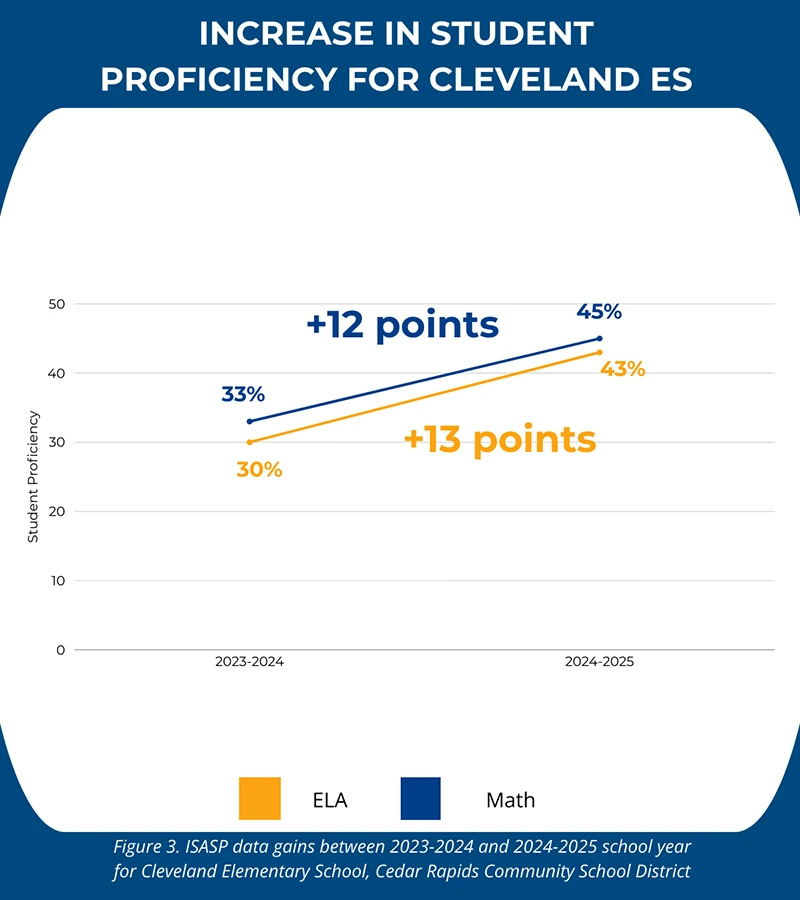
- Cleveland Elementary
-
- Math: +12.4 percentage points
- ELA: +13.2 percentage points
- Overall student proficiency jumped from 30% to 43% in ELA and 33% to 45% in math
At Cleveland Elementary, the transformation was visible not just in scores, but in classroom practice. Teachers had worked hard on Tier 1 practices and PBIS structures to create safe environments, but adding teaming structures took engagement to a new level.
Teachers coached student facilitators to ask questions instead of teachers asking all the questions, directing the classrooms to function as student-led rather than teacher-directed.
“This is a huge celebration at Cleveland,” Principal Allred told the board. “We increased 14.36% in literacy alone. And then our math increased by 11.49%. Teaming had a lot to do with that. Our classroom structures have completely changed.”
The current fourth graders—last year’s third graders who had been early implementers—started the 2025-2026 school year at 67.5% proficient in literacy. “We have never had a class start that high at the beginning of the year,” Principal Allred noted. “We’re hoping we can get them to 80%. It’ll be challenging, but we think we can do it.”
While math showed the strongest gains, ELA performance also improved meaningfully across the district.
State assessment results showed:
- Proficiency increased by 2.5 percentage point gains
Closing Achievement Gaps: Results for All Students
For district leaders, closing achievement gaps is central to the mission. The results demonstrate that high-rigor, student-led learning benefits all students and closes gaps for English learners, students with disabilities, and Black and Hispanic students.
Kenwood’s Remarkable Gains
Principal Westercamp shared Kenwood Leadership Academy’s district and publicly available data gains with the Board of Education in June 2025.
Black/African American Students:
- ELA proficiency: 36% to 57% (+21 percentage points)
- Math proficiency: 36% to 48% (+12 percentage points)
- Science proficiency: 13% to 40% (+27 percentage points)
Students with IEPs:
- ELA proficiency: 10% to 31% (+21 percentage points)
- Math proficiency: 21% to 41% (+20 percentage points)
- Science proficiency: 0% to 36% (+36 percentage points)
English Learners:
- ELA proficiency: 24% to 38% (+14 percentage points)
- Math proficiency: 18% to 50% (+32 percentage points)
- Science proficiency: 0% to 20% (+20 percentage points)
These results showcase the power of principal-driven implementation and what’s possible when every student has access to rigorous and collaborative learning.
“When instructional barriers come down and engagement goes up, achievement follows. That is exactly what we are seeing across CRCSD.”
– Dr. Tawana Lannin, Superintendent, Cedar Rapids Community School District, Iowa
Districtwide: Accelerating Growth for Black Students
Black student proficiency increased in both ELA and math across schools implementing the Model of Instruction for Deeper Learning, with math showing the strongest overall gains.
- Math proficiency increased by 5.9 percentage points districtwide
- ELA proficiency increased by 2.5 percentage points
The two schools that showed the highest gains for Black students, according to Instructional Empowerment’s analysis, were:
- McKinley STEAM Academy
-
-
- ELA: +4.76 percentage points
- Math: +14.47 percentage points
-
- Taft Middle School
-
- ELA: +7.34 percentage points
- Math: +5.60 percentage points
i-Ready Achievement Gap Closures
The i-Ready end-of-year data revealed consistent patterns of accelerated growth for Black and Hispanic students and students with disabilities:
- Math (Black vs. Non-Black Students)
-
- 2nd grade: 20% gap closure
- 6th grade: 12% gap closure
- 8th grade: 33% gap closure
- Math (Hispanic vs. Non-Hispanic Students)
-
- 1st grade: 100% gap closure
- 4th grade: 41% gap closure
- 7th grade: 17% gap closure
- Math (Students with Disabilities)
-
- 8th grade: 6% gap closure
- ELA (Black vs. Non-Black Students)
-
- 6th grade: 10% gap closure
State Assessment Gap Closures
Students from low socioeconomic backgrounds showed remarkable progress:
- Math: Up to 39% gap closure (4th grade)
- ELA: Up to 53% gap closure (4th grade)
English Learners demonstrated strong growth:
- Math: Up to 27% gap closure (5th grade)
- ELA: 6% gap closure (4th grade)
Black students showed meaningful gap closures across multiple grade levels:
- ELA: 8% for 4th grade, 5% for 5th grade, and 22% for 11th grade
- Math: Up to 38% in 11th grade
These results indicate that the Model of Instruction for Deeper Learning helps accelerate growth, while building learning environments suitable for ALL students, across all schools.
“Congratulations to the entire team. When the board looks at new initiatives and we take our vote, sometimes there is trepidation. Change is difficult and sometimes a little scary to adopt something new. We have the data; we have the results that taking that risk and doing something proactive pays off.”
– Cindy Garlock, Board President at Large, Cedar Rapids Community School District, Iowa
Looking Ahead
The district’s focus remains clear: creating team-based learning structures where every student becomes a trusted peer and problem solver, and a leader of their own learning.
“Instruction Empowerment has taken over my classroom! My students have grown so much in their academics, behavior, and social skills! IE is the best thing that has happened to my teaching. I love how it impacts student engagement, influences higher order thinking, and overall confidence!”
– Montana Morabito, 5th Grade Teacher, Trailside Elementary, Iowa
About Instructional Empowerment
Instructional Empowerment’s mission is to end generational poverty and eliminate achievement gaps through redesigned rigorous Tier 1 instruction that ensures deeper learning for ALL students.
We partner with school and district leaders to build schools’ capacity and instructional systems. Our goal is for schools to achieve rapid, measurable outcomes for their students by focusing on rigorous classroom instruction and deeper learning.
Learn more about us: https://instructionalempowerment.com/about/
References
Cedar Rapids Community School District. [EngageCRschools]. (2025a). Board of Education Meeting – June 9, 2025 [Video]. Youtube. https://www.youtube.com/live/kCPias8VjHk
Cedar Rapids Community School District. [EngageCRschools]. (2025b). Board of Education Meeting – September 22, 2025 [Video]. Youtube. https://www.youtube.com/watch?v=zGjcwKxd3 0&list=PL6oucTXO2CwJHqFm9wGpIzuosA75Qmdp3&index=8
Cedar Rapids Community School District. (2025). District Data. https://crschools.us/about/quick-links/district-data/
Geduld, A. (2025). K-12 Chronic Absenteeism Rates Down from Peak, But Remain Persistently High. The 74. https://www.the74million.org/article/k-12-chronic-absenteeism-rates-down-from-peak-but-remain-persistently-high/
Hobson, M. and Westercamp, J. (2025). Model of Instruction: Instructional Empowerment [PowerPoint slides]. Google Docs. https://docs.google.com/presentation/d/12CXTxyQAWPyBWDK68E7M9pbC_IGWGiN8myM_MhYqJHY/mobilepresent?slide=id.g35fa7152dca_9_44
Instructional Empowerment Applied Research Center (2025). Analysis of Academic Growth and Reduction in Chronic Absenteeism in Iowa K-12 Schools. [Unpublished.]
Malkus, N. (2024). Long COVID for Public Schools: Chronic Absenteeism Before and After the Pandemic. American Enterprise Institute (AEI). https://www.aei.org/research-products/report/long-covid-for-public-schools-chronic-absenteeism-before-and-after-the-pandemic/
Iowa Department of Education. (2025). PK-12 Education Statistics https://educate.iowa.gov/pk-12/data/education-statistics
Iowa Department of Education. (2025). Iowa Academic Standards. https://educate.iowa.gov/pk-12/standards/academics
Iowa Department of Education. (2024). Iowa School Performance for Cedar Rapids Community School District. https://www.iaschoolperformance.gov/ECP/StateDistrictSchool/DistrictSummary?k=8929&y=2024
Subscribe for curated education insights delivered every two weeks.
About Instructional Empowerment
Our mission is to end generational poverty and eliminate achievement gaps through redesigned rigorous Tier 1 Instruction that ensures deeper learning for ALL students.