Results & Research · Our Results

Our results are published, including in peer-reviewed journals.

Every product and service is tested by our Applied Research Center using U.S. Department of Education What Works Clearinghouse standards. Here’s what partner schools have achieved.

Browse every study in the Research Index
The evidence base

Studies behind the results.

Large-sample and comparison-group research from the Applied Research Center. Each card links to the full study.

Matched comparison · built to ESSA Tier 2 design featuresColorado Springs D11 · 2026
+22.4ELA points on STAR(+18.2 in math)

Students of teachers with verified implementation outscored matched comparison students, about 55% and 35% of typical annual growth (ELA p = .045, n = 357; math p = .011, n = 449).

Read the study
Quasi-experimental · WWC Design Standards with ReservationsDes Moines Public Schools · 2019
+15%more reading growth than expected(21 extra days of learning)

Six Des Moines schools in their second year of partnership, within a study of 22 schools and 10,431 students.

Read the study
ESSA Tier 3 · Promising EvidenceRigorWalk · 2026
+4–5ELA proficiency points(+5–6 in math)

In 82 schools across 12 districts and 9 states, stronger gains in instructional rigor were associated with these increases within one year, adjusting for socioeconomic and English-learner status.

Read the study
Applied Research Center analysisCedar Rapids, Iowa · 2025
+4.38more FAST ELA pointsat 70%+ progress toward verification

Across 6,200 elementary students in 318 classrooms, students whose teachers had at least 70% progress toward the 101 Implement badge outperformed students whose teachers had made none (p = .04).

Read the study
Closing gaps for every student

Impact across student groups, documented.

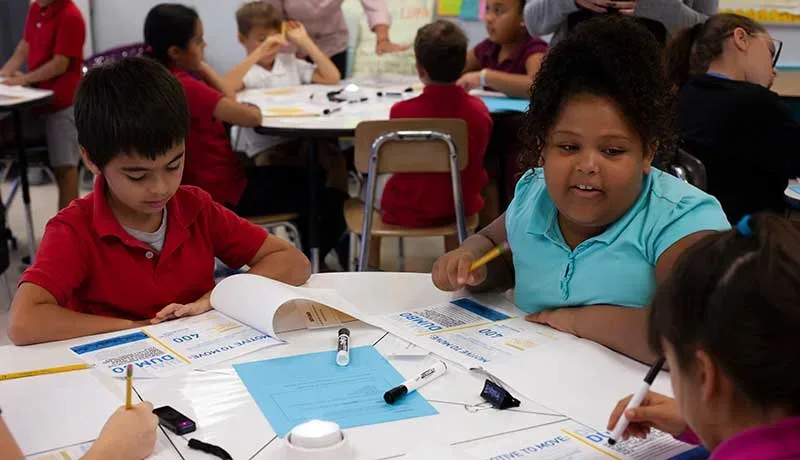
Multiple studies, including a 10,000-student study, document gap closures for English learners, students with disabilities, Black and Hispanic students, and students from low-income families when the Model of Instruction for Deeper Learning® is implemented well.

Students discussing a task around a table
English learnersGaps closed by 6% to 47% in ELA and 4% to 74% in math across four districts, 2023 to 2025.English Learners Are Capable of More (2025) Des Moines 10,000-student study (2019)
Students with disabilitiesGaps closed by up to 58% in ELA and up to 90% in math in elementary grades, and up to 92% in math in middle grades. At Des Moines North High School, the special-education graduation rate rose 16.42 points.Why Students with Disabilities Are Still Left Out (2025)
Black and Hispanic studentsCedar Rapids closed achievement gaps for Black students by up to 38% in math and 22% in ELA. McLaughlin Middle School narrowed gaps for Black and Hispanic students while exiting Comprehensive Support status.Cedar Rapids case study (2026) McLaughlin Middle School (2021)
Students receiving free and reduced lunchCedar Rapids closed gaps for low-income students by up to 39% in math and 53% in ELA. Lakewood Elementary narrowed gaps for low-income students while moving from the lowest-rated schools in Florida to the top 6%.Cedar Rapids case study (2026) Lakewood Elementary (2021)
Beyond test scores

Attendance, behavior, retention, and well-being.

Attendance5.6 pointsmedian reduction in chronic absenteeism79% of 76 schools reduced chronic absenteeism. The median reduction was more than twice the national average.Absenteeism brief (2025)
Behavior288 to 36office-managed referrals at Willard K–6, 2021 to 2024An 87.5% reduction in three years.Willard K–6 (2025)
Teacher burnoutr = −.38implementation and teacher burnoutAcross 570 teachers in 76 schools, higher implementation was associated with lower burnout.Teacher burnout brief (2025)
Teacher retention30% to 97%retention in two years at Lakewood ElementaryTeacher vacancies fell from 23 to 1 over three years.Lakewood Elementary (2021)
Student well-beingr = .594team learning and student well-beingAcross 1,112 students in grades 3–12 in Colorado Springs, more team learning was associated with higher well-being.Well-being study (2026)
The Applied Research Center

Transparent research that holds us accountable.

The Applied Research Center designs its studies rigorously and works with an Advisory Council and outside university co-authors to test and strengthen its work. We publish in open-access peer-reviewed journals so anyone can read our research.

Rigorous, transparent methods
Our studies use quasi-experimental and correlational designs, with matched comparison groups where possible. We share our methods so anyone can examine them.
External Advisory Council
National researchers outside Instructional Empowerment give input and feedback on our research.
Academic co-authors
We co-author studies with university researchers who are not part of Instructional Empowerment.
Tested multiple ways
We analyze results several different ways to reduce bias and check that findings stay consistent across districts and methods.
Peer-reviewed research

Published in peer-reviewed journals.

Our researchers publish in peer-reviewed journals, including a study of schools with no relationship to Instructional Empowerment.

SAGE Open · 2024Rigor Appraisal and coaching tied to achievement and climateBasileo et al. · 53 schoolsRead the study
Frontiers in Education · 2024Self-efficacy, motivation and academic achievementBasileo et al. · 2,359 students, GermanyRead the study
Quality Education for All · 2024Early adopters and the implementation of education innovationsBasileo & Lyons · 568 teachers, 8 districtsRead the study
Discover Education · 2026Leadership style and teacher adoption of innovationBasileo et al. · 422 educators, 7 statesRead the study
Journal of Educational Psychology · ForthcomingAutonomy-supportive leadership and teacher burnoutLyons et al. · 570 teachers, 7 statesAccepted for publication
International Journal of Leadership in Education · ForthcomingAutonomy-supportive leadership and teacher innovativenessBasileo et al. · 1,408 teachers, 71 schoolsAccepted for publication
In their own words

Hear from educators and students.

Students, teachers, and leaders from partner schools and districts describe what team learning looks like in their classrooms.

What Academic Discourse Sounds Like: Inside Deeper Learning Classrooms

Elementary, middle, and high school classrooms

Academic discourse is built through intentional team structures. Watch students in elementary, middle, and high school classrooms share ideas, cite evidence, and respectfully challenge different perspectives.

Read the transcript

Student A: My opinion is a bit different from yours. Over here it says, “We must always take sides — neutrality helps the oppressor.” But that isn’t inherently true, because sometimes both sides did something bad. So who would you help?

Student B: I understand — but I want to counter you. Wait, where was that again?

Student A: Page 260, paragraph 8, in the middle: “We must always take sides... to help the oppressor.”

Student B: So you’re saying that’s for a situation where there’s a clear oppressor and a clear victim — and sometimes there is, there are a lot of situations like that. When there’s an oppressor and a victim, there’s a good side and a bad side, and you can take sides. I understand what you’re saying, but I think that passage is more about a situation where a victim hasn’t done anything wrong.

Student C: I’d like to connect with what you both said, because I understand where you’re both coming from. In most wars, there’s a case where both sides have done something wrong.

Student D: ...then, yeah, they could probably pay it off. Actually, over fifty percent of students drop out of college because they can’t afford it. That’s over half.

Student E: Yeah, that’s over half.

Student D: Right — so like [classmate] said, over fifty percent of students drop out of public universities because they can’t afford it. If at least half of it were free, parents and students would feel a lot more relaxed about fees and bills.

Student E: So people who have jobs would have to pay taxes for a random person to go to college. If college were free, that wouldn’t happen, because they’d already have the money to pay for it themselves.

Student D: But where’s the money going to come from?

Student E: Because they went to college, they’d get a good job and be able to pay it back.

Student D: Yeah, but they haven’t paid for it yet. Colleges would lose money — and if the student doesn’t pay for it, who does? Some random person they don’t even know?

Student E: Yeah, basically.

Student D: But that’s not fair — a random person having to pay for someone they don’t even know to go to college. You should be the one paying, because you’re the one getting the experience, not someone who already graduated.

Student E: Yeah, but here’s the thing...

Student F: We need to figure out another key detail. Does this one work? No — so now we have to think of another one. Does it support the topic, or does it not?

Student G: When volcanoes erupt, it may make the weather change and become chilly outside.

Student F: Okay, yeah — I do think that’s right, but it doesn’t say everywhere. It just says some areas of the world. It doesn’t get cold in every area — just some.

Student G: I was confused because you said it gets cold outside.

Student F: Right, but maybe it just gets cold where the volcanoes actually are.

Student E: ...it’s the spider — the spider is trying to get the fly to come to him so he can eat the fly.

Student D: I didn’t think that.

Student E: He said, “Will you walk into my parlor?” He’s asking him to walk in.

Student D: Oh, now I get why they said “parlor” — the spider is saying to come into his home, where he lives, where he sleeps.

Student E: So let’s go back to the text and see who it really is.

Student A: Which one do you think grew faster — Friend Two or Friend Three? Take a guess, and then back it up.

Student B: Friend Three.

Student A: Why? Look at your data — everything you need to know is right there.

Student B: This one?

Student A: No, the other one.

Student C: It took two weeks to grow four inches. This one took six or seven weeks to grow six inches.

Student D: So you think this one’s bigger because it only took two weeks to grow four inches?

Student A: I think Eduardo is on to something.

Students and Educators at Metcalfe Elementary on Team Learning

Alachua County Public Schools, FL

At Metcalfe Elementary in Alachua County Public Schools (Florida), a fourth-grade teacher, fourth- and fifth-grade students, two assistant principals, and a literacy specialist and coach describe what team learning looks like in their classrooms.

Read the transcript

The impact of the students learning, a lot more engagement, a lot more ownership over their work, and a lot more independence. You have kids who normally aren’t able to work at a fourth grade level who are now, even if they can’t write the answer, they’re now being able to explain their answer because they’ve had a chance to talk it through with their teammates. So we’re seeing the work being completed in different ways.

It helps me learn from like, because I’m very much independent, so I don’t really communicate with people. So when I work in teams, it like, helps me communicate with people and it made me smarter.

When I work in teams, I get to hear everybody’s point of view. And when I hear everybody’s point of view, I can get a better understanding and understand my point of view.

I think it’s important to work in teams because you’re better to communicate and you’re better to get a better understanding.

Working in teams is different because when I was in third grade, I used to work by myself a lot because I didn’t like talking to people. But now while I’m in fourth grade, I can actually communicate with people. I’m the facilitator.

I have to get the conversation started.

I like to make sure they understand the question. I make sure they do like, I make sure they stay on time. I make sure we’re not talking too much.

I like the learning monitor one because you get to actually teach people what to do as well and I like teaching.

I would say there is a deeper focus on students and what students are doing even when planning, like not just thinking what the teacher is going to be doing, but how the students, like how they’re going to be engaged, what tasks they’re completing.

One of the things that we’ve implemented so far is the daily stand up, and it kind of gives us a daily focus of what we’re working on, the look fors that we’re going to see and it brings the entire leadership team on one accord.

Our RigorWalks® that we do on a regular basis really have provided an opportunity for us to gauge the level of success of our coaching and our reinforcement of expectations with our teachers.

I think the best part of that is that it’s non evaluative. So we’re looking at trends and things happening across the campus, and we think that we’re really emphasizing the importance of target task alignment and re-referencing the focus board and different things. Whenever we go and we’re able to just kind of pop in and then get a gauge on how things are working on around campus, it really gives us a more realistic view of how effective our support is for our teachers and staff.

Superintendent Michael Gaal on Bringing High-Quality Tier 1 Instruction to Scale

Colorado Springs School District 11, CO

Superintendent Michael Gaal of Colorado Springs School District 11 shares why he chose to partner with Instructional Empowerment to bring high-quality Tier 1 instruction to scale.

Read the transcript

What we had been searching for was an actual model to build district wide on this idea of high quality, best first, or just tier one instruction. What Instructional Empowerment offers us is the actual integrity and the ability to bring that to scale. What are the rubrics? What are the metrics that we need? What are the RigorWalks®? What are the look and learns? What are the Rigor Appraisals®? How do we actually score and hold ourselves accountable to that metaphysical idea?

Nobody disagrees with best first or tier one instruction, but once you get past the end of the philosophy, if there’s nothing underneath that, it crumbles under the individual abilities to deliver it on their own. So it really, Instructional Empowerment brought to us the ability to bring best first, high quality tier one instruction to scale, so we leave nothing to chance for children.

Our researchers

Meet the research team.

About the Applied Research Center
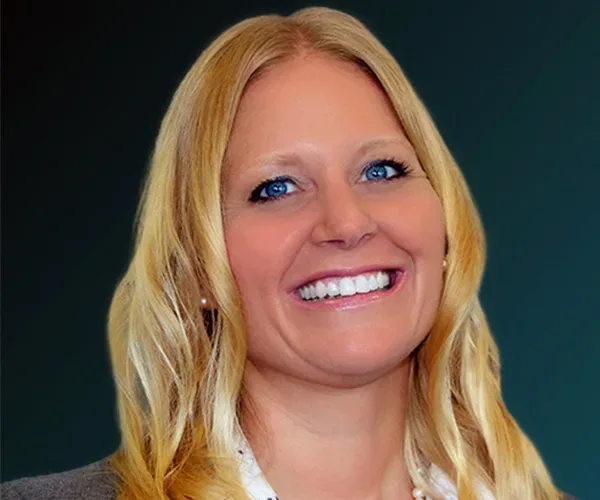
Dr. Lindsey Devers Basileo

Dr. Lindsey Devers Basileo

Director of Research
Dr. Merewyn “Libba” Lyons

Dr. Merewyn “Libba” Lyons

Senior Research Analyst
Research & resources

Insights for school and district leaders.

Visit the Library
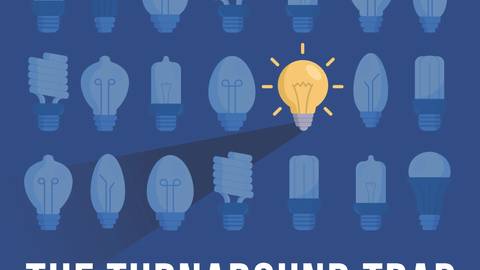
Report The Turnaround Trap: Why Quick Fixes Fail Students Access the report
Article The Missing Piece in HQIM Implementation: How to Get Higher Achievement from Your Existing Curriculum Read the article
Checklist Classroom Walkthrough Impact Checklist Get the checklist
FAQ

Questions about our research.

What do ESSA Tier 2 and Tier 3 mean?

The Every Student Succeeds Act (ESSA) defines tiers of evidence. Tier 2, moderate evidence, comes from well-designed quasi-experimental studies. Tier 3, promising evidence, comes from well-designed correlational studies with statistical controls. The Colorado Springs study was built to Tier 2 design features. The RigorWalk® study and the peer-reviewed Rigor Appraisal® study in SAGE Open are Tier 3.

Do these studies show the products caused the gains?

Most are matched-comparison or correlational studies, which show that results are associated with implementation but cannot prove cause. Case studies describe what happened in a school or district and are not designed to estimate effects. That is why we describe results as associated with implementation.

Which studies are peer-reviewed?

Studies published in peer-reviewed journals are listed in the Research Index, where you can filter by peer-reviewed journal article. Studies that have been accepted for publication, are under review, or are in progress are listed there too, each marked with its status, so the Research Index always shows our current research.

How do I find results for my state, grade levels, or student groups?

Use the Research Index, where you can filter every study by product, state, grade level, student group, and outcome.

Want results like these in your schools?

Connect with an experienced education leader to talk through your goals, your data, and the right starting point — whether that’s a single tool or a full partnership.

Schedule a Free Consultation Explore Products & Solutions