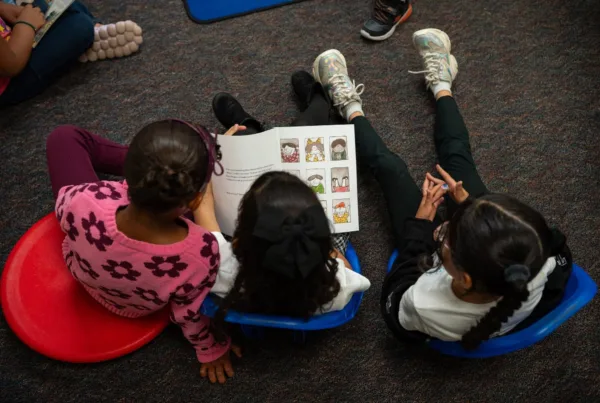
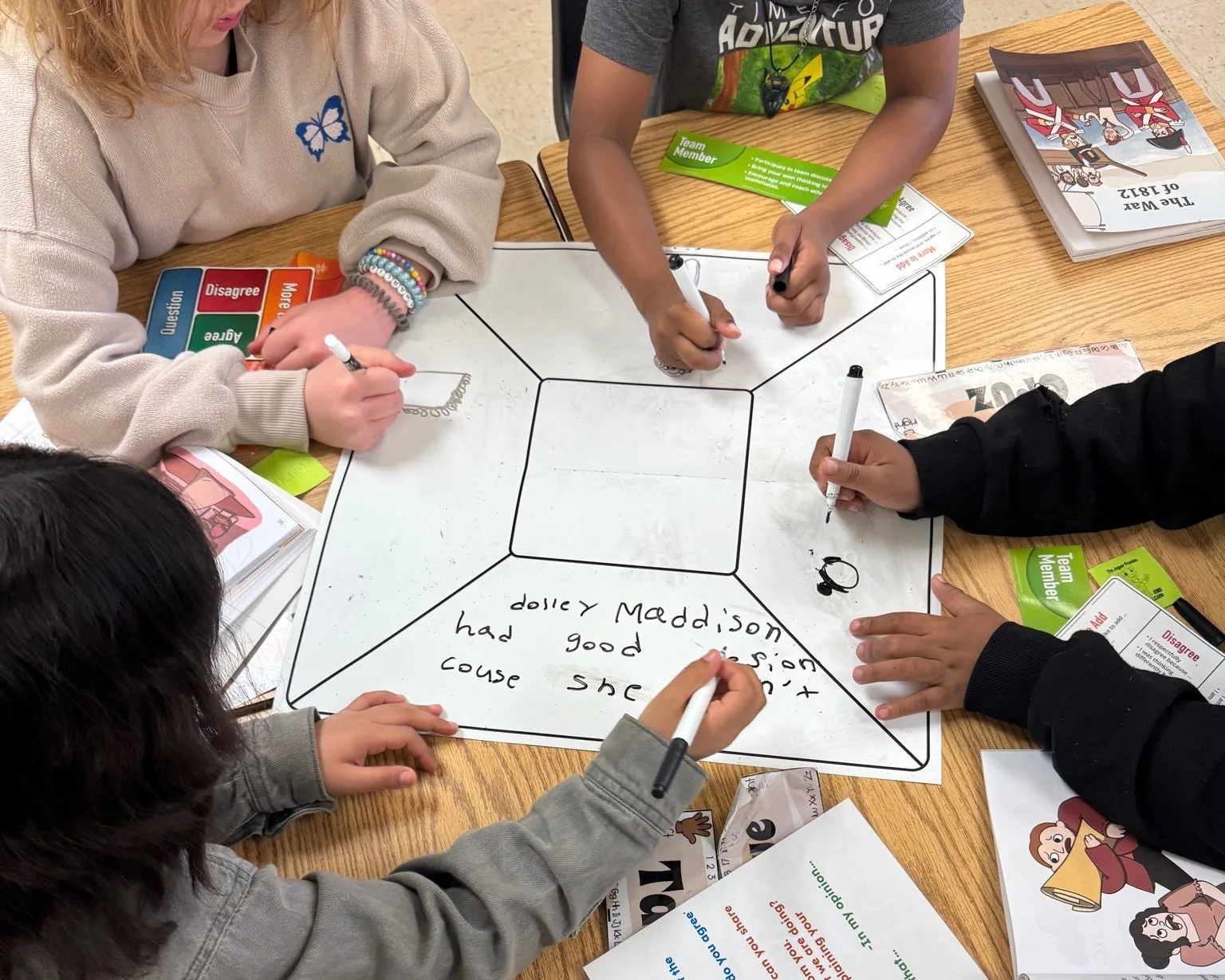
Students at Johnson STEAM Academy in Cedar Rapids, Iowa, work in teams as part of a Tier 1 instruction model designed for deeper learning.
Every classroom, school, and district has its share of strategies and programs aimed at improving student outcomes. However, few invest with the same intentionality in Tier 1 instruction itself.
This article will help you identify the gaps in Tier 1 instruction and how to strengthen your systems so all students can be successful.
What Is Tier 1 Instruction?
There are many misconceptions around what Tier 1 instruction really means. The term is often used loosely in schools and districts and overlaps with other common terms.
At its most basic, Tier 1 instruction can be defined as the classroom learning experiences in which all students participate. Tier 1 instruction does not include special education services, enrichment for gifted students, or academic intervention programs.
Other terms schools and districts may use for Tier 1 instruction (or Tier one instruction) include:
- Classroom instruction
- Universal instruction
- Core instruction
- The instructional core
- Foundational instruction
- Primary instruction
- Best first instruction
In this article, we’ll break down a more nuanced meaning of Tier 1 instruction, including what makes it effective or ineffective and how it can be redesigned so that every student experiences deeper learning.
But first, it’s useful to clarify what Tier 1 instruction is not.
Common Misconceptions: What Tier 1 Is Not
At Instructional Empowerment, we often hear common misunderstandings across the schools and districts we partner with regarding the definition of Tier 1 instruction.
To clarify, Tier 1 is:
- Not just core subjects: Tier 1 applies to all subject areas, not just the core content areas of English Language Arts, math, science, and social studies.
- Not a curriculum: The curriculum defines what students learn, while Tier 1 instruction is how students experience their learning.
- Not a program: Tier 1 instruction is not an add-on, initiative, or resource; it is the foundation of instruction.
- Not an intervention: Interventions are part of Tiers 2 and 3.

Understanding What Tiers 1, 2, and 3 Mean in Response to Intervention (RTI)
RTI stands for Response to Intervention and includes tiered instruction in Tiers 1, 2, and 3 (IRIS Center, 2025):
- Tier 1: The daily instruction that all students experience in the general education classroom.
- Tier 2: A standard validated instructional approach or program in a small-group setting of three to five students. Students may miss some Tier 1 instruction time for Tier 2 interventions. Tier 2 may also be referred to as targeted support or secondary instruction.
- Tier 3: Focused on a smaller-group setting of one to three students and/or more frequent sessions than Tier 2 to meet students’ individual needs. Students often must miss Tier 1 instruction time for Tier 3 interventions. Tier 3 may also be referred to as intensive interventions or tertiary instruction.
How Do Schools Determine Which Students Enter Tiers 2 and 3?
In RTI, typically, some type of universal screening is administered to identify students who are not demonstrating proficiency in grade-level content and may need Tier 2 and Tier 3 interventions.
However, a study of data collection and analysis in RTI indicates that, although schools may collect data to screen students for Tier 2 and 3 supports, this data is generally not used to inform student assignment, progress monitoring, or intervention practices (Silva et al., 2020).
Instead, many schools rely on informal observations of how students are performing. They may place students in interventions without knowing precisely why the student is struggling.
Example: How a Simple Tier 1 Adjustment Prevented an Unnecessary Intervention
Senior Research Analyst Dr. Merewyn Lyons shares this example from her time as a classroom teacher:
“I had a fifth-grade student who was reading at a second-grade level. The school wanted to put her in an intervention group, but I discovered as I was testing her that she had difficulty tracking the text with her eyes and so she kept missing words. I talked to the special education teacher, who gave me a tinted piece of plastic that my student could lay on the page and highlight the line she was reading, which helped her. If we had just put her in an intervention group, this problem probably would not have come to light, and she would have stayed in Tier 2 or been placed in Tier 3.”
How Many Students Should Be in Tiers 2 and 3?
The tiers of instruction have recommended guidelines outlining that only about 15-20% of students should be in Tiers 2 and 3 at any time. However, according to anecdotal data, 50% or more of students in some districts are in Tier 3 interventions (Spruell, 2024).
When so many students are in Tiers 2 and 3, this creates the “upside down pyramid” effect (see Figure 1). Shifting the focus to strengthening Tier 1 instruction can prevent the need for Tier 2 and 3 interventions for the majority of students.

Figure 1. Weak Tier 1 instruction causes overreliance on Tier 2 and Tier 3 interventions, creating the “upside down pyramid” effect.
What is RTI vs. MTSS (Multi-Tiered Systems of Support)?
RTI is a type of MTSS (Multi-Tiered Systems of Support). While RTI is focused primarily on academic progress, the broader group of multi-tiered supports can address other areas in addition to academics such as behavior and attendance. Positive Behavioral Interventions and Supports (PBIS) is another example of a multi-tiered approach (IRIS Center, 2025).
It is worth noting that behavior challenges and attendance issues often reflect weaknesses in Tier 1—low engagement, lack of strong peer relationships, or insufficient rigor can be the root causes driving students to act out or miss school. In other words, when Tier 1 is ineffective, the entire system feels the impact.
Subscribe for curated education insights delivered every two weeks.
5 Signs of Ineffective Tier 1 Instruction
Instead of waiting for end-of-year student achievement results, you can proactively identify the red flags that signal ineffective Tier 1 instruction right now. The following section will break down how to analyze your current data for five warning signs.
1. A Large Percentage of Students Are in Tiers 2 and 3
One of the easiest ways to spot ineffective Tier 1 instruction is by noting the percentage of students in Tier 2 or Tier 3 interventions.
As noted above, according to the IRIS Center at Peabody College, Vanderbilt University (2025):
- 80-85% of students should be in Tier 1
- 10-15% of students should be in Tier 2
- 5-10% of students should be in Tier 3
Check your student data; if you have more students in Tiers 2 and 3 than these recommended percentages, it’s a red flag that Tier 1 instruction is not yet fully effective.
As you review your intervention data, consider:
- What percentage of your students are:
-
- In Tier 2 interventions?
- In Tier 3 interventions?
2. Students Remain in Tiers 2 and 3 for Extended Periods
Tiers 2 and 3 are meant to be temporary interventions; students should be able to return to Tier 1 within three months to a year. Yet, we often see students spend multiple years in Tiers 2 and 3. Students often miss out on Tier 1 instruction while in these interventions, creating a vicious cycle in which they never catch up.
It’s a common myth that students must master all previous grade-level content before they are ready to tackle work at their current grade level. Properly planned and implemented Tier 1 instruction can help students bridge learning gaps without the need for interventions.
As you review your intervention data, consider:
- On average, how much time in Tier 2 and 3 interventions are students spending…
- Per day?
- Per year?
- How many of the same students are participating in interventions every year?
3. Achievement Gaps Grow Over Grade Levels
An achievement gap that grows over grade levels rather than shrinks is another sure sign that Tier 1 instruction is not up to par.
Students enter school with a wide range of experiences, skills, and knowledge. But each year they are enrolled in school should be helping to level the playing field through strong Tier 1 instruction.
As you review your intervention data, consider:
- What percentage of students are in Tiers 2 and 3 in each grade level?
4. Behavior Referrals and Suspensions Are High and Not Decreasing
Student behavior data is another key data point to track when determining the effectiveness of your Tier 1 instruction.
Although schools and districts often tackle student behavior and academic achievement challenges separately through different programs and interventions, these issues are highly interconnected.
The academic root causes behind challenging student behavior often include:
- Boredom with low rigor content
- Frustration from being behind grade level
- Feeling overcontrolled with limited agency in a teacher-directed classroom
When Tier 1 instruction is engaging and challenging, students are too busy thinking, discussing, and solving problems to consider other ways to entertain themselves or others.
As you review your data, consider:
- Are behavioral referrals and suspensions increasing, decreasing, or stagnant each month/year?
- Observe a few classrooms: Does the learning environment promote student-led behavior management?
5. Chronic Absenteeism Rates Are High and Not Decreasing
High rates of chronic absenteeism may be another sign that Tier 1 instruction is not engaging and motivating students.
Chronic absenteeism is defined as missing 10% or more school days during the year. School leaders should be especially concerned if chronic absenteeism rates are stagnant or increasing each year.
Being stuck in remediations and isolated from their peers can be a very demotivating situation. In contrast, effective Tier 1 instruction gives students a reason to come to school by creating a learning environment of student-led engagement and intrinsic motivation.
As you review your data, consider:
- What percentage of your students are chronically absent from school?
- Observe a few classrooms: Is the learning environment one where students want to come to school?

The Costs of Ineffective Tier 1 Instruction
When the Tier 1 instruction system is not functioning well, it can create systemic issues across the entire district:
- Negative student outcomes: Students who experience just one year of ineffective Tier 1 instruction often never recover academically—even when they receive high-quality core instruction during subsequent years (Sanders & Rivers, 1996).
- Higher teacher burnout: Teachers frequently cite schoolwide issues, including student behavior and negative school culture, as primary reasons for dissatisfaction and attrition, and retention rates often suffer in schools with low performance (Boyd et al., 2009; Sanderson et al., 2022). Many of these issues stem from weak Tier 1 instruction.
- Increased financial costs of interventions: With a high volume of interventions comes the increased costs of staffing, programs, resources, and diversion of time from other priorities.
- Diminished return on investments: Even the best resources can’t compensate for ineffective Tier 1 instruction, leading to wasted time and money on districtwide initiatives like curriculum adoption that struggle to take hold.
- Loss in student enrollment: One of the most pressing concerns for public schools is losing students and funding as birth rates decline, and more families use vouchers to exit the public school system. Choice providers— sensing families’ discontent with the traditional classroom experience in public schools—often promote their Tier 1 instruction as personalized, hands-on, and student-led. To increase student enrollment in public education, leaders must redesign their schools to become competitive, including strengthening Tier 1 instruction and three other key market share systems to attract and retain families.
The Three Types of Tier 1 Instruction
With a clear understanding of the warning signs of a weak Tier 1 instruction system and its potential impacts, let’s now look at the three types of Tier 1 and the effectiveness of each model.
Many schools and districts fall into the legacy “default” model without realizing there are three types of Tier 1 instruction:
- Teacher-Directed Instruction: The most commonly used “default” model, this type of Tier 1 instruction relies on methods such as whole-group instruction and independent practice. The teacher does the majority of the talking and directs students through activities. Students are expected to listen passively and follow directions, with little to no opportunities for collaboration.
- Teacher-Led Groups: Students participate in group work, with the teacher directing, correcting, and prompting their activities and conversations. Student engagement tends to be higher in this type of Tier 1 instruction compared to teacher-directed instruction as students actively process the content together. However, tasks are typically low rigor and students rarely have the autonomy to engage in productive struggle.
- Student-Led Team Learning: In this model, all students experience deeper learning as they collaborate in teams, engage in rich discourse, and persist through productive struggle. The teacher becomes a coach who designs rigorous tasks that build students’ critical thinking, communication, and teamwork to prepare them for real-world success. Students become leaders of their own learning who can self-regulate their behavior, encourage one another, and push one another’s thinking.

Which of these three types of Tier 1 instruction sounds most likely to create a learning environment where every student can be successful?
The typical teacher-directed experience is—for many students—demotivating, disempowering, and lacking in the support needed to achieve grade-level proficiency without instructional interventions.
In contrast, the student-led team learning model creates an environment where all students can experience deeper learning and receive support within Tier 1 to reach proficiency and beyond.
It’s important to emphasize that Tier 1 instruction is a model of teaching and learning. Redesigning Tier 1 is not a matter of adding more instructional supports, strategies, or interventions onto the traditional teacher-centered model, but instead replacing that model altogether.

How Redesigned Tier 1 Instruction Transforms the Learning Experience
The following are major benefits of effective Tier 1 instruction that cascade through the system, from stronger student outcomes to more empowered teachers and efficient use of resources.
Equips Teachers to Implement a Rigorous Curriculum
Traditional Tier 1 instruction does not equip teachers to activate the rigor in today’s high-quality curricula and curricular resources. No matter how much effort teachers put into lesson planning, what instructional strategies they use, and how hard they try to engage students, the teacher-directed model plateaus in terms of rigor because students are ultimately passive recipients.
The higher levels of rigor called for in the standards require redesigned Tier 1 instruction that:
- Engages students in academic discourse and debate with peers
- Creates frequent opportunities for students to develop fluency with academic vocabulary
- Equips students to transfer their academic knowledge to new situations with less support from the teacher
If teachers attempt to simply increase the level of rigor within the traditional model of Tier 1 instruction, there is a high risk that students will become lost and frustrated. With higher levels of rigor comes the need for more advanced support and structures that ensure all students can access that rigor.
The benefit of redesigned Tier 1 instruction is that it transforms the classroom from teacher-directed to student-led so that all students experience the full intent and rigor of the curriculum. A stronger learning culture also benefits teacher morale, resulting in lower levels of burnout (Basileo, 2025).
Provides Personalized Support for Students Within Tier 1
Another key benefit of redesigned Tier 1 instruction is that the small team setting provides personalized support for all students.
The key to making rigor accessible and reducing the need for Tier 2 and Tier 3 interventions is creating structures in Tier 1 instruction for students to share background knowledge and skills as they work together. Intentional team structures make rich and rigorous discourse possible for all students.
In teams, students often find comprehension easier as they have a chance to process the content together and consider different perspectives and ways of explaining academic concepts. Structures for equal participation are critical to ensure every student is engaged.
“Our discussions with our peers sink into our brains a lot more, so we can remember the information rather than us asking the teacher or the teacher just giving us the information.”
— 8th Grade Student, Grand Island, NE
As students engage in rigorous discourse, learning also becomes more visible to the teacher. Although teachers should be careful not to step in too early and “rescue” students from productive struggle, if teams are truly stuck and struggling unproductively, the teacher can provide an on-the-spot “Tier 1 micro-intervention” to ensure students’ learning begins to move forward. This process of tight monitoring—including micro-interventions where necessary—closes learning gaps before they become significant enough to warrant Tier 2 and 3 interventions.
Giving students the opportunity to collaborate with peers is especially important in settings where students may need extra Tier 1 support with bridging knowledge and skill gaps, such as in Title 1 schools, for students with disabilities, and for English learners. All students bring with them different strengths and unique abilities, and when given the right structures and support, every student will make valuable contributions to their teams.
“One of our ELL students recently said, ‘I can learn so much better when a teammate tells me because I hear a different way.'”
— Jill Burke, Principal, Howe Elementary, Des Moines, Iowa (see The Power of Student Teams, p. 84)
Increases Student Motivation and Engagement
In the typical Tier 1 instruction experience, students are often given tasks to complete without understanding the purpose behind their learning. The teaching style is often directive and highly controlling, especially at the middle and high school levels. This creates a demotivating learning environment where students will either passively comply or rebel out of frustration.
The number of students who reported absences due to boredom and giving up has grown since the pandemic, and these “disengagement”-related absences increased as students progressed from elementary to middle to high school. 28% of high schoolers in Rhode Island public schools reported missing school because they were bored or had given up (Gee et al., 2025).
According to another study of students from 3,000 schools, students became more disengaged the longer they were in school. 74% of fifth-graders were engaged in school, while the number dropped to 34% by twelfth grade (Calderon & Yu, 2017). See Figure 2.

Figure 2. Student engagement drops considerably as students progress from 5th to 12th grade.
In contrast, redesigned Tier 1 instruction shifts the learning environment from extrinsic to intrinsic motivation so that every student is engaged. Students take an active role in their teams and intentionally develop agency skills—the ability to self-direct their own learning.
In redesigned Tier 1 instruction, students:
- Establish worthy goals
- Organize their actions toward goals
- Self-reflect on progress
- Develop persistence
Students with agency become their own agents of change for self-improvement and advancement. These are the skills all students need to be successful in school and in life.
“When students are engaged in their learning, they want to come to school, and they want to be part of the team. I have heard in classrooms where students are saying ‘we missed you yesterday, you missed a great activity we did as a team.’ So students don’t want to miss out.”
— Dr. Maura Hobson, Chief of Schools + Curriculum & Instruction, Cedar Rapids Community School District, IA (Board of Education Meeting, June 9, 2025)
Example: High School Students’ Experience in Tier 1
Westside High School students in rural West Virginia expressed concerns to their new principal that they were not prepared for college and careers. Tier 1 instruction followed the typical teacher-directed model. “Some teachers will just have you do busy work,” one student said.
As the school shifted Tier 1 instruction to student-led team learning, a student remarked, “It has definitely changed, and you want to be here.” Westside’s adoption of redesigned Tier 1 instruction soon led the way to positive changes across the entire district. Hear students, teachers, and principals discuss the shift in the video below.
What Makes Transforming Tier 1 Instruction Difficult?
The benefits of shifting Tier 1 instruction to student-led team learning are clear. But in practice, this change can be difficult to execute. Just putting students into teams and expecting their learning to transform is not an effective approach.
Perhaps the most difficult aspect of student-led learning is planning for true academic discourse, which goes far beyond familiar instructional strategy examples such as “turn and talk.”
Academic discourse is essential to building knowledge and opens students’ opportunities to enter cognitively demanding professions in science and engineering (National Academies of Sciences, Engineering, and Medicine, 2022).
Teachers have rarely ever received Tier 1 training in academic discourse and may, understandably, struggle to help students elevate their conversations beyond surface-level interactions. Academic discourse requires careful task design and classroom structures for deeper learning.
Task Example: Surface Learning vs. Deeper Learning
Learning Target: I can use evidence to explain how sunlight affects plant growth.
Example of “Turn and Talk”:
Student A: “Group 1 grew taller.”
Student B: “Yes, I wrote that down too.”
Student A: “So sunlight makes plants grow.”
Student B: “Okay, I’ll circle that one too.”
(They both return to filling in the worksheet.)
Why This Is Surface Learning:
Students are exchanging answers, not ideas. They are talking and participating, but the task and team structures are not set up in a way that challenges them to figure something out together.
Example of Academic Discourse:
Student A: “The plants in full sunlight grew the tallest. That supports our hypothesis that light gives them more energy for photosynthesis.”
Student B: “But if sunlight was the only factor, Group 3 wouldn’t have grown as much—they got less light but almost the same height. I think water might be more important than light.”
Student C: “Where is your evidence for that idea? Look at the averages—Group 1 had more sunlight and more growth. The water levels were the same.”
Student D: “Well, maybe the key isn’t more water or more light, but both. We could test that next time by changing just one variable.”
Student A: “Yeah, that might tell us which factor actually causes more growth.”
Why This Is Deeper Learning:
Students use evidence, reasoning, and disciplinary language (“photosynthesis,” “variable,” “average”) to challenge and refine each other’s thinking. The task is designed for this level of conversation and students have learned the structures, routines, and resources to be able to interact in this way.
Bottom Line:
The same students who exchange brief answers on a worksheet are fully capable of analyzing, debating, and defending ideas when the classroom environment and task are designed for it.
Steps for Moving Forward with Redesigned Tier 1 Instruction
Redesigned Tier 1 requires not only shifting instruction in the classroom but also making shifts at a leadership level. Simply mandating teachers to implement the student-led team learning model will fail without the training and support to make the shift possible.
The Model of Instruction for Deeper Learning ® provides a step-by-step guide for teachers to design rigorous tasks for academic discourse and shift Tier 1 instruction to student-led team learning. In 16 weeks, the classroom transforms with higher engagement and deeper learning.
The following steps can help leaders reflect, plan, and decide how best to improve their Tier 1 system.
| Step 1 | Step 2 | Step 3 |
|---|---|---|
Plan Out Your Priorities for Tier 1 Instruction
|
Consider What Your Leaders and Teachers Need for Success
|
Find the Right Supports for Your School or District
|
Strengthening Tier 1 instruction is the most powerful lever a classroom, school, or district has to improve outcomes because it changes the learning experience for every student, every day. When core instruction is effective, the entire system moves from reaction to coherence.
About the Authors
Merewyn Lyons, Ed.D.
Merewyn Lyons, Ed.D. is a Senior Research Analyst with Instructional Empowerment’s Applied Research Center. Her primary research interest is educational psychology, with a focus on understanding the effect of motivation on teaching, learning, and educational leadership. She is co-author of peer reviewed articles in Frontiers in Education, Quality Education for All, and Sage Open. Dr. Lyons is a member of the Center for Self-Determination Theory, the American Educational Research Association, and the European Association for Research on Learning and Instruction. She is also a retired officer of the United States Navy and a retired K-12 educator.
Michael D. Toth
Michael D. Toth is founder and CEO of Instructional Empowerment (IE) and leads IE’s Applied Research Center. He is also the author of the multi-award-winning book The Power of Student Teams with David Sousa; author of Who Moved My Standards; and co-author with Robert Marzano of multiple books. Most recently, he co-authored peer-reviewed research articles published in academic journals in collaboration with researchers Lindsey Devers Basileo, Merewyn Lyons, Barbara Otto, and Natalie Vannini. Michael is a keynote speaker at conferences and coaches superintendents on creating a bold instructional vision, designing and launching a high-functioning cabinet team, transforming Tier 1 core instruction, and leading systems-based school advancement.
Learn more about Michael: https://instructionalempowerment.com/ie-founder-michael-d-toth/
References
Basileo, L.D. (2025). Applied research center brief: Reduced teacher burnout with a model that improves school culture. Instructional Empowerment. https://instructionalempowerment.com/library/teacher-burnout-research-brief/
Boyd, D., Grossman, P., Lankford, H., Loeb, S., & Wyckoff, J. (2009). Who leaves? Teacher attrition and student achievement [CALDER Working Paper 23]. National Center for Analysis of Longitudinal Data in Education Research. https://www.urban.org/sites/default/files/publication/29796/1001270-who-leaves-teacher-attrition-and-student-achievement_1.pdf
Calderon, V., & Yu, D. (2017). Student enthusiasm falls as high school graduation nears. Gallup. https://news.gallup.com/opinion/gallup/211631/student-enthusiasm-falls-high-school-graduation-nears.aspx
Gee, K.A., Yu, P., Ansari, A. (2025) Why were you absent? Students’ reasons for missing school before and after the pandemic. American Enterprise Institute. https://www.aei.org/research-products/report/why-were-you-absent-students-reasons-for-missing-school-before-and-after-the-pandemic/
IRIS Center at Peabody College, Vanderbilt University (2025). What is data-based individualization? https://iris.peabody.vanderbilt.edu/module/dbi1/cresource/q1/p01/
National Academies of Sciences, Engineering, and Medicine. 2022. Science and engineering in preschool through elementary grades: The brilliance of children and the strengths of educators. Washington, DC: The National Academies Press. https://doi.org/10.17226/26215.
Sanders, W. L., & Rivers, J. C. (1996). Cumulative and residual effects of teachers on future student academic achievement (Research Progress Report). University of Tennessee Value-Added Research and Assessment Center.
Sanderson, D., Kraft, M. A., Christian, A., & Candelaria, C. A. (2022). Teacher shortages: A unifying framework for understanding and predicting vacancies [EdWorkingPaper 22-684]. Annenberg Institute at Brown University. https://doi.org/10.26300/8t5b-2302
Silva, M. R., Collier-Meek, M. A., Codding, R. S., Kleinert, W. L., & Feinberg, A. (2020). Data collection and analysis in response-to-intervention: A survey of school psychologists. Contemporary School Psychology, 25, 554-571. https://doi.org/10.1007/s40688-020-00280-2
Spruell, S. (2024). Flipped MTSS triangle? Effective strategies for school administrators. https://www.branchingminds.com/blog/how-to-respond-to-an-upside-down-mtss-tiered-triangle
Subscribe for curated education insights delivered every two weeks.
About Instructional Empowerment
Our mission is to end generational poverty and eliminate achievement gaps through redesigned rigorous Tier 1 Instruction that ensures deeper learning for ALL students.