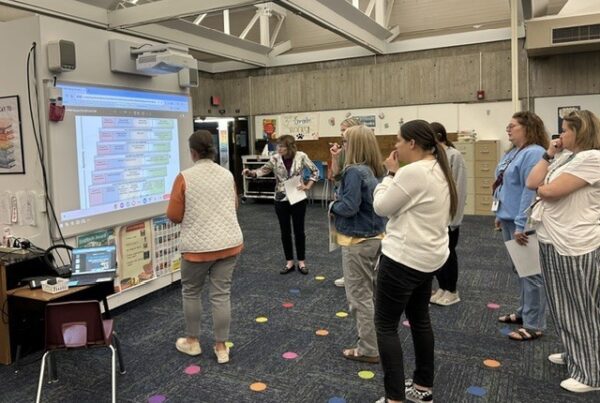
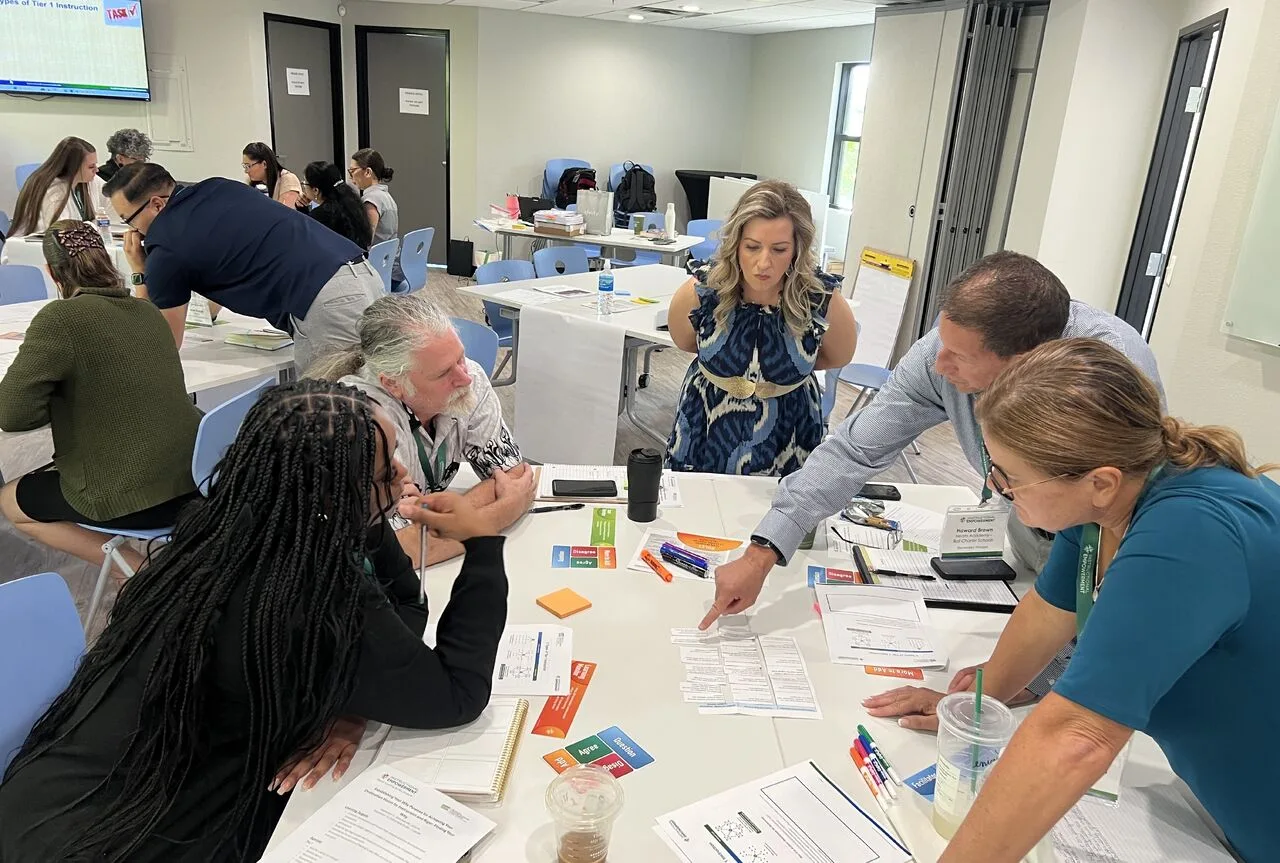
Education leaders in Arizona participate in a workshop focused on Tier 1 instruction, which is one of the four market share systems that equips public schools to retain and recruit students.
By: Michael D. Toth and Michael A. Grego, Ed.D.
Confronting the Student Enrollment Crisis
A profound shift is reshaping American education due to declining birth rates and increased competition: the era of stable enrollment is over, and public schools* now must develop the market share systems to compete for every student.
Explosive growth in homeschooling, charter, micro, and pod schools has dramatically increased the range of educational options available beyond typical private schools. Losing just 100 students to these alternative options can cost a district over $1 million in state funding each year. Tighter budgets mean reduced staffing and program cuts that make public schools even less attractive to families.
For the first time ever, competition for student enrollment isn’t optional; it is existential. If public education is to remain accessible in every community, schools and districts must develop a greater capacity to compete. Understanding the market share systems and critical leadership skills of this new arena will prepare public educators not just to survive, but to thrive.
*The term “public schools” as used in this article refers to traditional public schools.
Are School Closures an Effective Response to Declining Student Enrollment?
While closing a school may seem to be an efficient solution to declining student enrollment, it often accelerates the problem. Many families choose to leave the district entirely rather than be reassigned, and the long-term costs to the district, their students, staff, and communities far exceed the short-term savings.
The Negative Effects of School Closures
- Poorer student outcomes: Research shows that impacts to student outcomes are mixed. Students from closed schools in some districts experienced lower achievement, attendance, graduation rates, and college attendance (Gordon et al., 2018; Larsen, 2020).
- Uneven impact on communities: School closures tend to occur more often in schools with higher populations of Black students and in poorer neighborhoods (Forney, 2017; Brazil, n.d.).
- Less cost savings than expected: An analysis of six large urban districts indicated cost savings were often less than projected and districts incurred costs maintaining vacant buildings (Pew Research Center, 2011).
- Further enrollment loss: Decades ago, when the public education system had little competition, we could assume most families would dutifully comply with reassignment. However, with the level of choice options available to parents, we estimate for every school closure there will potentially be a 10-15% or higher drop in student enrollment from families who are not happy with the closure and reassignment.
How School Closures Can Create “Public Education Deserts”
As more public schools close, the impact on communities mirrors the “nutrition deserts” of low-income neighborhoods. Just as some communities lack easy access to affordable fresh fruits and vegetables, our most vulnerable communities may also lose easy access to the public education system.
When Closures Make Sense—and When They Don’t
When enrollment declines are purely due to a shrinking population of school-age children, closing a school may appear logical. But even then, districts give up the presence and influence of a neighborhood school.
When families leave for other options, the smarter strategy is to bring them back. In many cases, investing in redesigning the school to win back families is more efficient and better preserves community trust compared to closing a school.
Subscribe for curated education insights delivered every two weeks.
Increasing Student Enrollment Isn’t Luck—It’s Strategy
The public school system was never designed for intense competition. For decades, schools had a “captive audience,” but that reality no longer exists. Families now have many choices, and the education landscape has become a dynamic marketplace.
With birth rates falling, there simply aren’t enough students to sustain every public school if districts continue losing students to choice providers. To hold steady or grow, districts must win students from competitors.
Public schools with strong systems for retaining and recruiting students—what we call market share systems—will be the ones that succeed in today’s competitive environment.
Building the Leadership Skills to Win in Today’s Education Market
If you examine any preparation program for education leaders, how much coursework was dedicated to the following areas?
- Business strategy
- Marketing
- Sales
- Public relations
- Customer service
Likely, none of these were required courses. But these are the skills of your private sector competitors.
Public school educators who are experts in curriculum, assessment, interventions, and other academic and operational areas now need to close the gap with their private sector competitors and master a new skill set: market share systems.
Developing the 4 Market Share Systems in Public Schools
Our Applied Research Center identified four interconnected systems that are critical for public schools to retain and recruit students:
- Recruitment: Is your admissions system fed by a high-octane recruitment system?
- Marketing: Is detailed market intelligence and analysis driving differentiated marketing strategies?
- Customer experience: Is your customer experience creating advocates that act as recruiting ambassadors?
- Tier 1 instruction: How do you differentiate your classroom instruction from your competitors?
Districts may feel they’re already doing these things, but competing in a choice-driven market demands a deeper, more strategic approach in each system.

How the Four Systems Work Together
The four interlocking market share systems are reliant on one another. What makes a school strong in today’s marketplace is when all four systems are high-functioning together.
Public school districts have already proven their adeptness in many operational systems such as transportation and food service and in many academic systems such as curriculum and assessment. These are their “core business systems.”
Now districts must become equally skilled at market share systems and begin treating them like core business systems, too. Education leaders will know their market share systems are effective when they begin winning more students from their competitors.
Cautions if You Are Considering Outsourcing Your Market Share Systems
Outsourcing is a tempting approach to relieve the pressure of developing market share systems yourself. Professional marketing, PR, and recruitment agencies are eager to work with schools and districts.
But take abundant caution with outsourcing and consider the potential negative impacts:
- Agencies rely on temporary, canned solutions: Professional agencies rarely have any K-12 experience, and their tactics can fall flat when attempting to apply them to public schools. Their solutions are often short-term and stop working when the market shifts significantly.
- No one knows your market like you do: Typical agencies also lack experience in recognizing the nuances of each school and the community it serves. No one knows a school or district like the people who lead it.
- Outsourcing doesn’t help you build a better organization: Districts that choose to outsource pass up the opportunity for their leaders to develop the skills of deep market analysis and segmentation needed to drive decision making across the organization.
- You give up the opportunity for principals to build the muscle for competition: Developing school leaders’ skills in responding strategically to constant shifts in the marketplace is immensely valuable. Competitors may vary from school to school even within the same district, and different segments of parent/guardian populations may have different reasons for their school choices. Long-term success for schools requires principals to understand their local market segment and be able to compete effectively for their students, with central office leaders supporting them.
- You remain dependent on an outside provider forever: Ultimately, the fatal flaw of outsourcing is that it keeps you dependent on an agency indefinitely. Without investing in the long-term skills to develop and run robust market share systems yourself, your district will never be able to compete without constant (often very costly) support.
Building Your Internal Capacity
In our work with schools and districts, we support our partners to build internal capacity to recapture market share, develop long-term systems, and lead those systems successfully.
Our approach is to first “stop the bleed” by triaging the most urgent issues through customized 30-60-90-day plans. Then we build your internal capacity at both the school and central office levels so you can continue to improve and sustain your results over time with gradually less support.
We offer comprehensive services through:
- District-Level Workshops: Superintendents, cabinets, principal supervisors, and other senior leaders develop a strategic plan to retain and recruit students, with follow-up sessions for personalized consulting, coaching, and data analysis.
- School-Level Workshops: Principals and principal supervisors self-assess their current processes, develop a deep understanding of competitors and personas, and learn how to adapt private sector best practices.
- Academy for Deeper Learning: This certification program offers an alternative to school closure by rapidly transforming the market share systems in low-enrollment schools. The model quickly funds itself through increased FTE reimbursement. Certified Academies for Deeper Learning become demonstration sites for other schools in the district to learn from.
Interested in Learning How to Strengthen Your District’s Market Share Systems?
>> Request a private session with the authors to discuss your district’s unique challenges and opportunities.
About the Author
Michael D. Toth
Michael D. Toth is founder and CEO of Instructional Empowerment (IE) and leads IE’s Applied Research Center. He is also the author of the multi-award-winning book The Power of Student Teams with David Sousa; author of Who Moved My Standards; and co-author with Robert Marzano of multiple books. Most recently, he co-authored peer-reviewed research articles published in academic journals in collaboration with researchers Lindsey Devers Basileo, Merewyn Lyons, Barbara Otto, and Natalie Vannini.
Michael is a keynote speaker at conferences and coaches superintendents on creating a bold instructional vision, designing and launching a high-functioning cabinet team, transforming Tier 1 core instruction, and leading systems-based school advancement.
Learn more about Michael: https://instructionalempowerment.com/ie-founder-michael-d-toth/
Michael A. Grego, Ed.D.
Dr. Michael Grego has served in public education in the state of Florida for 42 years, with the last ten years of his career as Superintendent of Pinellas County Schools. He was the 2018 Florida Superintendent of the Year, leading his district to earn districtwide accreditation, achieve record-high graduation rates, and successfully narrow achievement gaps between minority students and their peers.
Twice during Dr. Grego’s leadership, the district earned the top score in Florida for offering the best choices for parents. Pinellas has also received national recognition for its digital curriculum and exemplary use of technology, and for preparing high school students for success in college, career, and life.
References
Brazil, N. (n.d.). School closures disproportionately affect disadvantaged communities. Center for Poverty & Inequality Research. https://poverty.ucdavis.edu/post/school-closures-disproportionately-affect-disadvantaged-communities
FLA. STAT. § 1002.333 (2025)
Forney, E. (2017). Subtracting schools from communities. Urban Institute. https://www.urban.org/features/subtracting-schools-communities
Gordon, M.F., de la Torre, M., Cowhy, J.R., Moore, P.T., Sartain, L., & Knight, D. (2018). School closings in Chicago. UChicago Consortium on School Research. https://consortium.uchicago.edu/publications/school-closings-chicago-staff-and-student-experiences-and-academic-outcomes
Larsen, M.F. (2020). Does closing schools close doors? The effect of high school closings on achievement and attainment. Economics of Education Review, 76. https://doi.org/10.1016/j.econedurev.2020.101980
National Center for Education Statistics. (2019). School choice in the United States: 2019. https://nces.ed.gov/programs/schoolchoice/ind_04.asp
National Center for Education Statistics. (n.d.). National teacher and principal survey. https://nces.ed.gov/surveys/ntps/tables/ntps1718_table_02_s2a.asp
Pew Research Center (2011). Closing public schools in Philadelphia: Lessons from six urban districts https://www.pew.org/en/research-and-analysis/reports/2011/10/19/closing-public-schools-in-philadelphia-lessons-from-six-urban-districts
Subscribe for curated education insights delivered every two weeks.
About Instructional Empowerment
Our mission is to end generational poverty and eliminate achievement gaps through redesigned rigorous Tier 1 Instruction that ensures deeper learning for ALL students.