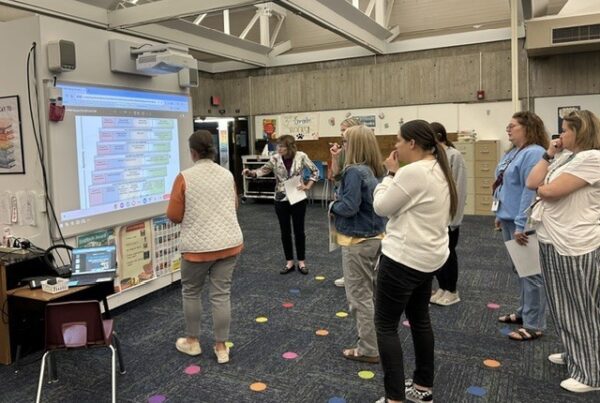

Students at School District U-46 collaborate as they create a Venn diagram, using resources and team structures from the Model of Instruction for Deeper Learning.
Topics Covered
- What Is Student Engagement?
- Why Is Student Engagement Important?
- How Overexplaining Affects Student Engagement
- Developing Students’ Agency to Prevent Overexplaining
- Recognizing Common Patterns
- Principals: Reflecting on Teacher Agency
- A Model Designed for Increasing Student Engagement and Agency
- Example: A District’s Success
As a teacher, do you see signs of disengagement in your students such as staring off into space during your lessons, barely responding, or passively copying down what you just said?
Or as a principal, do you see classroom after classroom where most students are silently disengaged, with the same few students responding to the teacher’s questions?
You’re not alone.
If you’re a teacher, you might wonder how to get all of your students to want to learn—how to engage them because they’re interested, not just compliant.
If you’re a school leader, you may be asking how to make engaged classrooms the norm across your campus, without expecting teachers to stay up all night lesson planning.
Here’s the often-overlooked truth: The key to increasing student engagement is to stop overexplaining.
When teachers overexplain, they unintentionally take the opportunity for deep cognitive engagement away from students. As we dive into this idea and think about potential solutions to increase classroom engagement, let’s start by defining student engagement.
What Is Student Engagement?
According to educational neuroscience expert Dr. David Sousa (2016), student engagement can be defined as “the amount of attention, interest, curiosity, and positive emotional connections that students have when they are learning, whether in the classroom or on their own” (p. 17).
Dr. Sousa’s definition is helpful, but we shouldn’t stop there. It is key that we personalize this definition to our own classroom(s) and lessons:
- In a Pre-K classroom, students might explore something without prompting or express that they heard something similar last week.
- In a middle school lesson, students might check in with each other as they are working to make sure they are on the right track, or they might ask questions about the content.
No matter which grade or subject you teach, it is important for you to determine what you want engagement to look and sound like in that lesson—before the lesson begins.
If you are a school leader, look for evidence of student engagement when observing instruction. Are students demonstrating attention, interest, and positive emotional connections during the lesson? Use these observations to guide your feedback and support teachers whose students may be less engaged.
Why Is Increasing Student Engagement Important?
In Why Is Deeper Student Engagement Important? 6 Strategies for Increasing Achievement by Engaging Students with Academic Rigor, Mr. Toth and Dr. Fitzgerald dig deeper into Dr. Sousa’s definition, noting that engaged students:
- Have more motivation to participate in class
- Enjoy achieving their learning goals
- Are more likely to persist through challenges in learning
- Feel intrinsically motivated to gain new and deeper understanding
Simply put: student engagement is the gateway to learning. If students aren’t paying attention and engaged, they aren’t learning—no matter how well a lesson is planned.
How Overexplaining Affects Student Engagement
Overexplaining often comes from a good place—teachers genuinely want to ensure students understand the content. But it can unintentionally limit opportunities for students to think critically and engage more deeply with the content.
The standards clearly call for students to engage in rigorous lessons that require analysis and knowledge utilization. Yet, many times, overexplaining lowers the rigor to basic recall and comprehension—leaving the teacher to do most of the higher-level thinking.
An Example: Why Overexplaining Turns a Rigorous Task into a Recall Activity
A common example of overexplaining is when a teacher leads a whole class discussion to complete a Venn diagram. The task is meant to develop students’ analytical thinking—comparing and contrasting ideas. But because the teacher is doing most of the talking and asking questions, only the few students who participate are engaged in meaningful thinking and practicing comparing or contrasting. Most are just listening, and some may be checked out entirely.
When it’s time for independent work where students complete their own Venn diagram, many students simply copy what the teacher wrote. Overexplaining turns an activity that is intended to be at the analysis level into a low-level recall exercise.
The Same Task, Transformed by Student-Led Learning
Now contrast that with a version of the same task in a student-led team learning model of instruction. Students collaborate with clear team roles and structures. Each student brings evidence from the text and discusses similarities and differences with their team. Instead of the teacher explaining the thinking, students are the ones doing the work to create a Venn diagram: reasoning, debating, and building understanding together.
In this model, every student is actively engaged in analysis—not just the ones who raise their hands. But how do you create the structures for students to work productively in teams?
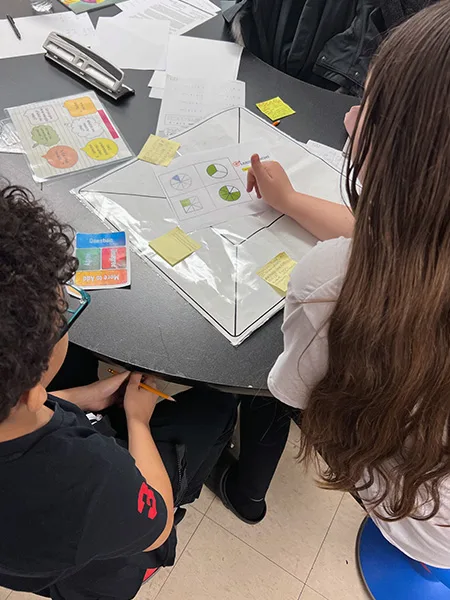
Students in partner district Woonsocket, Rhode Island, engage in student-led team learning through the Model of Instruction for Deeper Learning.
Developing Students’ Agency so You Don’t Have to Overexplain
If the key to increased student engagement is to stop overexplaining, the path to get there is by putting structures into place that build students’ agency skills. Agency is students’ ability to self-direct their own learning.
If a teacher simply turns over the complex thinking to students without guidance and support, students will not be able to “pick up the ball” to begin leading their own learning. Agency is what makes it possible for students to productively collaborate with their peers in teams and experience deeper learning.
When students take ownership of their learning and are challenged to think deeply, they become more engaged and motivated—because the learning is theirs, not just controlled by the teacher. This is why it’s so important to focus on creating structures that foster agency if you want to increase student engagement.
Subscribe for curated education insights delivered every two weeks.
The First Step to Increasing Student Engagement: Recognizing Common Patterns
The first step to increasing student engagement is to identify your starting place. Are you overexplaining? Are your students’ agency skills undeveloped?
You can use the table below to determine if your classroom or school is experiencing these challenges. You are likely to see similar patterns across elementary, middle, and high school classrooms.
What You Might See | What It Might Mean |
|---|---|
| Students wait for the teacher before getting started. | Students aren’t clear on how to begin or don’t feel ownership over the task. |
| Group work is often unproductive, and students don’t participate equally. | Students haven’t been taught how to collaborate meaningfully. |
| Students need directions repeated or need content retaught multiple times. | Students are used to relying on the teacher as the source of knowledge instead of thinking for themselves. |
| Few students participate in discussions—or only the same few. | Students may not feel safe to take risks, or they don’t know how to productively disagree or build on others' thinking. |
If any of these patterns feel familiar, you’re likely facing more than just an engagement issue. You’re seeing the effects of low student agency—and it’s a solvable problem. Agency isn’t something students need to develop before they can work in teams—they develop agency through working in structured teams.
Principals: Noticing the Connection Between Teacher and Student Agency
Principals may notice similar patterns as the table above in department or school meetings, including Professional Learning Community (PLC) meetings. You might reflect on how to shift these staff meetings from talking at teachers to encouraging meaningful conversations where teachers collaborate, brainstorm, and solve problems together.
In “How Education Leaders Can Harness Teacher Agency to Improve Student Outcomes,” Dr. Merewyn E. Lyons and Dr. Lindsay Elliott write about how school leaders can support teachers to develop agency by:
- Empowering teachers’ professional practice
- Providing growth producing feedback
- Fostering collaboration with peer teams
A Model Designed for Increasing Student Engagement and Agency
The Model of Instruction for Deeper Learning is intentionally designed to help students take ownership of their learning through structured collaboration, rigorous thinking tasks, and clear expectations. At the heart of this approach is the belief that every student can learn to lead their own learning—and that agency is something we build, not something students either have or don’t.
Through team roles, thinking tools, and purposeful routines, students begin to rely on one another as learning resources instead of depending solely on the teacher. When students think, talk, and reason together, they become more engaged and motivated to learn.
You don’t need to explain every detail every time. Instead, you’re building a classroom culture where students expect and want to do the thinking themselves.
How Principals Can Model and Lead the Work
Many school leaders have seen success using elements of the Model of Instruction for Deeper Learning—like role cards or Agree/Disagree cards—in their own staff meetings. When teachers experience these structures firsthand, they begin to see how they increase engagement and deepen learning.
In addition to modeling these routines, principals can support implementation by engaging in professional learning, visiting classrooms with a shared focus on the model, and partnering with an Instructional Empowerment coach to deepen their understanding of how the model works across grade levels and content areas. When principals lead by example, they create a strong foundation for schoolwide adoption and lasting impact.
A District’s Success with Increasing Student Engagement
It is one thing for me to share ideas about increasing student engagement, but it’s even more powerful when you hear directly from educators who have experienced the increase in student engagement firsthand. Here is an excerpt from a case study about one of our partner districts that I worked with to implement the Model of Instruction for Deeper Learning:
The Woonsocket Education Department (WED), a school district serving over 5,000 students in Woonsocket, Rhode Island, faced a persistent challenge. Debra Steers, an Innovation Specialist within the district, shared that educators were “struggling with how to get students to even participate at all,” reflecting that within classrooms, many students “didn’t talk.”
This issue was particularly pressing given the district’s mission to provide all students with a rigorous learning experience that leads to students becoming productive members of the global community…
Despite efforts to prioritize academic discourse through small-group instruction as well as blended and personalized learning pathways, educators continued to grapple with the task of engaging students in rich, student-led discussions that deepened their understanding of academic concepts…
It was amid these challenges that the Model of Instruction for Deeper Learning emerged, offering a potentially transformative path for teaching and learning.
When Heather Neil, Blended and Personalized Learning Coach, attended her first professional development session on the model at the beginning of the 2022-2023 school year, she realized the potential impact it would have on students and educators. “It was just this a-ha moment that blew me over,” Neil recalled. “It was noisy, it was exciting, and it was best practice.”
The Model’s emphasis on student engagement, academic discourse, and fostering deeper conceptual understanding resonated with Neil, offering a potential solution to the challenges they had been grappling with.
Key results from the partnership with the Woonsocket Education Department included not only increased student engagement, but also improved academic performance, enhanced communication skills, and a positive impact on families and the community.
Read the full case study: Woonsocket Education Department Boosts Student Engagement and Achievement Through Model of Instruction for Deeper Learning.
Share Your Stories and Questions
No matter where you are on your journey of increasing student engagement, consistency is key, and having a community of like-minded educators will accelerate your growth.
I would love to hear your questions and success stories!
- If you are already using the Model of Instruction for Deeper Learning, follow me in our internal community, Model of Instruction Newbies, Gurus, and Everyone In Between within Empowerment Central.
About the Model of Instruction for Deeper Learning
There has always been deeper learning for some students – but not for all students in every classroom, every day. Now it is possible with the research-based Model of Instruction for Deeper Learning™, which provides every teacher and all students with the professional learning, support, and resources to achieve deeper, more rigorous learning of the curriculum.
The Model of Instruction for Deeper Learning places students at the center of their learning, shifting from traditional teacher-directed methods to student-led team learning. In this approach, students collaborate in structured, interdependent teams, guided by clear roles and responsibilities. Unlike traditional grouping, this approach ensures equal participation and accountability – fostering deeper understanding, critical thinking, and collaboration.
We guide you through the process, starting with a well-designed pilot involving volunteer principals and teachers, then scaling success to meet the district’s goals, timeline, and resources.
About the Authors
Deana Senn, MSSE
Deana Senn, MSSE, serves as the Executive Director of Model of Instruction for Deeper Learning at Instructional Empowerment and is a school instructional model expert educator. She leads the creation and development of IE’s Model of Instruction for Deeper Learning content and coaching tools. Deana supports internal faculty and partner districts to shift the culture of classrooms by increasing rigor and student agency through the intentional implementation of the Model of Instruction for Deeper Learning.
Deana calls upon her 20+ years of experience in education to support leaders and teachers in increasing engagement, ensuring equity, and closing achievement gaps through student conversations and rigorous learning. She is an award-winning author and international speaker who conducts research and development for Instructional Empowerment. Having experience that spans the United States and Canada in rural and urban districts, she is passionate about creating innovative solutions for all students, teachers, and leaders.
References
Sousa, D. A. (2016). Engaging the rewired brain.
Subscribe for curated education insights delivered every two weeks.
About Instructional Empowerment
Our mission is to end generational poverty and eliminate achievement gaps through redesigned rigorous Tier 1 Instruction that ensures deeper learning for ALL students.