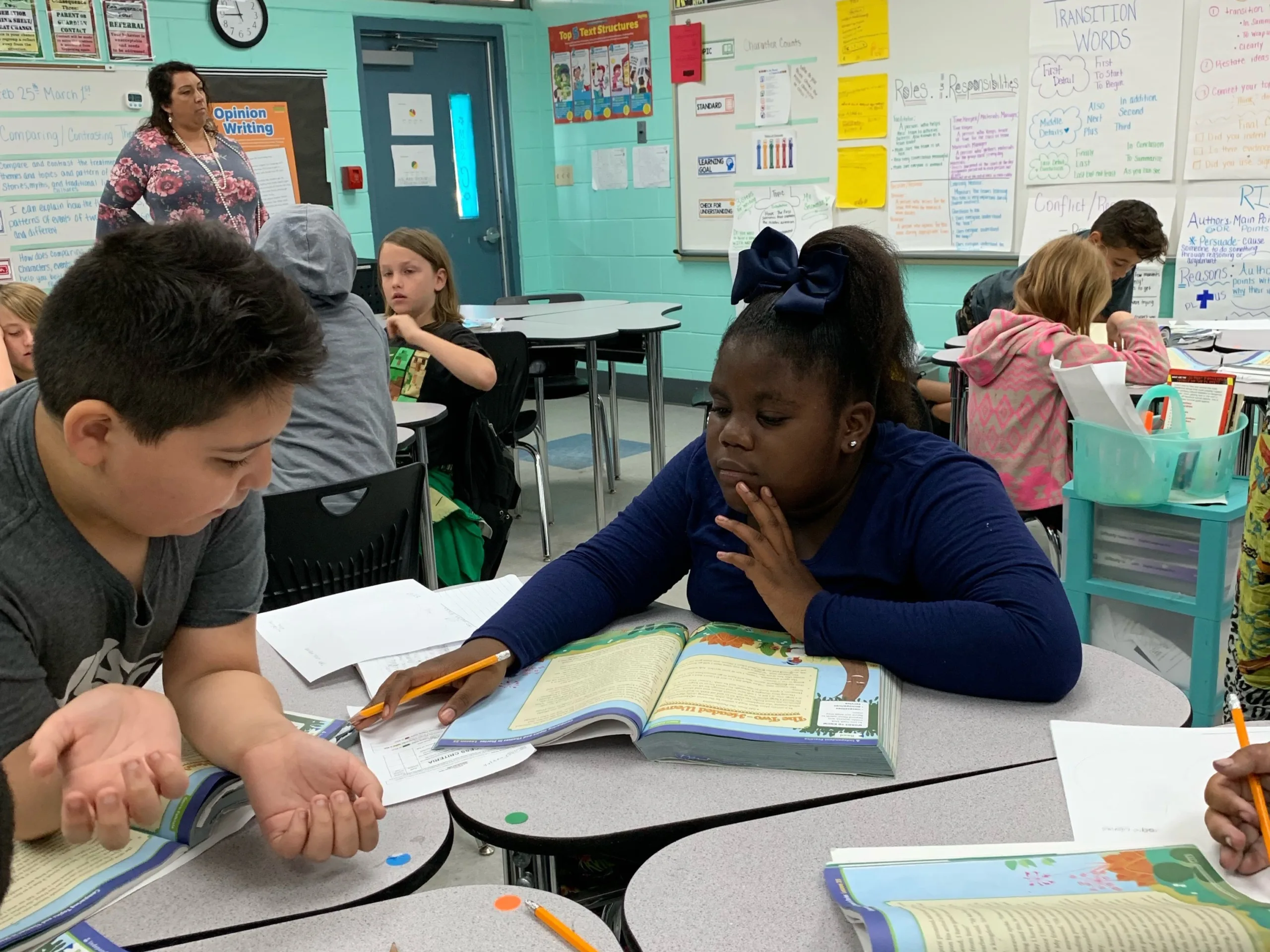
Students at partner school Moseley Elementary previously acted out due to low academic engagement. Behavior referrals dropped by more than half after one year of adopting a research-based model for deeper learning.
Why Most Classroom Behavior Expectations Don’t Work
Teachers work hard to create a safe, productive learning environment—but even with rules in place, classroom behavior can still feel unpredictable and difficult to manage. The problem may not be the consistency or consequences. It might be the clarity of the behavior expectations themselves.
Below are some typical examples of classroom behavior expectations:
- Be polite
- Follow directions
- Respect personal space
- Stay on task
Nothing on this list is surprising. In fact, you would likely come up with a similar list. But the issue with the list is that the expectations aren’t really guiding students on what to do. The expectations may seem simple and clear at first glance, but they leave out the most important part: the specific behaviors we expect from students at different moments in the lesson.
For example, what does it look like to “follow directions” or “stay on task” when working independently versus in a team? The expectations set for students are usually broad and unchanging despite the lesson changing minute by minute while students may not have developed the self-management skills to adapt appropriately.
We often rely on consequences for challenging behavior to motivate students to follow the classroom expectations and exhibit positive behavior. Instead, effective expectations should define what we want students to do, rather than just what we don’t want them to do. Expectations should focus on specific actions and have clear parameters so that students understand how to apply them to different situations. This is where student-led behavior management comes in.
Student-led behavior management means that students learn strategies to self-regulate their behavior as part of a collaborative learning team. Students have clear roles and responsibilities and engage in rigorous team tasks while the teacher takes on the role of a coach rather than a director.
Whether you’re a classroom teacher or a school leader, in this article you’ll learn the strategies for managing classroom behavior by engaging students in meaningful learning and giving them clear, consistent structures to self-manage.
What Is the Best Strategy for Preventing or Addressing Behaviors?
You, and every other teacher and school leader, have likely asked yourself, What is the best way to manage classroom behavior?
A highly effective approach that might seem counterintuitive at first is shifting your focus from classroom behavior interventions and consequences to managing behavior through student engagement.
How do you do this? Provide structures and processes for the behaviors you want to see. When students have a role in the self-management of their own behavior, they become more interested and active rather than being disengaged or acting out with disruptive behavior.
Providing clear structures and classroom procedures allows students to dive into deeper learning and work productively with their teams. When you raise the level of academic rigor and students have the support to know exactly what they should be doing throughout the lesson, self-direction will become the norm, and you’ll spend less time addressing and trying to prevent behaviors.
Give students a specific purpose each time they interact. Students’ understanding of the purpose of their grouping will facilitate the positive interdependence necessary for effective student interactions. Consider the details of when, where, why and how you want students to interact with each other.
– Organizing for Learning, Senn & Marzano (2015, p. 7)
How to Manage Classroom Behavior Through Engagement
Managing behavior in the classroom doesn’t have to mean constant correction. Instead, build a classroom where students are active, engaged, and understand what’s expected—because the structure around them supports self-direction. Here are a few ways to manage classroom behavior through engagement:
1. Routines for Learning and Interaction
Consider how to go beyond basic routines for classroom management and establish routines that support how students learn and interact with each other throughout a lesson.
Examples of routines can include:
- How to get into partners or teams
- How to access resources without asking the teacher
- When to use the textbook or other text
2. Structures That Support Collaboration
Provide resources that guide student-to-student interactions and help students collaborate respectfully and productively to complete team tasks.
Examples of team structures can include:
- Agree/Disagree Cards
- Step-by-step directions for interdependent tasks
- Sentence stems to guide discussions
3. Learning Resources That Promote Autonomy
Give students the materials needed for more autonomous learning and self-management of their behavior so they can successfully stay on task and take ownership of their learning.
Examples of learning resources can include:
- Math manipulatives
- Timers
- Anchor charts with key information
It’s important to use a research-based model of instruction that brings these routines, structures, and resources together, rather than trying to piece them together on your own. A cohesive approach helps teachers establish consistency and makes it easier for students to take ownership of their learning and behavior. School leaders can also use the model to better recognize and celebrate these practices in action.
Why Structures and Supports Are Key to Improving Classroom Behavior
You might be thinking, My students aren’t ready for this kind of independence, or: My teachers and their students aren’t ready for this. That is a natural concern, and it’s also why you need behavior strategies for students that don’t focus solely on expectations and consequences. If we want students to eventually manage their own behavior and learning, we have to remember, they won’t automatically know how to do it.
The first step to empowering student autonomy is actually a little more guidance and control, not less. Think of these structures and supports as training wheels on the way to students becoming independent critical thinkers. Teams need these structures in place when they are first learning how to be more independent and to take charge of their own conversations and learning. Over time, students will outgrow them just like we outgrow the training wheels on our bikes.
Will some students need sentence stems? (Definitely.) Will teams need talking protocols? (Again, yes.) Do students know how to resolve conflict without guidance? (Probably not.) Spending 10 minutes creating a quick step-by-step dialogue guide or some sentence stems will pay off with much deeper conversations and learning and less need for you to “manage behavior.”
Subscribe for curated education insights delivered every two weeks.
The First Step to Shifting Classroom Behavior Strategies: Recognizing Common Patterns
The first step in shifting the behavioral strategies in a classroom is to identify the starting place. That means observing the patterns you’re seeing and focusing on building student-led behavior management from there.
You can use the table below to identify common behavior problems and solutions and create behavior management systems in your classroom or school that address the root causes.
| What You Might See | What it Might Mean | Behavior Management Strategy |
|---|---|---|
| Students don’t start their work and disrupt other students | Students don’t want to admit they find the work too hard | Ensure that students have resources for extra support that they can access independently—plus a teammate to help them use the resources |
| Students tune out and don’t pay attention when the teacher speaks | The teacher has talked for too long without allowing processing time | Pause the lesson and ask students to discuss their learning with a partner or team |
| Students rush through their work then start talking to each other about non-academics | Students are bored because they find the work too easy | Create open-ended questions and structures for interaction within every lesson so students can dive deeper into the learning |
Using Learning Walks to Promote Professional Collaboration
A helpful tool in shifting to student-led behavior management is learning walks, where teachers either invite colleagues into their classrooms or ask to observe peers who are using student-led behavioral strategies successfully. Principals can support by organizing or leading these learning walks.
There are always a few teachers in a school who are well on their way to enacting student-led behavior management. When principals observe a classroom that has the characteristics discussed in this article, it’s time to show them off!
Principals can invite “learning” teachers on these walks—“learning” teachers are those who are interested in making behavior management shifts in their own classroom but have questions. Seeing even small changes in action during these learning walks will make a big difference.
Learning walks work best if:
- The “learning” teacher is guided with conversations before and after the classroom visit. This is an especially effective strategy for new teachers.
- Someone accompanies the “learning” teacher to help them see the shifts and the supporting structures and resources that are in place.
- Someone helps the “learning” teacher identify the subtle moves of teachers who have a proactive behavior management system in place, and how it is different than a behavior system focused on consequences.
Principals looking for support in organizing learning walks and encouraging Early Adopter teachers can engage in a school pilot.
Case Study: How Willard Elementary Decreased Discipline Referrals by Engaging Students in Deeper Learning
At Willard Elementary in School District U-46 (Elgin, Illinois), discipline referrals have dropped significantly since implementing the Model of Instruction for Deeper Learning. “In 2021, when we first started, we were looking at 288 office managed referrals,” said Principal Covarrubias. “This year, we have 82 referrals and 46 were managed by teachers. Almost all of our referrals are happening in the hallway, lunch, or recess.”
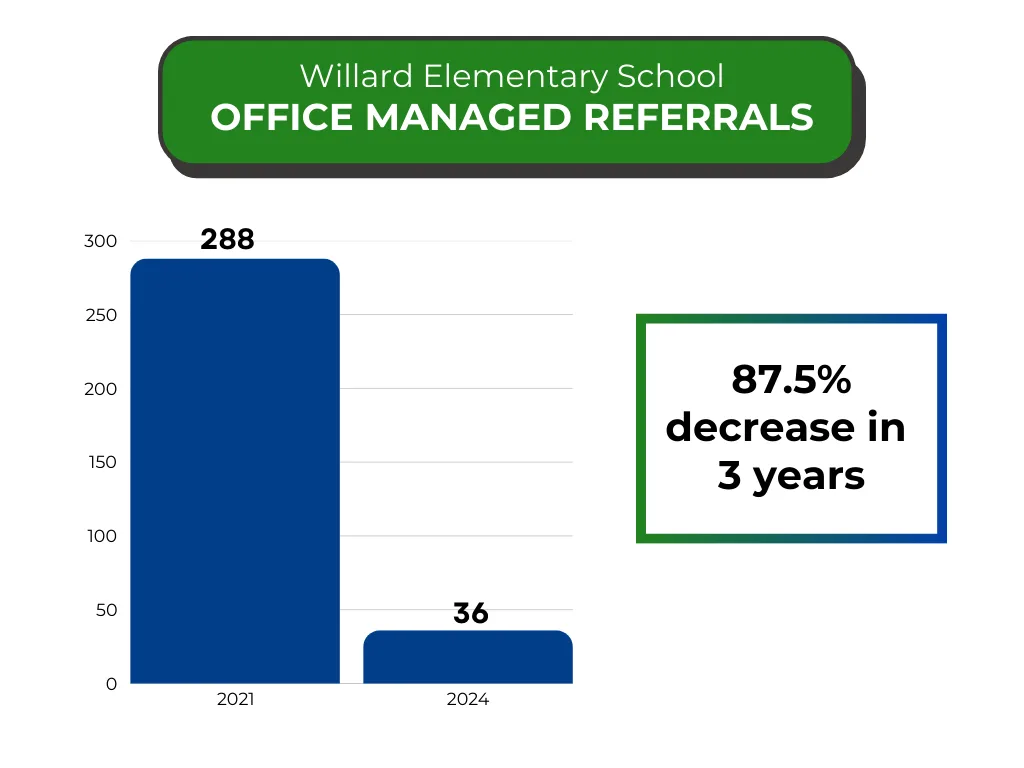
In previous years, challenging student behaviors frequently occurred during instructional time. Now, with the structures for self-managed behavior in place, all students are actively engaged in more rigorous, deeper learning—a shift that has significantly impacted school culture. “We don’t really have behavioral issues here anymore,” shared Covarrubias. “I tell people all of the time that our students’ brains are tired from learning, so they don’t misbehave.”
Educators implementing student-led team learning often find that when every student has a voice and role, challenging behaviors significantly decrease or even disappear altogether. “We haven’t had any discipline referrals during instructional time this year,” said Covarrubias. “Students want to be in the classroom to actually learn.”
When students are engaged in deeper learning and supported by clear structures and routines, classroom behavior improves as a natural result. Whether you’re a teacher or a principal, these strategies can help you create a classroom where students are focused, collaborative, and eager to learn.
If you’re looking for a clear framework for student-led behavior management, the Model of Instruction for Deeper Learning brings everything together for teachers and leaders to strengthen classroom behavior through deeper learning.
About the Author
Deana Senn, MSSE
Deana Senn, MSSE, is an Education Consultant and award-winning author of Fostering Deeper Learning: A Handbook for the Model of Instruction for Deeper Learning. She is a school instructional model expert educator and led the creation and development of IE’s Model of Instruction for Deeper Learning content and coaching tools. Deana supports internal faculty and partner districts to shift the culture of classrooms by increasing rigor and student agency through the intentional implementation of the Model of Instruction for Deeper Learning.
Deana calls upon her 20+ years of experience in education to support leaders and teachers in increasing engagement, ensuring equal learning for all students, and closing achievement gaps through student conversations and rigorous learning. She is an award-winning author and international speaker who conducts research and development for Instructional Empowerment. Having experience that spans the United States and Canada in rural and urban districts, she is passionate about creating innovative solutions for all students, teachers, and leaders.
References
Senn, D. & Marzano, R.J. (2015). Organizing for Learning: Classroom Techniques to Help Students Interact Within Small Groups.
Subscribe for curated education insights delivered every two weeks.
About Instructional Empowerment
Our mission is to end generational poverty and eliminate achievement gaps through redesigned rigorous Tier 1 Instruction that ensures deeper learning for ALL students.