Structure that hands over the work
Team roles, norms, and protocols give students clear responsibility for leading discussions, checking understanding, and keeping the team on track.
The Model of Instruction for Deeper Learning is a research-validated instructional model, supported by ESSA Tier 2 evidence, that builds student ownership of thinking and learning through student-led team learning, where students use roles and protocols to lead rigorous tasks together.
Start with five volunteer teachers. Watch students take over the work of learning.
Explore the Model of Instruction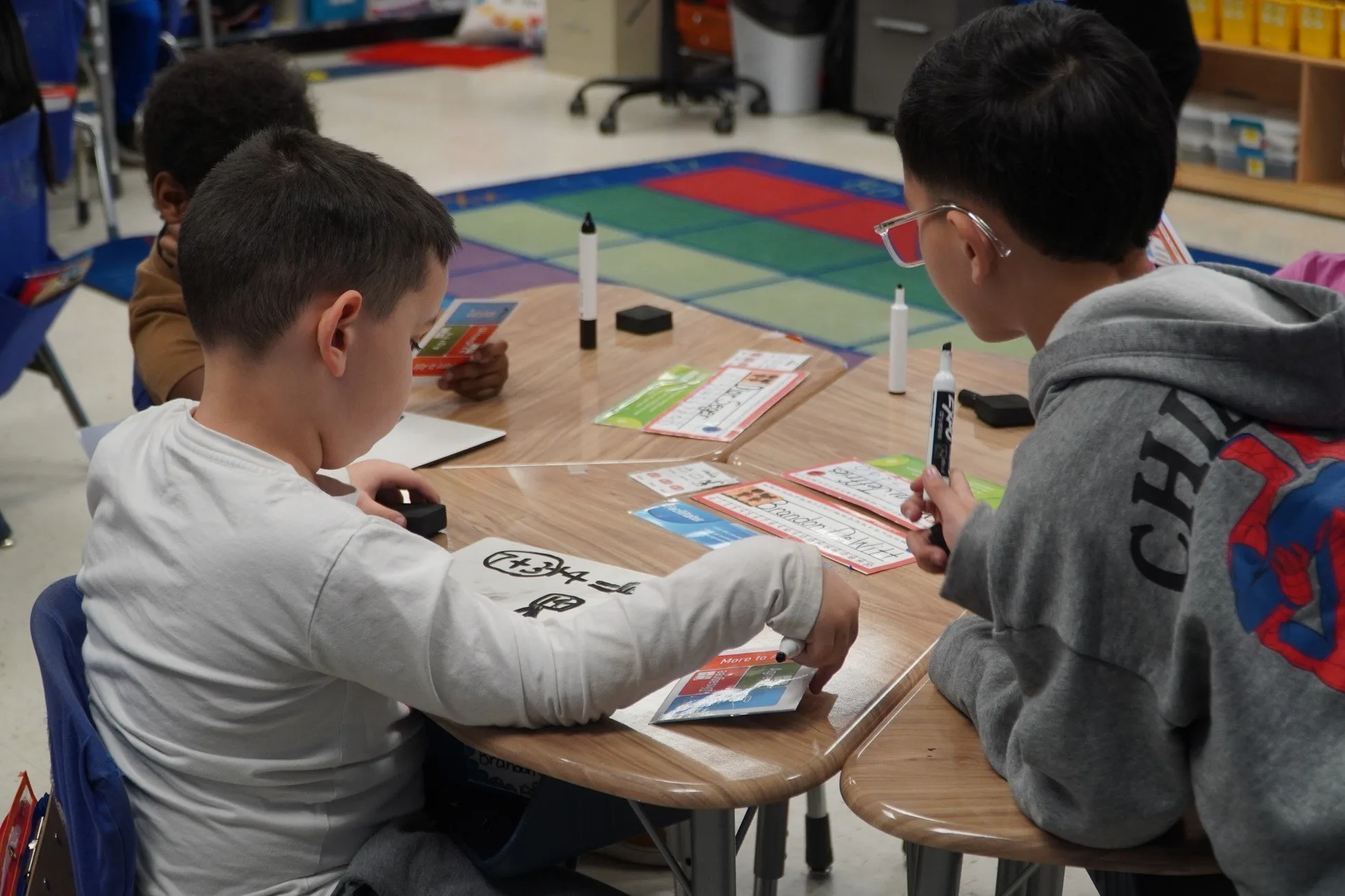
In many classrooms, teachers thoughtfully explain, model, and overly support learning. While well-intentioned, this can sometimes lead students to rely on the teacher for answers rather than developing the confidence to work through challenges independently. When students are given opportunities to grapple with rigorous tasks, think through difficulties, and engage in productive struggle, they build greater confidence, independence, and problem-solving skills.
This is becoming increasingly important in a world where AI can generate answers instantly. The greatest value of learning is no longer simply finding the right answer, but developing the ability to think critically, collaborate with others, reason through complex problems, and persist when solutions are not immediately apparent.
Turn-and-talks, choice boards, and group work make lessons more active, but the teacher still directs every step of the learning process. Students comply; they don’t lead. Ownership requires a structure where students are responsible for the learning itself.
| Part of the learning | Engagement strategies | Student-led team learning |
|---|---|---|
| Directing the steps of the task | Teacher | Students |
| Leading the discussion | Teacher | Students |
| Checking understanding | Teacher | Students |
| Keeping the team on track | Teacher | Students |
| Helping when it gets hard | Teacher | Peers |
In student-led teams, roles, norms, and protocols hand these responsibilities to students. The teacher monitors and coaches every team.

Team roles, norms, and protocols give students clear responsibility for leading discussions, checking understanding, and keeping the team on track.
Productive struggle encourages students to persevere, test ideas, and learn from mistakes while collaborating with peers who provide support, feedback, and new perspectives.
Students make decisions, solve problems, and contribute their own background knowledge while thinking through grade-level tasks.
As teams succeed on more complex work, students see themselves as capable learners and leaders, a cycle that builds on itself.
Face-to-face academic discourse, respectful debate, and collaboration are practiced every day, not just taught.
A peer-reviewed international study of 2,359 students across 35 middle schools found that student self-efficacy was the strongest predictor of academic achievement. The finding validates the student autonomy and self-regulation conditions the Model of Instruction for Deeper Learning is designed to build.
Frontiers in Education (2024)In a one-year pilot across 6 classrooms in 3 grade levels, partner classrooms outperformed comparison classrooms by 2.8 to 16.7 points in ELA and 10 to 27 points in math. The sample is small, so read it as a promising early signal.
Woonsocket Education Department case study (2024)Willard Elementary began as a pilot school and now hosts more than 300 educators a year who come to see student-led team learning in action.
Willard Elementary case study (2025)Arthur Elementary’s principal and a teacher show what happens when students take responsibility for learning, and how the shift spread from a few classrooms to the whole school.

[Placeholder: 2 short paragraphs and 3 to 5 quotable lines, added after the recording.]

“They progress from ‘sage on the stage’ to the students taking responsibility. You can see how it’s changed the whole atmosphere of the school.”
“I was very shy in 3rd grade… but now that teaming came into this school, I’ve been more confident in my work.”
“It’s taught my students how to work together… and how to have conversations with people and not just behind a screen.”
You invite teachers to volunteer; you don’t assign them. A team of 3 to 5 teachers learns the Model of Instruction for Deeper Learning together through interactive modules that take under 1 hour a week and apply in class the next day. An Instructional Empowerment coach, always a former educator, supports the team through live virtual coaching sessions.
Students learn team roles, norms, and protocols. Early wins are often visible in the first week.
Teachers design rigorous, interdependent team tasks from the curriculum they already use, and shift from directing all aspects of learning to coaching students toward greater ownership of learning.
You review student evidence with your team and decide whether to expand. Classrooms begin evolving within weeks.
Student ownership of learning means students take responsibility for their own thinking: setting goals, making decisions, solving problems, and reflecting on progress. In the Model of Instruction for Deeper Learning, students practice ownership every day through team roles and protocols.
In group work, the teacher still directs the learning and a few students often do most of it. In student-led team learning, every student fulfills a role, protocols require equal voice, and tasks are interdependent, so the team can only succeed if everyone contributes.
Yes. Student-led teams build the skills AI can’t do for students: critical thinking, reasoning aloud with peers, respectful debate, and persistence. Students practice them face to face, every day, with rigorous content.
Teachers spend under 1 hour a week on interactive learning modules and apply what they learn the next day. Live virtual coaching sessions are 1 hour each: 2 in Pilot One, 4 in Pilot Two.
No. The Model of Instruction for Deeper Learning works with your adopted curriculum and high-quality instructional materials. Teachers learn to turn existing lessons into rigorous, interdependent team tasks.
The model is used in elementary, middle, and high schools across all content areas. Classroom Toolkits are grade-band specific.
At the end of the pilot, you review results with your team and your Instructional Empowerment coach. Schools can expand by adding a second cohort of volunteers, upgrading to include coaches and leaders, or bringing onsite professional development to the whole staff.

Our mission is to end generational poverty and eliminate achievement gaps through redesigned rigorous Tier 1 instruction that ensures deeper learning for ALL students.
Contact Us© 2026 Instructional Empowerment. All Rights Reserved. Privacy Policy | DMCA Notice | Contact