Close Achievement Gaps by Opening Rigorous Learning to Every Student
The Model of Instruction for Deeper Learning is a research-validated instructional model, supported by ESSA Tier 2 evidence, that closes achievement gaps by giving every student, including English learners, students with IEPs, and students experiencing poverty, equal voice and access to rigorous, grade-level learning in student-led teams.
Start with five volunteer teachers. Put every student at the center of the learning.
Why do achievement gaps persist, even with more intervention?
Too often, the students who would benefit most from rigorous learning opportunities have the fewest chances to engage in them. In an effort to provide support, they may be assigned simplified tasks, excluded from rich academic discussions, or spend significant time in interventions outside the classroom. While these approaches are well-intentioned, they can unintentionally limit students’ access to grade-level thinking and meaningful learning experiences.
Why don’t pull-outs and extra interventions close the gap?
Pull-outs, tutoring, and intervention programs can provide valuable support. However, when they are not paired with stronger core instruction, they often address learning gaps temporarily without changing students’ daily learning experiences. To accelerate learning, students need consistent access to grade-level content, rigorous thinking, and meaningful engagement throughout the school day.
Gaps close when core instruction gives every student daily access to rigorous work and a real voice in the learning.
The same student, two different school days
When support limits access
Assigned a simplified task
Left out of rich academic discussion
Pulled out during core instruction
Waits for the teacher when work gets hard
When core instruction opens access
Works on the same grade-level task
Has a defined role and an equal voice
Learns alongside peers in a mixed-ability team
Teammates need their thinking to finish
Services and accommodations continue in both. What changes is how much of the day the student spends in rigorous, grade-level learning.
How it works
How does the Model of Instruction for Deeper Learning close gaps?
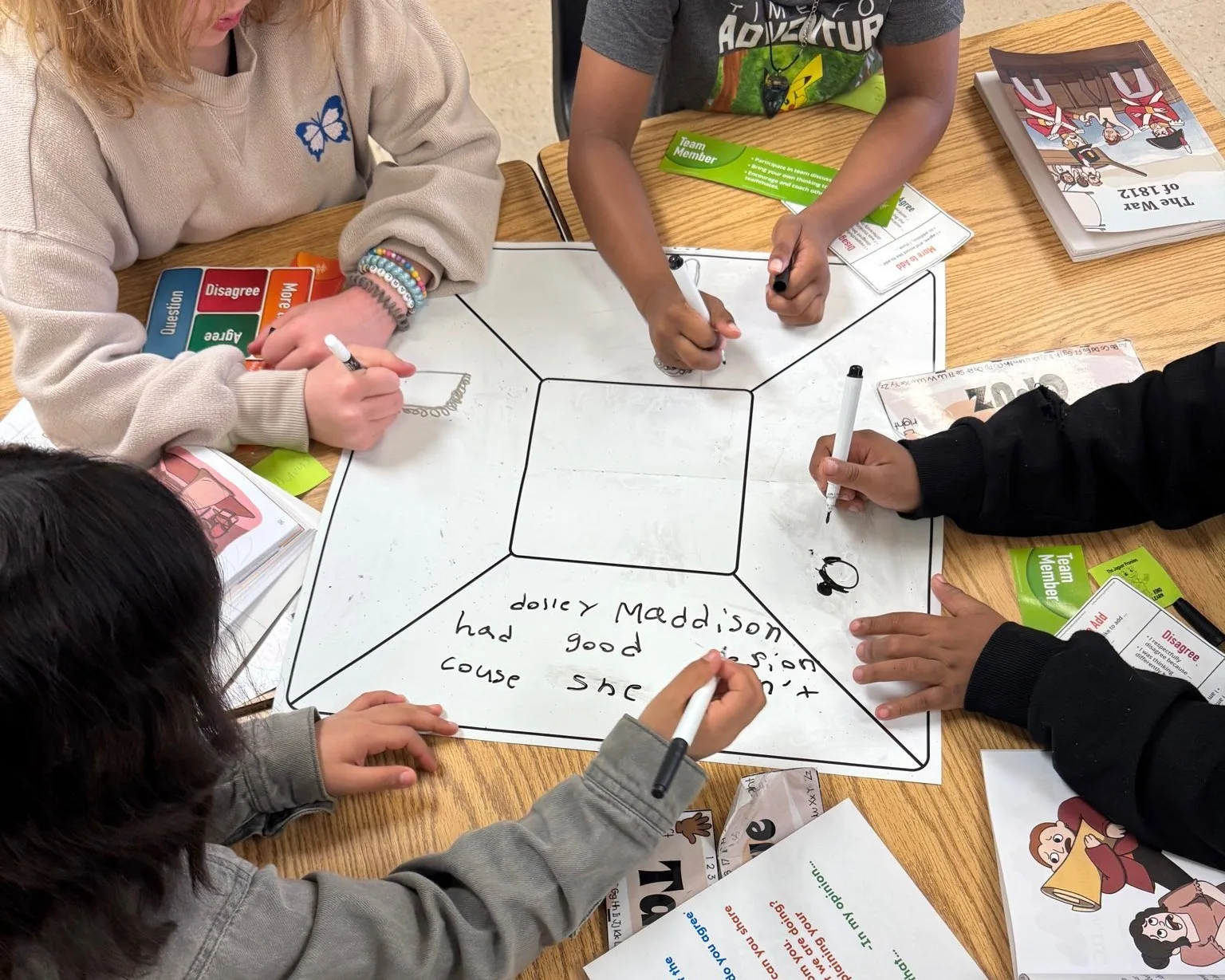
Every student works in a small, mixed-ability team with a defined role, and protocols require equal voice. Tasks are interdependent, so the team needs every member’s thinking to complete the task. Students support one another’s learning, creating opportunities for every teammate to participate and succeed.
How does it help English learners?
English learners practice academic language every day in a low-risk team setting, using content vocabulary in structured discourse with peers, with task guides and mats making the work visible. Roles and protocols provide every student with a clear pathway into the conversation, creating opportunities to share their unique experiences, knowledge, and perspectives.
How does it include students with IEPs?
Protocols guarantee every student a voice, and roles can be matched to each student’s strengths, so students with IEPs participate at the center of rigorous tasks rather than at the periphery. Accommodations and services continue; what changes is their access to grade-level learning with peers in mixed-ability teams.
How does it help students experiencing poverty?
Students get daily access to grade-level rigor instead of remediation, plus the belonging, agency, and self-efficacy that predict achievement. A peer-reviewed study of 48 schools found that student teaming predicted higher achievement in schools with more low-income students.
How does it close opportunity gaps for underserved racial and ethnic groups?
Equal voice, high expectations, and teammates who value each other’s background knowledge create classrooms where every student is treated as a capable scholar with a strong sense of belonging. Gaps close when access to rigor expands to every student.
Impact and results
What results have schools seen?
Gap closure across groups
10,431Students across 22 Des Moines schools
A study meeting What Works Clearinghouse design standards with reservations found the model closed achievement gaps by 7% in reading and 6% in math for Black students compared to White students, 6% and 5% for students with disabilities, and 6% and 4% for English learners.
Across 4 districts from 2023 to 2025, schools implementing the model closed achievement gaps for students with disabilities by up to 58% in ELA and 90% in math at the elementary level, and up to 58% in ELA and 92% in math in the middle grades. At North High School in Des Moines, the special education graduation rate rose 16.42 percentage points after one year.
The same 4-district analysis found schools closed achievement gaps for English learners by 6% to 47% in ELA and 4% to 74% in math, depending on the district.
A peer-reviewed study of 48 schools found that student teaming predicted higher achievement in schools with more students from low socioeconomic backgrounds.
Madison Elementary’s principal and a teacher share how student-led teams brought students who had been on the margins into the center of rigorous learning.
Register to watch the full recording
Which students the principal saw change first, and why
How teachers support English learners and students with IEPs inside teams
What more students reaching grade-level proficiency looked like in the data
Webinar summary
[Placeholder: 2 short paragraphs and 3 to 5 quotable lines, added after the recording.]
In their words
What leaders are saying
Principal
“When we implemented the Model of Instruction, what I’m seeing now is we are catching kids that we did not catch.”
DLDerien LatimerPrincipal, Madison Elementary, Colorado Springs School District 11, CODistrict leader
“They have a background with schools that serve students with lives like ours. I think that is very important to the work that they do.”
BWBrandon WhiteFormer Assistant Superintendent of Academics, South Bend School Community Corporation, IN
The teacher champion pilot
How does a teacher champion pilot work?
You invite teachers to volunteer; you don’t assign them. A team of 3 to 5 teachers learns the Model of Instruction for Deeper Learning together through interactive modules that take under 1 hour a week and apply in class the next day. An Instructional Empowerment coach, always a former educator, supports the team through live virtual coaching sessions.
Getting Started
Launch teams
Students learn team roles, norms, and protocols. Early wins are often visible in the first week.
Building Momentum
Design rigorous tasks and shift to coaching
Teachers design rigorous, interdependent team tasks from the curriculum they already use, and shift from directing all aspects of learning to coaching students toward greater ownership of learning.
Measuring Success
Review and decide
You review student evidence with your team and decide whether to expand. Classrooms begin evolving within weeks.
Because the pilot starts with teachers who want to try it, you expand something your staff already supports, not something you have to sell.
Start with a pilot
Choose your pilot
Pilot OneStart here
Getting Started with Teachers
$2,500
5 volunteer teachers, each with a one-year Teacher Digital Resource Suite subscription
5 Classroom Toolkits, including printed and laminated student tools and a Teacher Guidebook
Funding your pilotMany schools fund pilots with Title I or Title II professional development funds. Check allowability with your federal programs office.
What is the difference between an achievement gap and an opportunity gap?
An achievement gap is the difference in outcomes between student groups. An opportunity gap is the difference in access to rigorous instruction, resources, and high expectations that often causes it. The Model of Instruction for Deeper Learning addresses the opportunity gap inside Tier 1 classrooms.
Does this replace IEP services or English language development?
No. Services, accommodations, and English language development continue. The model changes general education instruction so English learners and students with IEPs participate fully in rigorous learning with their peers.
Can Title I funds pay for a pilot?
Many schools fund pilots with Title I, Part A or Title II, Part A professional development funds. Printed resources and companion technology may be funded from other sources. Allowability depends on your school’s program and district rules, so confirm with your federal programs office.
How much time does the pilot take for teachers?
Teachers spend under 1 hour a week on interactive learning modules and apply what they learn the next day. Live virtual coaching sessions are 1 hour each: 2 in Pilot One, 4 in Pilot Two.
Do we need a new curriculum?
No. The Model of Instruction for Deeper Learning works with your adopted curriculum and high-quality instructional materials. Teachers learn to turn existing lessons into rigorous, interdependent team tasks.
What grades and subjects does it work in?
The model is used in elementary, middle, and high schools across all content areas. Classroom Toolkits are grade-band specific.
What happens after the pilot?
At the end of the pilot, you review results with your team and your Instructional Empowerment coach. Schools can expand by adding a second cohort of volunteers, upgrading to include coaches and leaders, or bringing onsite professional development to the whole staff.
Every student deserves a seat at the center of the learning. Start with five teachers.