SIMM: The Evidence-Based Framework Behind Our School Improvement Work

Every school has untapped potential. The question is: what is the right framework for unlocking it? 

The School Instructional Maturity Model™ (SIMM) is a school improvement framework with six pillars that are supported by peer-reviewed, ESSA Tier 3 validated research. It was developed by Instructional Empowerment’s Applied Research Center to surface the root causes holding schools back and raise achievement for all students.

Field-proven with over a decade of use across hundreds of schools in multiple states, SIMM gives school and district leaders a systems-level framework. 

SIMM guides leaders to diagnose where a school is, understand why, and take targeted action—whether the goal is exiting state-mandated turnaround, closing persistent achievement gaps, or elevating an already-strong school to the next level.
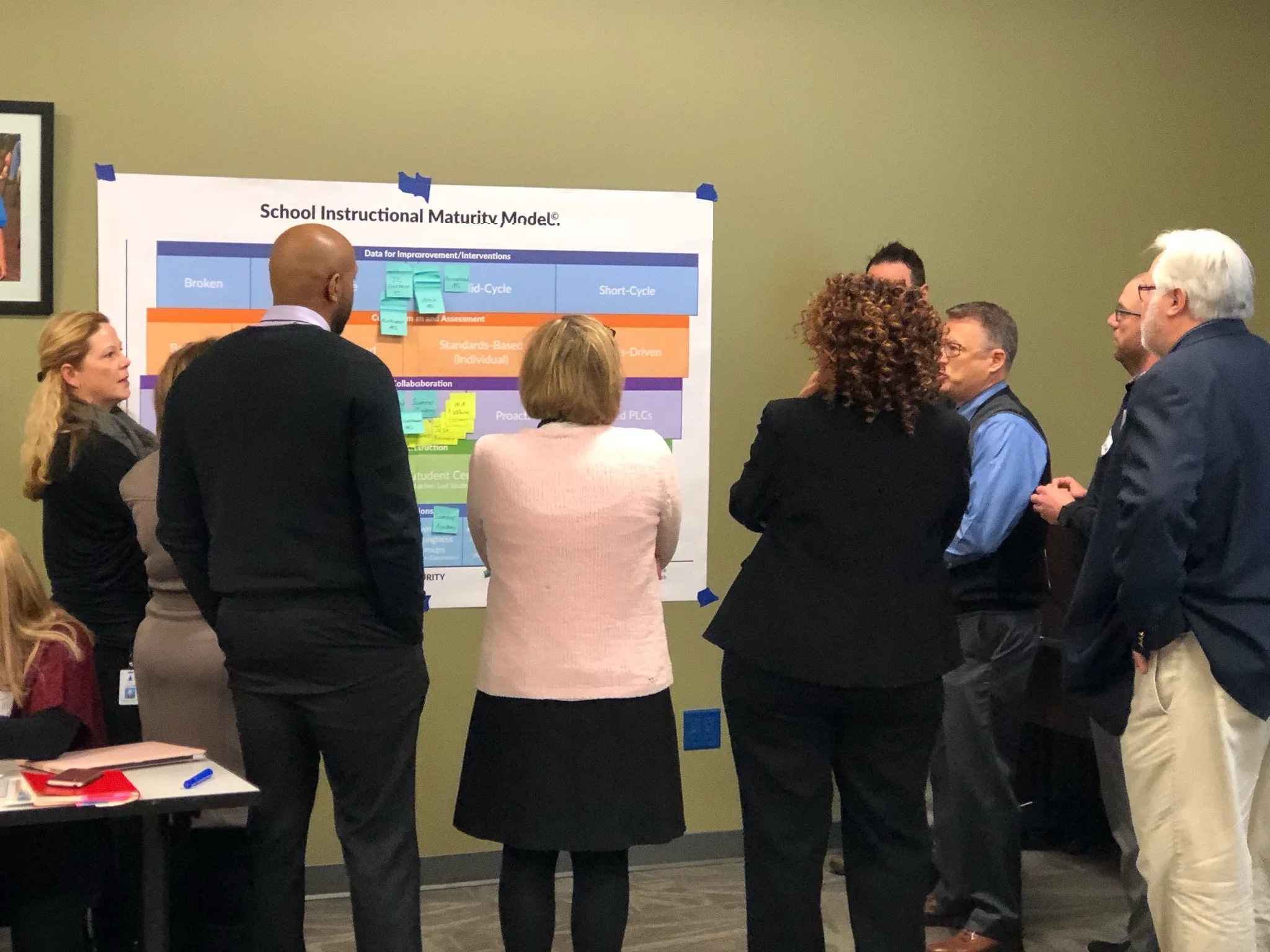
School and district leaders meet with Michael D. Toth, the author of the School Instructional Maturity Model, to analyze their schools.

Unlike generic improvement frameworks, the pillars of SIMM are validated through applied research conducted under federal What Works Clearinghouse standards, published in peer-reviewed academic journals, and rated ESSA Tier 3 (Promising Evidence).  

Examples of Questions SIMM Helps You Answer

Effort isn't the problem. Underdeveloped systems are the problem. SIMM reveals how gaps in a school's instructional systems keep achievement flat and pinpoints which of the six pillars to strengthen first.

Short-term fixes raise scores temporarily, but without mature underlying systems the gains don't hold. SIMM diagnoses the root-cause systems that produce durable, year-over-year improvement.

Good schools often plateau because their strongest practices aren't yet systematized across every classroom and team. SIMM identifies the specific pillars where a high-performing school can mature further to reach the next level.

What Are the Six Pillars of SIMM?

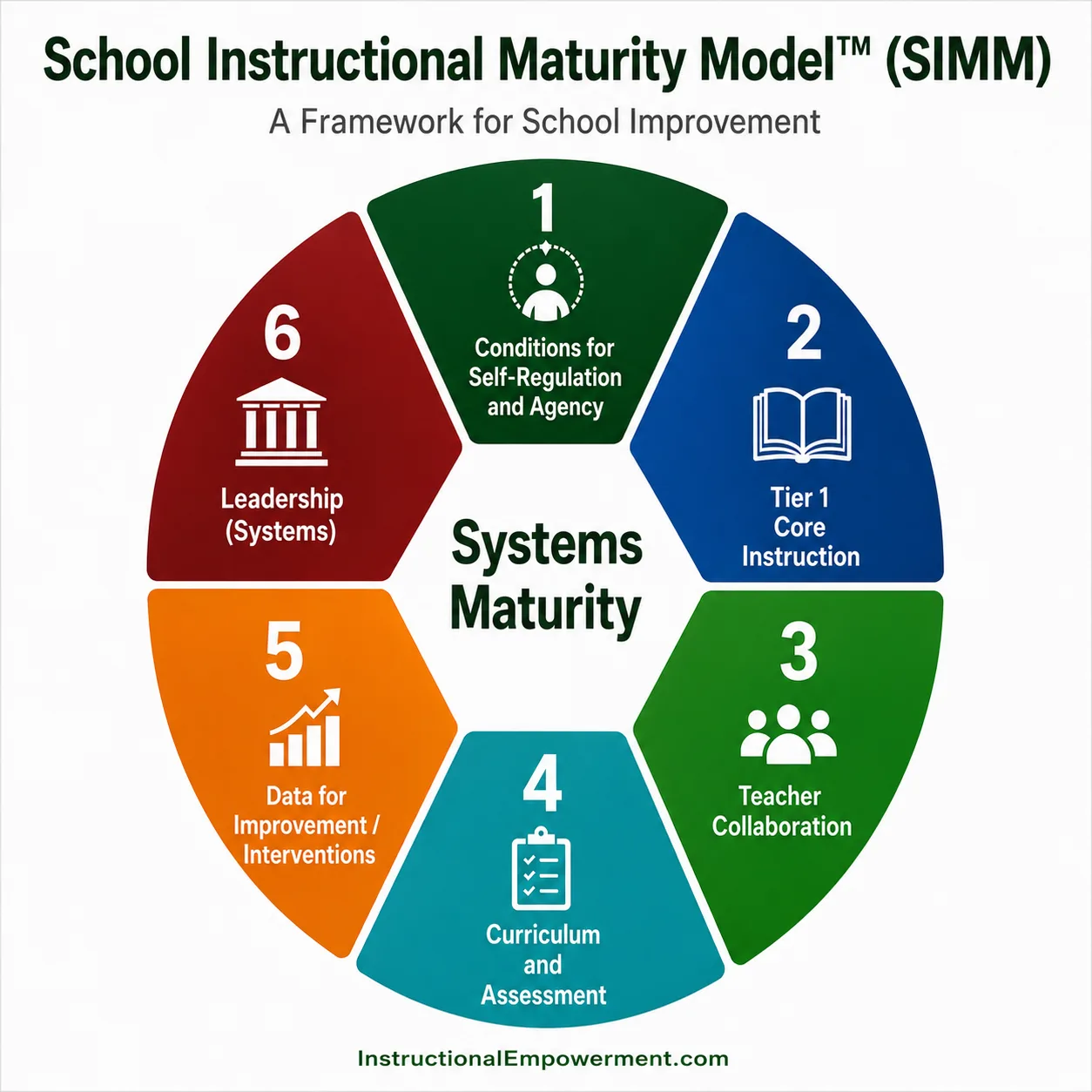
SIMM defines six instructional pillars, each a dimension of a school’s instructional systems. A school reaches a highly mature system when the practices in these pillars are consistent, schoolwide, and self-sustaining—embedded in daily routines rather than dependent on individual teachers or short-term initiatives. The outcomes under each pillar below show what that maturity looks like in practice.

It’s important to note that all schools—including Title I schools and those with low test scores, high levels of chronic absenteeism, high teacher turnover, and other challenges—can achieve the outcomes of highly mature systems stated for each pillar through an intentionally-phased process.

1 Conditions for Self-Regulation and Agency

The first pillar is the foundation of school culture. Indicators include how students behave, how they interact with one another and their teachers, and how they see themselves as learners. When schools work on this pillar, students develop the cognitive, interpersonal, and intrapersonal skills that are key to academic success.

Outcomes in Highly Mature Systems:

  • Students learn how to self-regulate and work productively with their peers.
  • Negative behavior decreases and learning time is maximized.
  • Students take responsibility for their learning.
  • Students and teachers feel more motivated, focused, and energized.
  • Students improve their self-esteem and experience a sense of belonging in their classrooms.

2 Tier 1 Core Instruction

The second pillar encompasses the classroom instructional routines and systems that determine how students experience their learning. Tier 1 instruction shifts from teacher-directed instruction to student-led team learning, a model that raises achievement according to extensive research (see Research Validation section below).

Outcomes in Highly Mature Systems:

  • Teaming structures empower students to rely less on the teacher for their primary support.
  • Teachers have more time to monitor learning and adjust on the spot.
  • Students rise to meet higher standards and develop self-efficacy and growth mindset.
  • All students gain access to rigorous standards-based instruction, high-quality resources, and peer support.
  • Students develop future-ready skills like leadership, decision-making, and conflict resolution.

3 Teacher Collaboration

The third pillar focuses on how teachers function as teams: how they analyze student data, manage interventions, drive instructional improvements, plan rigorous lessons, and take ownership of ambitious goals.

Outcomes in Highly Mature Systems:

  • Teacher teams use leading data (daily student work) rather than relying on lagging data (like state tests or unit tests).
  • Teacher teams proactively identify students who are struggling and take action to adapt instruction.
  • The daily learning gap is eliminated as systems become highly responsive to student needs.
  • Teacher teams set a high standard for themselves and support one another to reach ambitious goals.
  • The school’s professional learning culture elevates as teacher teams continuously improve their lessons and pedagogy.

4 Curriculum and Assessment

The fourth pillar is centered on whether students experience the full intent and rigor of the standards through high-quality tasks. It also examines whether all students are learning within Tier 1 instruction rather than interventions and how assessments are integrated into daily instruction.

Outcomes in Highly Mature Systems:

  • Teachers use formative assessment to proactively close student achievement gaps.
  • More students are on track in Tier 1 instruction and require fewer interventions.
  • All students engage in the full academic rigor of the standards.
  • Teachers become experts in standards and well-designed tasks.

5 Data for Improvement/Interventions

The fifth pillar encompasses short-cycle, mid-cycle, and long-cycle data systems. It analyzes the alignment of leader and teacher actions to metrics and goals that improve student learning.

Outcomes in Highly Mature Systems:

  • Short-cycle, predictive assessment provides real-time data.
  • Teachers and leaders understand how students are performing and what to do next.
  • District leaders, school leaders, and teachers align actions around common, measurable goals.
  • The school uses reliable metrics to track progress.

6 Leadership (Systems)

The sixth pillar examines the school leadership structure and how power is distributed to teams. It considers how leaders coach their teachers, the clarity of goals and responsibilities, and the level of empowerment and ownership throughout the school.

Outcomes in Highly Mature Systems:

  • Leaders empower teams with clear goals, a compelling purpose, and other essential conditions of an effective team.
  • Leaders monitor the teams’ processes and coach when necessary.
  • Team members invest discretionary effort into their work and own their team’s results.
  • Leader and team goals are aligned, and everyone knows how to contribute effectively to the school’s mission.

SIMM’s Research Validation: A Higher Standard of Evidence

Across education, many school improvement approaches claim to be “research-based.” SIMM was designed to meet the higher standard of research validation through multiple studies conducted under federal What Works Clearinghouse standards, applied research published in peer-reviewed academic journals, and verification across dozens of districts, hundreds of schools, and multiple states. 

Instructional Empowerment’s Applied Research Center is led by Lindsey Devers Basileo, Ph.D., a U.S. Department of Education What Works Clearinghouse certified reviewer. The following research meets ESSA Tier 3 (Promising Evidence) criteria, qualifying SIMM’s pillars as evidence-based practices under federal guidelines.

Pillars 1 & 2: School Culture and Tier 1 Instruction

The research behind these pillars addresses two interconnected questions: what conditions help students become motivated, confident learners, and what instructional model best delivers those conditions?

Peer-Reviewed Construct Validation | Frontiers in Education (2024)

A peer-reviewed study published in Frontiers in Education, conducted in collaboration with international researchers outside Instructional Empowerment, examines the correlation between students’ basic psychological needs and academic success. It provides externally validated, foundational support for Pillar 1’s emphasis on self-regulation and agency.

Using hierarchical linear modeling of survey data from 2,359 students across 35 middle schools in Germany, the study found:

  • Self-efficacy emerged as the strongest predictor of academic achievement
  • Teacher support for students’ basic psychological needs enhanced autonomous motivation and achievement via self-efficacy
Source: Basileo, L. D., Otto, B., Lyons, M. E., Vannini, N., & Toth, M. D. (2024). The Role of Self-Efficacy, Motivation, and Perceived Support of Students’ Basic Psychological Needs in Academic Achievement. Frontiers in Education. https://doi.org/10.3389/feduc.2024.1385442

Student Achievement | Research Brief (2026)

A study of 6,200 students across 318 classrooms in one district examined the impact of the Model of Instruction for Deeper Learning, the instructional model anchoring the highly mature systems in Pillars 1 and 2. 

Key findings included:

  • Higher implementation was associated with higher student achievement gains in ELA
  • Teachers reaching ≥70% implementation saw +4.38 point increases in student performance (statistically significant, p=0.04)
Source: Basileo, L. D. (2026). Validated Impact: Linking Deeper Learning Professional Development to Student Achievement. Instructional Empowerment Applied Research Center.

Chronic Absenteeism | Research Brief (2025)

A study of 76 schools across 10 districts in 7 states found that schools implementing the Model of Instruction for Deeper Learning saw significant reductions in chronic absenteeism, an outcome directly tied to Pillars 1 and 2 that focus on the classroom learning environment and school culture:

  • 79% of schools reduced chronic absenteeism
  • Median reduction in absenteeism: 5.6 percentage points, which is over twice the national average improvement rate 
  • Highest reduction in a single school: 20 percentage points

Source: Instructional Empowerment Applied Research Center. (2025). Analyzing Chronic Absenteeism Rates in Schools Implementing the Model of Instruction for Deeper Learning.

Teacher Burnout | Research Brief (2025)

A study of 570 teachers in 76 schools across 10 districts in 7 states examined how the Model of Instruction for Deeper Learning affected teacher burnout, connecting to the improved school culture of Pillar 1 and the transformed learning environment of Pillar 2:

  • Higher implementation of student-led team learning correlated with significantly lower teacher burnout (r=–0.38, p<0.001)
  • Advanced modeling confirmed meaningful, measurable reductions in burnout with higher implementation

Source: Basileo, L. D. (2025). Reduced Teacher Burnout with a Model that Improves School Culture. Instructional Empowerment Applied Research Center.

Pillars 3 & 6: Teacher Collaboration and Leadership Systems

Together, these pillars address the human systems that sustain school improvement: how teachers collaborate and drive innovation, and how leaders create the conditions that make continuous improvement possible.

Peer-Reviewed Study of Early Adopter Teachers | Emerald Insight (2024)

A peer-reviewed study published in Emerald Insight by Instructional Empowerment’s Applied Research Center explored what motivates early-adopter teachers to implement education innovations such as the Model of Instruction for Deeper Learning and what school leaders can do to support them. It directly addressed teacher collaboration (Pillar 3) and leadership support (Pillar 6). 

Using triangulated data from over 600 teacher surveys and interviews, the study found:

  • Early-adopter teachers play a pivotal role in spreading innovation across schools
  • Teachers’ motivation and support systems significantly affect the success of implementation
  • School leaders can drive change by fostering autonomy, competence, and collaboration among teachers

Source: Basileo, L. D., & Lyons, M. E. (2024). An Exploratory Analysis of Early Adopters in Education Innovations. Quality Education for All (Emerald Insight). https://doi.org/10.1108/QEA-10-2023-0009 

Peer-Reviewed Study of Coaching & Student Achievement | SAGE Open (2024)

A peer-reviewed study of 53 schools published in SAGE Open found that the more coaching days a school received, the greater the gains in student achievement in both ELA and math. Results were statistically significant, reinforcing that leadership-driven coaching systems (Pillar 6) directly elevate teacher practice (Pillar 3) and student outcomes.

Source: Basileo, L. D., Lyons, M. E., & Toth, M. D. (2024). Leading Indicators of Academic Achievement: Investigating the Predictive Validity of an Observation Instrument in a Large District. SAGE Open. https://doi.org/10.1177/21582440241261119

Pillars 4 & 5: Curriculum/Assessment & Data for Improvement

Together, these pillars are supported by two research-validated measurement tools that provide visibility into whether students are experiencing the full rigor of the standards and how leaders can use real-time data to improve student outcomes.

Peer-Reviewed Study on Measuring Rigor | SAGE Open (2024)

A peer-reviewed study of 53 schools published in SAGE Open validated Rigor Appraisal®, a tool that uses mid-cycle data to measure the effectiveness of instructional systems, including alignment to the full intent and rigor of standards (directly connecting to Pillars 4 & 5). Among the key findings were that student teaming practices significantly predicted higher achievement, especially in schools serving students from low socioeconomic backgrounds. 

Higher Rigor Appraisal scores were significantly correlated with:

  • Higher ELA and math achievement
  • Higher attendance rates
  • Lower discipline referrals and suspensions
  • Stronger school climate

Source: Basileo, L. D., Lyons, M. E., & Toth, M. D. (2024). Leading Indicators of Academic Achievement: Investigating the Predictive Validity of an Observation Instrument in a Large District. SAGE Open. https://doi.org/10.1177/21582440241261119

Predictive Data for Higher Student Achievement | Research Brief (2026)

A study of 82 schools across 12 districts in 9 states validated RigorWalk®, a classroom walkthrough tool providing real-time instructional data on the level of classroom rigor (Pillars 4 & 5). 

Higher RigorWalk scores predicted: 

  • 4–5 percentage point gains in ELA proficiency
  • 5–6 percentage point gains in math proficiency

Results were significant even after accounting for student demographics, and gains occurred within a single school year.

Source: Instructional Empowerment Applied Research Center. (2026). RigorWalk and Achievement: Evidence from the Applied Research Center.

How Schools and Districts Use SIMM

School Comprehensive Needs
Assessments

The SIMM framework is the basis for our School Comprehensive Needs Assessments. Designed to meet state requirements, these needs assessments apply the SIMM framework to analyze all six pillars of each school and deliver a highly detailed, personalized report with research-validated school improvement recommendations.

Learn About Needs Assessments

School Turnaround
Partnerships

Our school turnaround partnerships rapidly develop the systems identified across SIMM’s six pillars. A phased approach integrates coaching, professional development, metrics, and ongoing support. Schools not only exit turnaround quickly—they experience long-term success with systems that last and results that increase enrollment demand.

Learn About Turnaround Partnerships

Talk to an Expert About SIMM

Not sure where to start? Tell us about your school or district, and an Instructional Empowerment expert will help you identify the right first step.