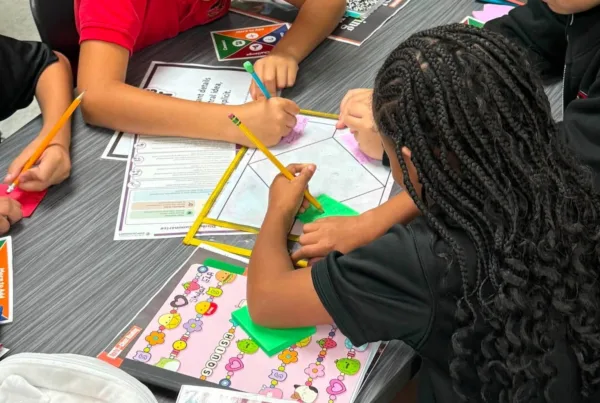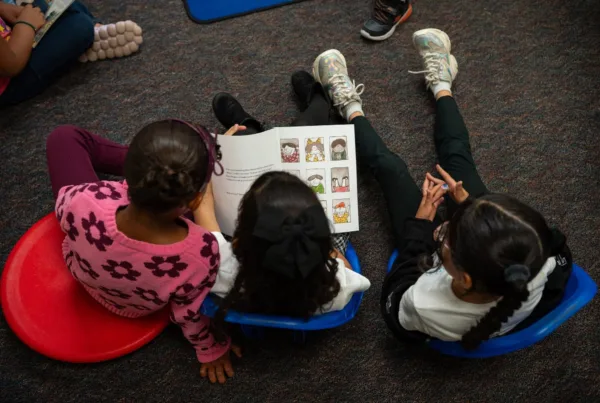
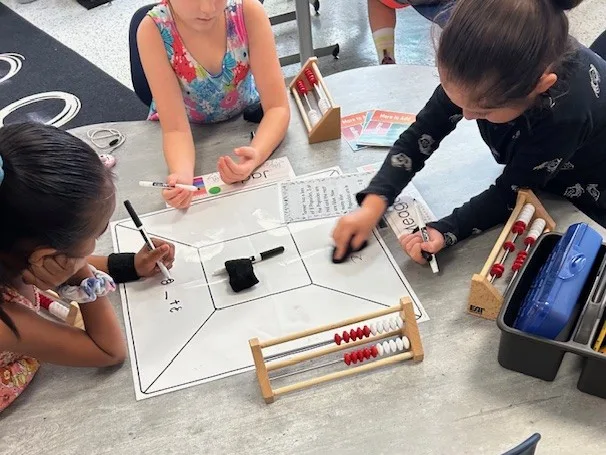
First-graders at Cleveland Elementary in Cedar Rapids, Iowa, engage in a collaborative team task through the Model of Instruction for Deeper Learning. According to a new study, if teachers showed higher implementation of the model, their students had higher gains on their ELA assessments.
By: Lindsey Devers Basileo, Ph.D.
Executive Summary
Districts invest heavily in teacher professional development, yet evidence directly linking it to improved student achievement is often limited.
This study examines whether teachers’ completion of professional learning to implement the Model of Instruction for Deeper Learning was associated with gains in student achievement.
Instructional Empowerment’s Applied Research Center analyzed performance on a benchmark ELA assessment using data from 6,200 students.
The analysis found that when teachers demonstrated implementation of the deeper learning model in their classrooms, their students experienced higher achievement gains compared with students whose teachers did not demonstrate implementation.
Why This Study Matters
Few studies rigorously examine whether professional development directly improves student learning. A 2023 analysis found that out of 125 studies on teacher professional development, only 11 investigated the impact on student learning using an experimental or quasi-experimental design, and only 8 met high-quality standards (Ventista & Brown).
Without clear evidence, leaders may struggle to identify which investments in professional development actually translate into better instruction and improved achievement. This study aims to strengthen that evidence base.
About the Model of Instruction for Deeper Learning
The Model of Instruction for Deeper Learning® is a research-based approach to classroom instruction that puts students at the center of their learning by shifting from teacher-directed methods to student-led teams.
Students work together with clear roles and rigorous tasks, gradually taking on more responsibilities as they learn to lead, collaborate, and think critically. Unlike typical group work, specific protocols ensure equal participation, accountability, and deeper learning, with less reliance on the teacher for constant support.
Instructional Empowerment’s Applied Research Center has conducted extensive research to validate the effectiveness of the Model of Instruction for Deeper Learning. Numerous studies and case studies have linked the model to:
- Increased student achievement
- Closed achievement gaps
- Improved student behavior
- Better student attendance
- Lower teacher burnout
This new research analysis was designed to directly link teachers’ completion of interactive learning modules (which help them implement the model) with student achievement.
Implementing the Model Through Professional Development
The Model of Instruction for Deeper Learning professional development modules focus on equipping teachers with the skills to design rigorous team tasks and learn to use classroom structures, resources, and routines to support their students in leading their own learning.
Teachers build deeper learning classrooms through a job-embedded approach:
- Teachers participate in less than one hour per week of learning through interactive modules.
- Teachers apply their new skills and strategies in the classroom immediately.
- Teachers participate in Look & Learns, where instructional coaches, school leaders, or fellow teachers offer low-stakes feedback on the quality of implementation and whether there is evidence of the desired classroom effects.
- For example, a desired effect of the model is that students understand the purpose of their learning, and classroom evidence includes students accessing and using learning targets.
- Look & Learns create opportunities for collaborative professional growth and on-the-spot adjustments to better implement the deeper learning model.
- Once teachers demonstrate all desired effects of the model as verified through the Look & Learns, they earn the “Implement” badge.

Subscribe for curated education insights delivered every two weeks.
Study Design
To examine the connection between professional learning and student achievement, the Applied Research Center analyzed data from one district implementing the model at scale.
The study investigated whether there was an association between teachers earning the Implement badge within the Model of Instruction for Deeper Learning and students experiencing significantly greater gains in achievement.
The following section provides an overview of the district’s demographics, the student sample included in this study, and the measures used in the analysis.
Districtwide Demographics
District: Cedar Rapids Community School District
State: Iowa
Student Enrollment: 14,729 (Iowa Department of Education, 2024)
- 56.6% Low Socioeconomic Status
- 15.8% Students with Disabilities
- 9.9% English Learners

Sample Studied
Grade Levels: K-5
Subject: English Language Arts
Students: 6,200
Classrooms: 318
Data Sources and Measures
This study utilized two main data sources: student ELA assessment results and records of teachers’ professional learning.
Student Achievement Data: ELA Benchmark Test
- Student performance was measured using the Fall and Spring 2025 FAST (Formative Assessment System for Teachers) ELA benchmark assessment, a tool widely used in school districts across the country.
- Only English Language Arts (ELA) data for elementary students taking the assessment had student roster data available for analysis. Math was not available.
- The point increase reflects the average gain in students’ ELA scale scores from the Fall to the Spring benchmark.
Teacher Professional Development Data: Progress Toward Implement Badge
- Teachers’ progress toward the Implement badge was tracked through Instructional Empowerment’s platform.
- The study focused on earning the “101” Implement badge, which is the first level of the Model of Instruction for Deeper Learning.
- Successful demonstration of all the desired effects in the level (verified through the Look & Learn process) earned teachers the 101 Implement badge.
- The platform also tracked teachers’ percentage of progress toward the badge to examine whether partial completion was linked to student achievement.
How the Analysis Was Conducted
A multilevel model tested whether higher implementation of the deeper learning model by teachers predicts greater student achievement.
The model accounted for classroom-level clustering, recognizing that students within the same classroom tend to be more similar to each other than to students in other classrooms. For example, some classes may start the year with higher or lower overall achievement. Accounting for these classroom differences helps ensure the results reflect the impact of the model itself, rather than pre-existing differences between classrooms.
The analysis also controlled for key differences in student populations to ensure a fair comparison, including:
- Baseline ELA scores
- Grade
- Gender
- Race/ethnicity
- Special education status
- Gifted status
- English-learner status
Controlling for these factors helps isolate the relationship between teachers’ implementation of the model and student achievement, ensuring that results reflect differences associated with implementation rather than differences in the types of students served.
Key Finding
Teacher Progress Toward the 101 Implement Badge Was Linked to Higher Student Achievement
The analysis found that even partial progress toward completing the 101 Implement badge was associated with higher student achievement. Teachers who reached 70% or more progress saw an average +4.38 point increase in students’ FAST scores, compared to teachers with no progress.
- This difference is statistically significant (p = 0.04), indicating there is strong evidence the result is not due to chance.
- This finding represents a meaningful average increase in student achievement within a single academic year.

Seeing the Difference: A Principal’s Experience
Condra Allred is the principal of Cleveland Elementary in Cedar Rapids, Iowa and is leading the adoption of the Model of Instruction for Deeper Learning.
Allred noted that the teachers who are showing the most progress toward implementing the model, achieving the desired effects, and earning badges are also seeing the most positive outcomes with their students. Allred says, “We’re seeing the most growth academically, the teachers’ practices are better, and so the classroom management is better…We don’t get referrals or calls for those classrooms on most days.”
Seeing the correlation between adoption of the model and positive results, Allred and her team are working hard to spread adoption across the entire school. She says, “[The classrooms that have] the least structures in place and the least amount of teaming going on is where we have our highest referral data, so we’re setting up plans for that.”
The model is also well-suited to less experienced teachers. Allred noted that two second-year teachers are among the classrooms with the highest levels of implementation. “I will be shocked if they’re not the ones that show the most growth in January…They’re stellar, one of them is probably our best teacher in the building.”
Takeaways for Educators and Leaders
- Implementation of a deeper learning model is linked to stronger student learning. When teachers implemented the Model of Instruction for Deeper Learning and demonstrated evidence of the desired effects, students showed greater ELA growth.
- Student-led structures appear to drive gains. Combined with previous research and case studies, this new study reinforces that when students experience deeper learning in a collaborative, rigorous classroom environment, achievement improves.
- Models that track and measure implementation can strengthen professional learning. Unlike traditional professional development with limited follow-up, this job-embedded model produced meaningful changes in instruction. Teachers spent about one hour per week on modules, applied learning immediately, and demonstrated evidence of desired effects to earn badges, resulting in measurable improvements in practice and achievement.
This study adds to a growing body of research directly linking well-designed instructional models and effective professional development to stronger outcomes in student learning. For district leaders seeking reliable, evidence-backed approaches to raising student achievement, the Model of Instruction for Deeper Learning represents a promising path forward.
About the Author
Dr. Lindsey Devers Basileo
Dr. Lindsey Devers Basileo is the Director of Research at Instructional Empowerment’s Applied Research Center. She earned her doctorate from Florida State University in 2010 and is a nationally certified reviewer for the What Works Clearinghouse, specializing in Group Design Standards (Version 4.0 and 4.1). Her research interests include school improvement, educational innovations, self-determination theory, Diffusion of Innovation theory, Group Design standards, survey design and collection, and both quantitative and qualitative methods.
Dr. Basileo’s dedication to conducting thorough and impartial research in the field of education has not only tremendously helped our organization, but the many students and educators that we collaborate with through our efforts to improve educational outcomes in schools.
References
Iowa Department of Education (2024). Cedar Rapids Comm School District (Demographics). https://www.iaschoolperformance.gov/ECP/StateDistrictSchool/DistrictSummary?k=8929&y=2024
Ventista, O.M. and Brown, C. (2023). Teachers’ professional learning and its impact on students’ learning outcomes: Findings from a systematic review. Social Sciences & Humanities Open. 8(1). https://doi.org/10.1016/j.ssaho.2023.100565.
Subscribe for curated education insights delivered every two weeks.
About Instructional Empowerment
Our mission is to end generational poverty and eliminate achievement gaps through redesigned rigorous Tier 1 Instruction that ensures deeper learning for ALL students.