Every student has a job
Students work in small teams where each member holds a role with clear responsibilities. It’s hard to drift when your team is counting on you.
The Model of Instruction for Deeper Learning is a research-validated instructional model, supported by ESSA Tier 2 evidence, that reduces classroom disruptions by engaging students in rigorous, student-led team learning with roles, norms, and protocols for self-regulation.
Start with five volunteer teachers. Watch behavior change as engagement rises.
Explore the Model of Instruction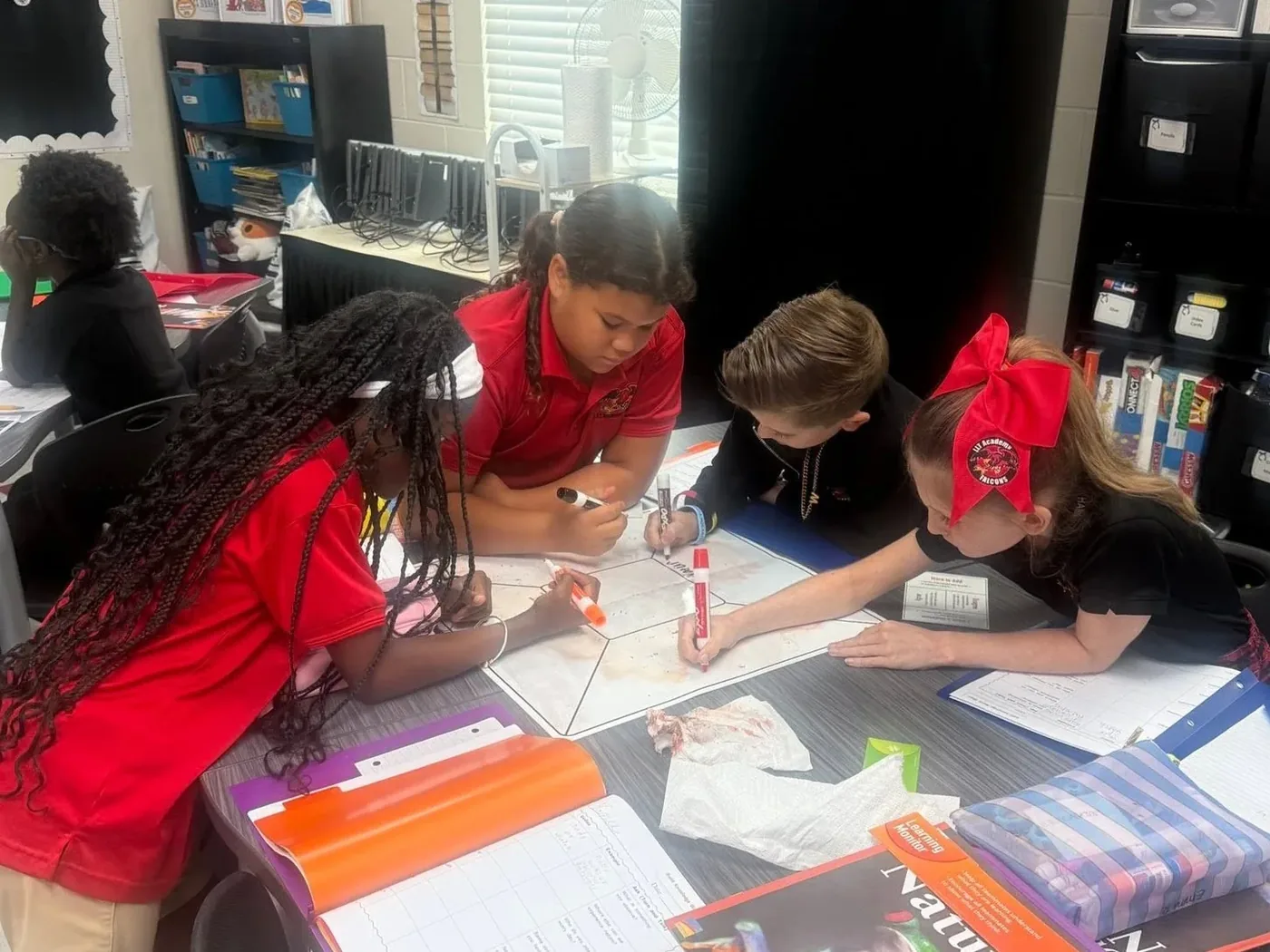
In a teacher-directed lesson, most students spend the majority of the time listening and waiting.
Students who are bored, or lost find something else to do, and disengagement turns into disruption. Teachers end up managing behavior instead of teaching, and principals end up managing referrals instead of leading instruction.
At Walnut Middle School in Grand Island, Nebraska (771 students, 85% free or reduced lunch), discipline referrals fell from 777 to 489, a 37% drop, and positive behavior recognitions rose from 90 to 272 in one year. Engagement improved for English learners and students receiving special education services.
PBIS, reward systems, and behavior interventions shape behavior from the outside. They set expectations, but they don’t change students’ moment-to-moment engagement during instruction.
These systems often assume students already have the self-regulation skills needed to meet expectations, but many students are still developing those skills. Self-regulation is learned through intentional practice, modeling, and support within the learning process, not simply through posted expectations or incentives.

Students work in small teams where each member holds a role with clear responsibilities. It’s hard to drift when your team is counting on you.
Norms and structures teach self-regulation, peer-regulation, respectful discourse and debate, and how to resolve team conflict, so the team stays productive. The model doesn’t assume students arrive with these skills; it builds them.
Rigorous, interdependent tasks give students real problems to solve together instead of worksheets to finish alone.
Each teammate becomes a trusted peer, and the team shares responsibility for everyone’s learning.
At Walnut Middle School in Grand Island, Nebraska (771 students, 85% free or reduced lunch), discipline referrals fell from 777 to 489, a 37% drop, and positive behavior recognitions rose from 90 to 272 in one year. Engagement improved for English learners and students receiving special education services.
Walnut Middle School case study (2018)At Willard Elementary in School District U-46, Illinois, discipline referrals fell from 288 to 36 over two years of implementing the Model of Instruction for Deeper Learning, while chronic absenteeism dropped 6.6 points.
Willard Elementary case study (2025)In a study of 76 schools across 10 districts in 7 states, 79% of schools implementing the Model of Instruction for Deeper Learning reduced chronic absenteeism, with a median reduction of 5.6 percentage points.
Applied Research Center brief (2025)
“There was a huge decrease in referrals because our kids were just more engaged in class. They were doing things that were meaningful to them and they were happy to be there.”
“Teachers started to see that when students had some control in a positive way over their own learning, they wanted to learn.”
You invite teachers to volunteer; you don’t assign them. A team of 3 to 5 teachers learns the Model of Instruction for Deeper Learning together through interactive modules that take under 1 hour a week and apply in class the next day. An Instructional Empowerment coach, always a former educator, supports the team through live virtual coaching sessions.
Students learn team roles, norms, and protocols. Early wins are often visible in the first week.
Teachers design rigorous, interdependent team tasks from the curriculum they already use, and shift from directing all aspects of learning to coaching students toward greater ownership of learning.
You review student evidence with your team and decide whether to expand. Classrooms begin evolving within weeks.
No. PBIS sets schoolwide expectations; the Model of Instruction for Deeper Learning changes what happens inside the lesson, so students are engaged and managing their own teams. Schools use them together.
Student-led behavior management means students use team roles, norms, and structures to keep themselves and their teammates on task, resolve conflict, and support each other. The teacher coaches the process instead of policing it.
Yes. The model teaches self-regulation and peer regulation explicitly rather than assuming students already have those skills. Walnut Middle School, where 85% of students qualify for free or reduced lunch, cut referrals 37% in one year.
Teachers spend under 1 hour a week on interactive learning modules and apply what they learn the next day. Live virtual coaching sessions are 1 hour each: 2 in Pilot One, 4 in Pilot Two.
No. The Model of Instruction for Deeper Learning works with your adopted curriculum and high-quality instructional materials. Teachers learn to turn existing lessons into rigorous, interdependent team tasks.
The model is used in elementary, middle, and high schools across all content areas. Classroom Toolkits are grade-band specific.
At week 16 you review results with your team and your Instructional Empowerment coach. Schools can expand by adding a second cohort of volunteers, upgrading to include coaches and leaders, or bringing onsite professional development to the whole staff.

Our mission is to end generational poverty and eliminate achievement gaps through redesigned rigorous Tier 1 instruction that ensures deeper learning for ALL students.
Contact Us© 2026 Instructional Empowerment. All Rights Reserved. Privacy Policy | DMCA Notice | Contact